
The Jews of Judea, always generally hostile …
Years: 64 - 64
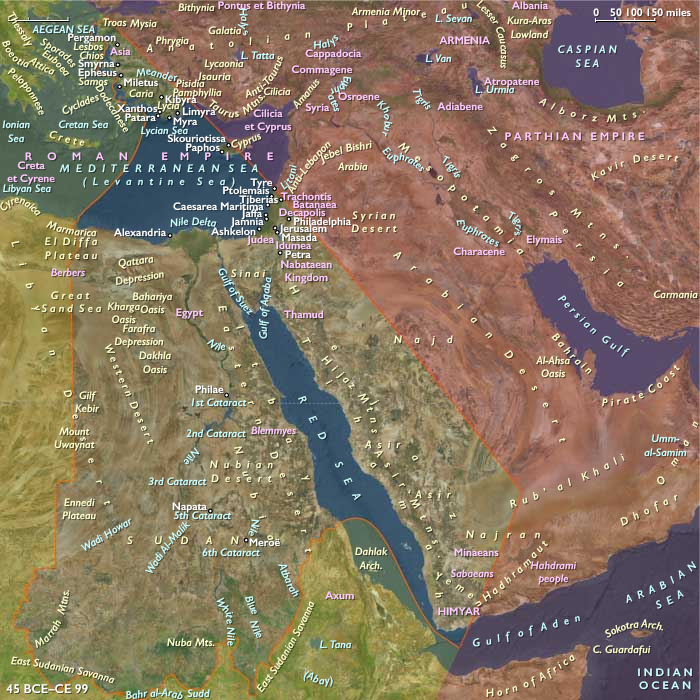
The Jews of Judea, always generally hostile to the ruling Idumaean dynasty and increasingly incensed by the political and religious insensitivity of the various Herodians and the Roman governors, are on the verge of rebellion.
Burdened by excessive taxation and outraged by acts of brutality, the Judaeans have become increasingly restive under Roman rule, the more so because they are confident that God will ultimately vindicate them.
Jewish scholars have, for four centuries, intensively studied the biblical laws recorded in the Pentateuch—long transmitted by word of mouth and known as the Oral Torah—applying them to new situations and supplemented them with traditions of popular observance and with precedents established by prominent leaders.
Another body of laws, halachah, or halakhah, a Hebrew term meaning "the way," have developed since biblical times to define the holy way of life in Judaism.
Distinct from the laws recorded in the Pentateuch, halachah, based on oral traditions believed to have been revealed to Moses at the same time as the Scriptures, is used to explicate and interpret the Scriptures.
Study of the written and unwritten oral law had become central to Judaism during the Hasmonean period, during which the Pharisees had become dominant.
The Roman-supported Sadducees, drawn mainly from the conservative and aristocratic priestly class, have engaged in an ongoing power struggle with the Pharisees, who tend to be middle class and open to religious innovation.
The struggle has led to rancor and, in some instances, violence.
The Zealots, pledged to expel all foreigners from the Jewish state, antagonize Cestius Gallus, the inept Syria-based Roman provincial governor, and Gessius Florus, the avaricious Roman procurator of Judea, both of whom are entirely contemptuous of the Jews.
The ultra-orthodox Zealots and other revolutionary groups agitate for armed revolt.
The Sadducees are inclined to collaborate with the Romans; the Pharisees advocate passive resistance but seek to avoid open war.
Joseph ben Matthias, born in 37-38 of an aristocratic priestly family in Jerusalem, was, according to his own account, a precocious youth who by the age of 14 was consulted by high priests in matters of Jewish law.
At age sixteen, he had undertaken a three-year sojourn in the wilderness with the hermit Bannus, a member of one of the ascetic Jewish sects that flourishes in Judaea.
Returning to Jerusalem, he had joined the Pharisees—a fact of crucial importance in understanding his later collaboration with the Romans.
Joseph in 64 is sent on an embassy to Rome to secure the release of a number of Jewish priests of his acquaintance who are held prisoners in the capital.
He is there introduced to Poppaea Sabina, Emperor Nero's second wife, whose generous favor enables him to complete his mission successfully.
During his visit, Joseph is deeply impressed with Rome's culture, it’s sophistication, and, especially, its military might.
Locations
People
Groups
- Jews
- Greeks, Hellenistic
- Pharisees
- Sadducees
- Galilee, Roman province of
- Zealots
- Judea (Roman province)
- Roman Empire (Rome): Julio-Claudian dynasty
Topics
Commodoties
Subjects
Regions

Subregions
Related Events
Showing 10 events out of 46 total
Years: 64 - 64
Locations
People
Groups
- Jews
- Greeks, Hellenistic
- Pharisees
- Sadducees
- Galilee, Roman province of
- Zealots
- Judea (Roman province)
- Roman Empire (Rome): Julio-Claudian dynasty
Topics
Commodoties
Subjects
Regions
Subregions