
The Kingdom of Hu Goguryeo (later called…
901 CE
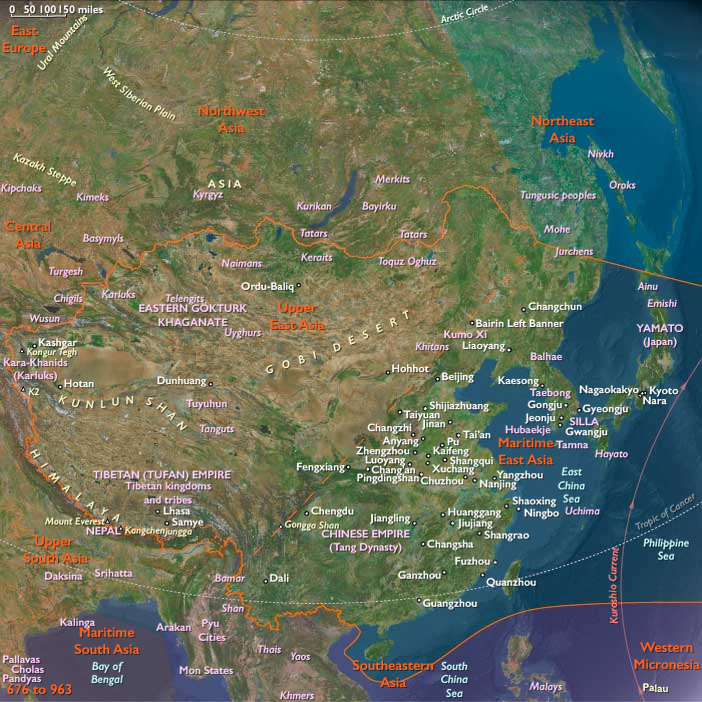
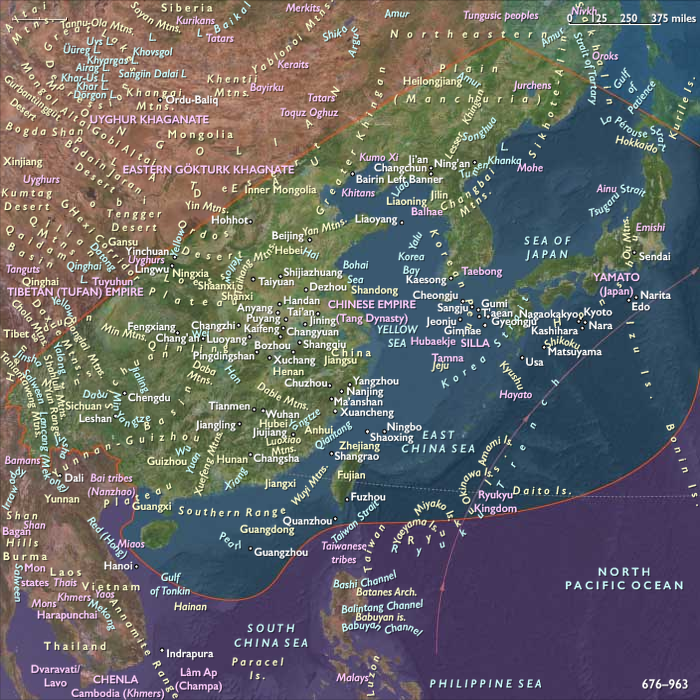
The Kingdom of Hu Goguryeo (later called Taebong) is established by Gung Ye in the Korean peninsula.
Gung Ye is known as a son of King Heonan or King Gyeongmun.
A soothsayer had prophesied that the newborn baby would bring disaster to Silla, so the King had ordered his servants to kill him.
However, his nurse had hid Gung Ye and raised him secretly.
He had joined Yang Gil's rebellion force in 892.
Silla, after nearly a millennium as a centralized kingdom, was quickly declining, and Gung Ye had instigated his own rebellion and absorbed Wang Geon's force in Songak.
In 898, he had set up the capital in Songak.
He eventually defeats Yang Gil and other local lords in central Korea to proclaim himself king of Later Goguryeo in 901.
Locations
Commodities
Subjects
Regions
East Asia
View →Subregions
Maritime East Asia
View →Related Events
No active filters.
Showing 10 events out of 53559 total
Fuzhou's economic and cultural institutions have grown and developed throughout the mid-Tang Dynasty.
The later years of the Tang have seen a number of political upheavals in the Chinese heartland, prompting another wave of Chinese to immigrate to the modern-day Fujian and Guangdong areas.
In 879, a large part of the city had been captured by the army of Huang Chao during their rebellion against the Tang government.
In 893, the warlord brothers Wang Chao and Wang Shenzhi had captured Fuzhou in a rebellion against the Tang Dynasty, successfully gaining control of the entire Fujian Province.
Fuzhou City is expanded in 901 with construction of a new city wall ("Luo City").
Cui, in turn, is in communications with Zhu, plotting to restore the emperor.
He also persuades the Shence Army officer Sun Dezhao to join his cause, and Sun in turn persuades his fellow officers Dong Yanbi and Zhou Chenghui to join.
In spring 901, they act.
They first ambush and kill Wang Zhongxian, and captured Liu and Wang Yanfan, who are then killed by caning.
Xue tries to commit suicide by drowning, but is taken out of the water and decapitated.
Emperor Zhaozong is restored to the throne.
In gratitude to the three officers, he bestows the imperial clan name of Li on them, renaming them Li Jizhao, Li Yanbi, and Li JIhui respectively.
Shortly after Emperor Zhaozong's restoration, Li Maozhen shows an intent of reestablishing his relationship with the emperor by visiting Chang'an to pay homage to Emperor Zhaozong.
While Li Maozhen is still at Chang'an, Cui Yin makes a proposal intending to eliminate the control that the eunuchs have over the Shence Armies — that he and fellow chancellor Lu Yi be put in command of the Shence Armies.
This proposal is opposed by Li Jizhao, Li Jihui, and Li Yanbi, however, and as Cui cites, as a rationale, the possibility that the Shence Armies could thus counteract the warlords, Li Maozhen is also suspicious of it.
Emperor Zhaozong therefore rejects the proposal, and puts instaead appoints the eunuchs Han Quanhui and Zhang Yanhong, both of whom had previously served as eunuch monitors of the Fengxiang army, and further wants the retired eunuch Yan Zunmei to serve as the overseer of both Shence Armies, but Yan declines and remains in retirement.
Cui, apprehensive of allowing the eunuchs to command the Shence Armies again, asks Li Maozhen to leave a corps of Fengxiang troops at Chang'an to counteract the eunuchs; Li Maozhen agrees, and leaves his adoptive son Li Jiyun in command of the Fengxiang soldiers at Chang'an.
Despite this setback, Cui continues to try to plan to slaughter the eunuchs.
The eunuchs headed by Han eventually become aware of this, and, in order to reduce Cui's power, they have the Shence Army soldiers claim that Cui is not giving them the proper winter uniforms.
Emperor Zhaozong is forced to again remove Cui from his post as the director of salt and iron monopolies.
Moreover, by this point they have persuaded Li Jiyun and his Fengxiang soldiers to their cause.
Cui, realizing that the eunuchs intend to destroy him, becomes fearful, and writes Zhu Quanzhong, urging him to bring troops to Chang'an to act against the eunuchs.
Zhu agrees, and began mobilizing his army.
Han and the other eunuchs, hearing of Zhu's impending arrival, believe that Zhu's forces intend to slaughter them.
They, with the cooperation of Li Jiyun, Li Jihui, and Li Yanbi (but not Li Jizhao, who refuses to align with them), seize Emperor Zhaozong and his household, and take them to Fengxiang's capital Fengxiang Municipality.
Cui and the imperial officials largely remain at Chang'an, although some follow the emperor and the eunuchs to Fengxiang.
After Zhu arrives at Chang'an to confer with Cui, he advances to Fengxiang and puts it under siege.
Li Maozhen seeks an alliance with Wang Jian.
Wang Jian, however, tries to play both sides—outwardly aligning with Zhu, but secretly encouraging Li Maozhen to resist Zhu, while sending an army to head north to attack Li Maozhen's Shannan West Circuit.
The Magyars grouped to the north of the middle Danube attack the Moravians at Mikulcice in 901, but the invasion is repelled.
Numerous "firsts" in medical research, clinical care, and chemistry are attributed to Muhammad ibn Zakariya al-Razi, known in the Latin West as Rhazes, including being the first to differentiate smallpox from measles, and the discovery of numerous compounds and chemicals including alcohol, kerosene, among others.
The preeminent pharmacist and physician of his time, Razi makes fundamental and enduring contributions to the fields of medicine, alchemy, music, and philosophy, recorded in over two hundred books and articles in various fields of science.
He is well-versed in Ancient Persian, Greek and Ancient Indian medical knowledge and makes numerous advances in medicine through own observations and discoveries.
Educated in music, mathematics, philosophy, and metaphysics, he had chosen medicine as his professional field.
As a physician, he is an early proponent of experimental medicine and has been described as the father of pediatrics.
He is also a pioneer of ophthalmology.
He is among the first to use Humoralism to distinguish one contagious disease from another.
In particular, Razi is the first physician to distinguish smallpox and measles through his clinical characterization of the two diseases.
He becomes chief physician of Rayy and Baghdad hospitals.
Given what is now known about the evolution of measles, Rhazes' account is remarkably timely, as recent work that examined the mutation rate of the virus indicates the measles virus emerged from rinderpest (cattle plague) as a zoonotic disease between CE 1100 and 1200, a period that may have been preceded by limited outbreaks involving a virus not yet fully acclimated to humans.
This agrees with the observation that measles requires a susceptible population of greater than five hundred thousand to sustain an epidemic, a situation that will occur in historic times following the growth of medieval European cities.
Tahir spends much of his time early in his reign in the western part of his territories, having to deal with the occupation of Fars by the Abbasid Caliph al-Mu'tadid after the downfall of 'Amr.
A 900-901 campaign, in which both Tahir and Sebük-eri participate, temporarily regains Fars, but the Saffarids withdraw soon afterwards.
Al-Hadi enters San'a in 901.
He strikes coins and the khutbah is read in his name.
However, fighting soon breaks out, and San'a rapidly changes hands between him and the Yu’firid ruler Abd al-Qahir.
Guaimar I had made his son, also Guaimar, co-prince, and it was he who had ruled Salerno in the elder Guaimar's absence.
Upon the elder prince's return, a Neapolitan faction in the city, supported by one Athanasius, revolts, but the two Guaimars put it down and the elder, like his father before him, retires (or is forced by his son) to a monastery, San Massimo, Guaifer's foundation, in 900 or 901, dying soon after.
The chronicles of his reign describe him in despotic terms and he does not seem to have been popular, despite the later popularity of his name within the dynasty his father had founded.
Louis has traveled onward from Pavia to Rome, where, in 901, he is crowned Emperor by Pope Benedict IV, who has upheld the ordinances of Pope Formosus.
However, Louis’s inability to stem the Magyar incursions and impose any meaningful control over northern Italy sees the Italian nobles quickly abandon his cause and once again align themselves with Berengar.
Benedict also excommunicates Baldwin II of Flanders for murdering Fulk, Archbishop of Reims.
Rollo and the Viking Raids in France (c. 892–900)
Following a series of unproductive raids in southeastern England between 892 and 896, Danish Vikings, frustrated by their failure to establish a permanent foothold, shift their attention to West Francia, where they encounter weaker resistance and greater opportunities for settlement.
Early Viking Raids in France and Rollo’s Arrival (c. 900)
- After several unsuccessful campaigns in England, a Viking force under Gonge-Hrolf (better known as Rollo), a Norwegian warlord and the second son of the Earl of Orkney, turns its sights toward France.
- Rollo’s fleet begins raiding along the lower Seine River, attacking coastal settlements and moving inland to plunder Frankish territories.
- By 900, Rollo and his men establish a semi-permanent presence near the Seine’s mouth, using the region as a staging ground for further incursions into West Francia.
Impact on Frankish Territory
- The Carolingian dynasty, already weakened by internal noble conflicts, struggles to mount an effective defense against Viking incursions.
- The Vikings plunder towns and monasteries, disrupt trade and agriculture, and force local lords to either fight or negotiate for peace.
- Rollo’s growing military strength makes him a major threat to the stability of West Francia, prompting Frankish rulers to seek diplomatic solutions.
Prelude to the Norman Settlement (911)
- Over the next decade, Rollo continues his raids, while also beginning to establish control over territory along the Seine.
- His presence foreshadows the events of 911, when King Charles the Simple will grant him land in what becomes Normandy, in exchange for Rollo’s loyalty and defense against further Viking invasions.
Significance of Rollo’s Raids (c. 900–911)
- Marks the beginning of the Viking transition from raiders to settlers in northern France.
- Demonstrates West Francia’s continued vulnerability, as its rulers increasingly rely on treaties and land grants to pacify Viking threats.
- Lays the foundation for the establishment of the Duchy of Normandy, a region that will play a critical role in medieval European history.
Though Rollo begins as a raider, his presence in France soon leads to permanent settlement, setting the stage for the creation of Normandy and the integration of Norse warriors into Frankish society.