The precolonial history of many parts of…
1396 CE to 1539 CE
The precolonial history of many parts of Africa has been carefully researched and preserved, but there is relatively little information on the region that forms contemporary Angola as it was before the arrival of the Europeans in the late 1400s.
The eventual European colonizers of Angola, the Portuguese, will not study the area as thoroughly as will the British, French, and German scholars research heir colonial empires.
The Portuguese, in fact, will be more concerned with recording the past of their own people in Angola than with the history of the indigenous populations.
The limited information that is available indicates that the original inhabitants of present-day Angola were hunters and gatherers.
Their descendants, called Bushmen by the Europeans, still inhabit portions of southern Africa, and small numbers of them may still be found in southern Angola.
These Khoisan speakers lose their predominance in southern Africa as a result of the southward expansion of Bantu-speaking peoples during the first millennium CE.
The Bantu speakers are a Negroid people, adept at farming, hunting, and gathering, who probably began their migrations from the rain forest near what is now the Nigeria-Cameroon border.
Bantu expansion is carried out by small groups that make a series of short relocations over time in response to economic or political conditions.
Some historians believe that the Khoisan speakers had been peacefully assimilated rather than conquered by the Bantu.
Others contend that the Khoisan, because of their passive nature, had simply vacated the area and moved south, away from the newcomers.
In either case, the Bantu settle in Angola between 1300 and 1600, and some may have arrived even earlier.
The Bantu form a number of historically important kingdoms.
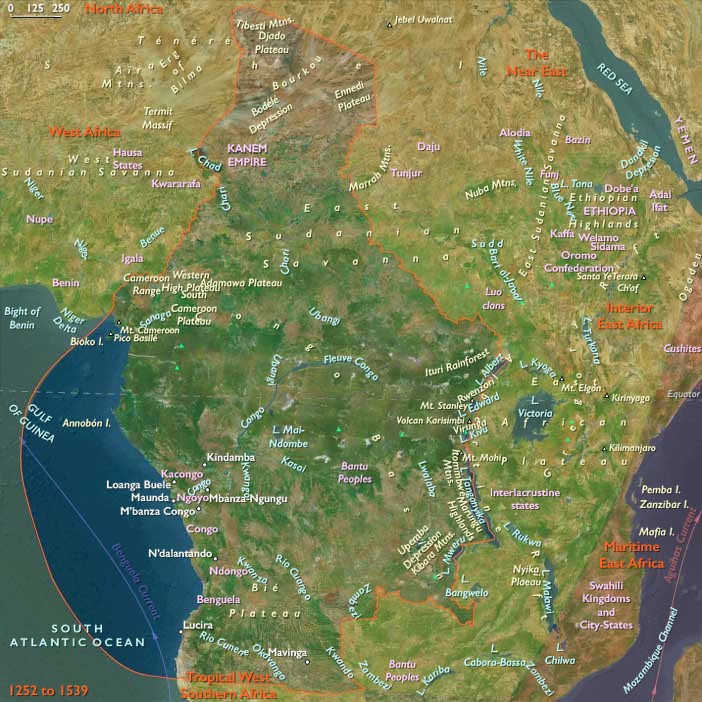
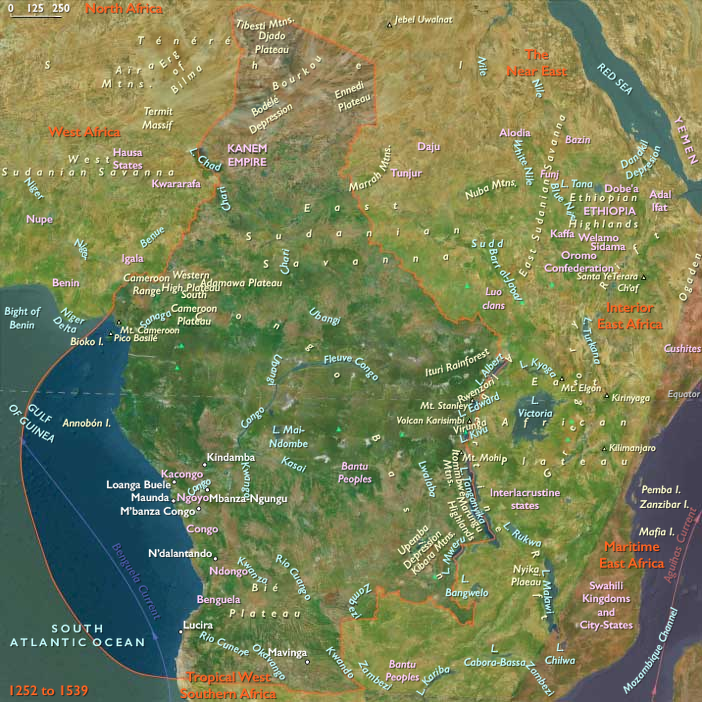
The earliest and perhaps most important of these is the Kongo Kingdom, which arises between the mid-1300s and the mid-1400s in an area overlapping the present-day border between Angola and the Democratic Republic of the Congo.
Other important kingdoms are Ndongo, located to the south of Kongo; Matamba, Kasanje, and Lunda, located east of Ndongo; Bie, Bailundu, and Ciyaka, located on the plateau east of Benguela; and Kwanhama (also spelled Kwanyama), located near what is now the border between Angola and Namibia.
Although they do not develop a strong central government, the Chokwe (also spelled Cokwe) will establish a significant cultural center in the northeast of present-day Angola.
The precolonial kingdoms differ in area and the number of subjects who owe allegiance, however nominal, to a central authority.
The kings might not directly control more land or people than a local ruler, but they are generally acknowledged as paramount.
Kings Are offered tribute and Are believed to possess substantial religious power and authority.
A king's actual secular power, however, is determined as much by his own personal abilities as by institutional arrangements.
The African kingdoms tend to extend their lines of communication inland, away from the Atlantic Ocean.
Until the arrival of the Europeans, Africans regard the sea as a barrier to trade.
Although the sea might supply salt or shells that could be used as currency, the interior holds the promise of better hunting, farming, mining, and trade.
Locations
Groups
Subjects
Regions
Middle Africa
View →Subregions