
The landmark Devil's Bridge is built over …
Years: 1442 - 1442
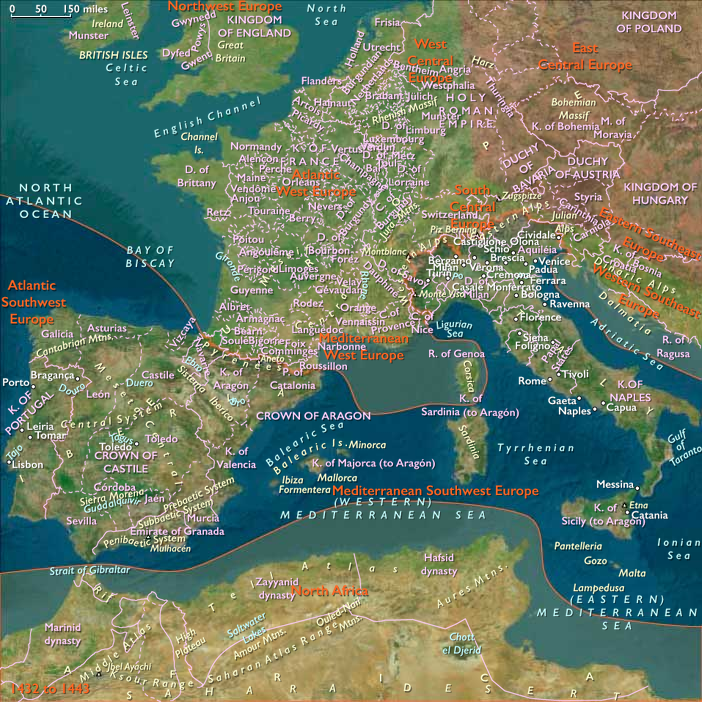
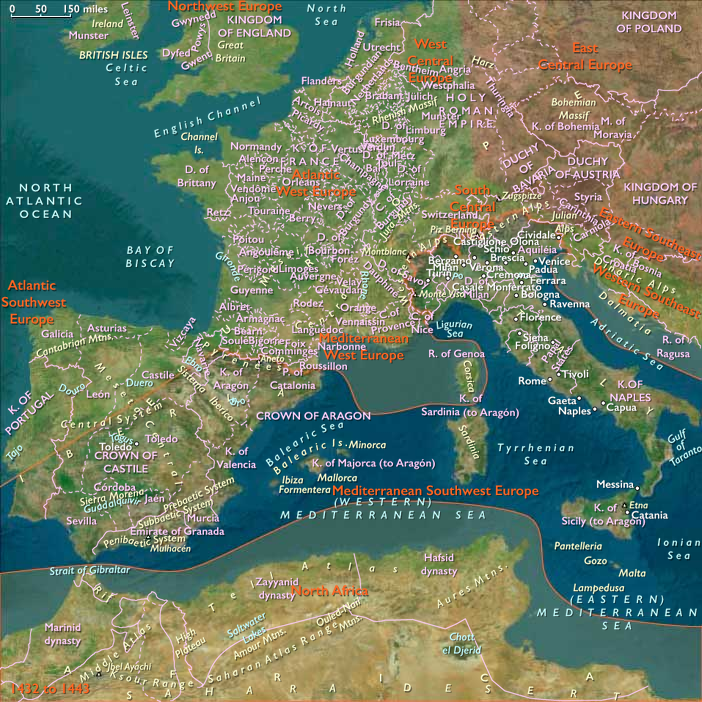
The landmark Devil's Bridge is built over the Natisone River in the town of Cividale del Friuli, just northeast of Udine, in 1442.
Locations
Groups
Topics
Subjects
Regions
Subregions
Related Events
Filter results
Showing 10 events out of 29 total
The Death of John V of Brittany and Succession of Francis I (1442)
John V (VI), Duke of Brittany, whose complex relationship with King Charles VII of France included early efforts toward reconciliation in the 1430s, later became involved in significant rebellions against royal authority, notably the Praguerie Revolt in 1440 and the League of Nevers in 1442. Despite this political turbulence, within Brittany itself John had successfully carried out substantial reforms, enhancing governmental efficiency, strengthening military organization, and improving economic stability.
Upon John's death on August 28, 1442, his eldest son, Francis I, born from his marriage to Jeanne de Valois, a French princess, succeeded to the ducal throne. Francis had previously married Yolande of Anjou, daughter of Louis II of Anjou, at Nantes in 1431; Yolande died in 1440. To reinforce Brittany's political alliances, Francis remarried soon after his accession, marrying Isabella Stuart, a Scottish princess and daughter of the assassinated King James I, on October 30, 1442, at the Château d'Auray.
Francis I’s succession, marked by these strategic marital alliances, underscored Brittany’s ongoing attempt to maintain political independence and regional power amid shifting allegiances and tensions with the French crown. This transitional moment highlighted Brittany’s continued role as a significant, if sometimes disruptive, political force in Atlantic West Europe.
Northwest Europe (1444–1455 CE): Dynastic Tensions and Cultural Advances
England: Growing Tensions and Prelude to Civil War
The reign of Henry VI became increasingly fraught, characterized by worsening political instability and the deterioration of English holdings in France. Losses such as Normandy in 1450 deepened discontent among nobles and commoners alike, contributing to internal strife. Henry VI, England’s Lancastrian king, proved ineffectual and unstable as he matured, prompting those dissatisfied with government by his favorites to rally around Richard, Duke of York, head of the rival House of York. Armed clashes had occurred previously between supporters of Henry and Richard, but the first open fighting broke out in 1455, marking the onset of the Wars of the Roses.
Scotland: Stability and Cultural Growth
Following the reforms initiated by James I, Scotland enjoyed relative stability under his successor, James II. James II, ascending to the throne as a child in 1437, gradually consolidated his rule throughout the 1440s and early 1450s. His reign saw the continued growth of royal authority, further weakening the power of the nobility. Cultural activities flourished, reflecting broader European influences and enhancing the country's literary and artistic heritage.
Ireland: Gaelic Autonomy and Cultural Flourishing
Gaelic lordships continued to assert their dominance across Ireland, maintaining their autonomy and cultural identity against limited English authority. The O’Neill and O’Brien clans solidified their regional power bases, and Irish literary traditions thrived, marked by vibrant poetry and annalistic writing that preserved and celebrated Gaelic heritage. English control remained limited primarily to The Pale, with attempts at expansion encountering persistent resistance.
Scandinavia: Instability within the Kalmar Union
The Kalmar Union, under King Eric of Pomerania and later under King Christopher of Bavaria and then Christian I, experienced persistent internal tensions. Sweden's dissatisfaction with union policies increased, sparking periodic revolts and political unrest. Despite these ongoing challenges, the union persisted, albeit tenuously, through diplomatic maneuvers and fragile agreements.
Iceland: Literary and Cultural Vigor
Within the broader Scandinavian political context, Iceland maintained its cultural vitality. The island continued to produce significant literary works, particularly historical sagas and chronicles that documented its rich past and preserved its distinct identity. Icelandic literature served not only as historical records but also as symbols of cultural pride and resilience in a changing political landscape.
Cultural and Artistic Developments
The period witnessed significant cultural developments across Northwest Europe. Architectural advancements, notably at York Minster, continued to exemplify the evolving Perpendicular Gothic style. The innovative compositions of John Dunstaple and contemporaries continued to shape European music, spreading harmonically rich practices centered around intervals of thirds and sixths. These artistic achievements highlighted the region's continued intellectual vibrancy amid political uncertainty.
Legacy of the Era
By 1455 CE, Northwest Europe stood on the brink of transformative upheaval. England faced imminent civil war, Scotland enjoyed strengthened central authority and cultural growth, Ireland continued its robust Gaelic traditions, and the Kalmar Union grappled with internal dissent. These complex dynamics were balanced by impressive cultural advances, showcasing the region's resilience and creativity during this turbulent period.
Northwest Europe (1444–1455 CE): Dynastic Tensions and Cultural Advances
England: Growing Tensions and Prelude to Civil War
The reign of Henry VI became increasingly fraught, characterized by worsening political instability and the deterioration of English holdings in France. Losses such as Normandy in 1450 deepened discontent among nobles and commoners alike, contributing to internal strife. Henry VI, England’s Lancastrian king, proved ineffectual and unstable as he matured, prompting those dissatisfied with government by his favorites to rally around Richard, Duke of York, head of the rival House of York. Armed clashes had occurred previously between supporters of Henry and Richard, but the first open fighting broke out in 1455, marking the onset of the Wars of the Roses.
Scotland: Stability and Cultural Growth
Following the reforms initiated by James I, Scotland enjoyed relative stability under his successor, James II. James II, ascending to the throne as a child in 1437, gradually consolidated his rule throughout the 1440s and early 1450s. His reign saw the continued growth of royal authority, further weakening the power of the nobility. Cultural activities flourished, reflecting broader European influences and enhancing the country's literary and artistic heritage.
Ireland: Gaelic Autonomy and Cultural Flourishing
Gaelic lordships continued to assert their dominance across Ireland, maintaining their autonomy and cultural identity against limited English authority. The O’Neill and O’Brien clans solidified their regional power bases, and Irish literary traditions thrived, marked by vibrant poetry and annalistic writing that preserved and celebrated Gaelic heritage. English control remained limited primarily to The Pale, with attempts at expansion encountering persistent resistance.
Scandinavia: Instability within the Kalmar Union
The Kalmar Union, under King Eric of Pomerania and later under King Christopher of Bavaria and then Christian I, experienced persistent internal tensions. Sweden's dissatisfaction with union policies increased, sparking periodic revolts and political unrest. Despite these ongoing challenges, the union persisted, albeit tenuously, through diplomatic maneuvers and fragile agreements.
Iceland: Literary and Cultural Vigor
Within the broader Scandinavian political context, Iceland maintained its cultural vitality. The island continued to produce significant literary works, particularly historical sagas and chronicles that documented its rich past and preserved its distinct identity. Icelandic literature served not only as historical records but also as symbols of cultural pride and resilience in a changing political landscape.
Cultural and Artistic Developments
The period witnessed significant cultural developments across Northwest Europe. Architectural advancements, notably at York Minster, continued to exemplify the evolving Perpendicular Gothic style. The innovative compositions of John Dunstaple and contemporaries continued to shape European music, spreading harmonically rich practices centered around intervals of thirds and sixths. These artistic achievements highlighted the region's continued intellectual vibrancy amid political uncertainty.
Legacy of the Era
By 1455 CE, Northwest Europe stood on the brink of transformative upheaval. England faced imminent civil war, Scotland enjoyed strengthened central authority and cultural growth, Ireland continued its robust Gaelic traditions, and the Kalmar Union grappled with internal dissent. These complex dynamics were balanced by impressive cultural advances, showcasing the region's resilience and creativity during this turbulent period.
William de la Pole, Marquess of Suffolk: Diplomat, Soldier, and Courtier (1415–1444)
William de la Pole, second son of Michael de la Pole, 2nd Earl of Suffolk, and Katherine de Stafford, had been deeply involved in England’s military campaigns in France since his youth. During the siege of Harfleur in 1415, William was gravely wounded, and his father was killed. Later that same year, his elder brother, Michael, the 3rd Earl of Suffolk, died at the Battle of Agincourt, leaving William to inherit the earldom as the 4th Earl of Suffolk.
In 1429, William de la Pole became co-commander of the English forces at the critical siege of Orléans following the death of Thomas Montacute, Earl of Salisbury. After Joan of Arc famously relieved the siege, Suffolk retreated to Jargeau, where he was compelled to surrender to French forces on June 12. Captured, he remained a prisoner of King Charles VII for three years before being ransomed in 1431.
Upon returning to England in 1434, Suffolk’s political career flourished through his alliance with the influential Cardinal Henry Beaufort, and he was appointed Constable of Wallingford Castle. His most significant diplomatic achievement came in 1444 when he successfully negotiated the marriage between King Henry VI of England and Margaret of Anjou, niece of King Charles VII and daughter of René d’Anjou. This diplomatic success earned Suffolk the elevated title of Marquess of Suffolk.
However, a secret clause in the marriage treaty—requiring England to return the strategically vital provinces of Maine and Anjou to France—later became a major source of controversy and was instrumental in undermining Suffolk’s political standing. Ultimately, this agreement contributed significantly to his political downfall, marking a turning point in English fortunes in France and foreshadowing future instability in the English monarchy.
Charles VII's Military and Administrative Reforms after the Treaty of Tours (1444–1445)
Following the Treaty of Tours in 1444, King Charles VII of France capitalized on the temporary pause in hostilities to strengthen and reorganize French military capabilities significantly. Recognizing the opportunity presented by peace, Charles VII systematically reformed the kingdom’s administrative structures and rebuilt its financial resources, echoing the successful reforms implemented nearly a century earlier during the 1360s.
In 1445, these efforts culminated in the creation of a permanent standing army—a major innovation marking a decisive break from reliance on mercenary companies and feudal levies. This permanent military force allowed Charles VII to maintain a disciplined, well-equipped, and reliably funded army, drastically improving France's strategic readiness.
In contrast, England, hampered by the weak and indecisive leadership of King Henry VI, struggled to maintain cohesion and effectiveness. Although the Treaty of Tours had allowed England to retain considerable French territory initially, the English administration and military became increasingly fragmented and vulnerable.
Charles VII’s reforms fundamentally altered the balance of power. The establishment of a permanent French army—financed by improved taxation and overseen by a centralized royal administration—enabled the kingdom to swiftly regain the upper hand. These actions laid the essential foundations for France’s decisive victories in the closing stages of the Hundred Years’ War, setting the stage for the eventual complete recovery of territories previously lost to England.
The dauphin, restored to royal favor after the unsuccessful Praguerie rebellion of 1440, holds a number of important commands in the 1440s, but in 1447 he retires to the Dauphiné.
Jean Fouquet: Artistic Innovation and French Identity after the Hundred Years' War (ca. 1447)
Jean Fouquet, born in Tours around 1420, emerged as one of the most influential French painters of the mid-15th century, playing a pivotal role in shaping French visual culture. Before 1447, Fouquet traveled to Italy, where he notably executed a portrait of Pope Eugene IV (died 1447), known today only through later copies. During this formative Italian period, Fouquet carefully absorbed elements of contemporary Italian Renaissance style and composition, subsequently merging them with the distinctively French aesthetic traditions upon his return to France.
Settling again in his native Tours, Fouquet rapidly secured prestigious commissions from prominent figures of the French court, including King Charles VII, his influential treasurer Étienne Chevalier, and the chancellor Guillaume Jouvenel des Ursins. Fouquet’s artistic synthesis combined the refined naturalism and innovative perspectives observed in Italy with a distinctly French sensibility and iconographic tradition, aligning closely with the emerging political and cultural aims of the Valois monarchy.
Indeed, Fouquet’s artwork became intimately associated with the French court's broader project of reinforcing national identity following decades of warfare and cultural fragmentation during the Hundred Years' War. His elegant portraits, religious paintings, and manuscript illuminations articulated a confident, sophisticated vision of French monarchy and identity at a moment when France sought cultural as well as political renewal and cohesion in the aftermath of prolonged conflict with England.
In sum, Jean Fouquet's career exemplifies how artistic innovation intersected with broader political objectives, contributing to France’s emerging national identity and cultural confidence in the mid-fifteenth century.
The Anglo-French truce arranged by William de la Pole has brought him to the peak of his influence.
With the deaths in 1447 of Humphrey, Duke of Gloucester and Cardinal Beaufort, Suffolk had become the principal power behind the throne of the weak and compliant Henry VI.
In short order he had been appointed Chamberlain, Admiral of England, and to several other important offices.
He was created Earl of Pembroke in 1447 and in 1448 he had been made first duke of Suffolk.
However, Suffolk is later suspected of being a traitor.
He meets in secret on July 16 with Jean, the Bastard of Orleans, and comte de Dunois at his mansion of the Rose in Candlewick street.
The first of several meetings in London, they plan a French invasion.
Suffolk passes Council minutes to Dunois, the French hero of the siege of 1429 at Orleans.
It is rumored that Suffolk never paid his ransom of twenty thousand pounds owed to Dunois.
Lord Treasurer Ralph Cromwell wants heavy taxes from Suffolk; the duke's powerful enemies include the Pastons and Sir John Fastolf.
Many blame Suffolk's retainers for lawlessness in East Anglia.
Jean Bureau and the French Military Revival (1449)
In 1449, hostilities between England and France reignited due to English violations of the peace agreement established by the Treaty of Tours, offering France a strategic opportunity to renew its offensive against remaining English-held territories. Central to France’s military resurgence during this critical phase was Jean Bureau, a talented artillery commander appointed by King Charles VII as Master of Artillery.
Jean Bureau, assisted closely by his brother Gaspard Bureau, revolutionized French siege warfare through highly effective use of advanced gunpowder artillery. Their mastery dramatically accelerated the recapture of key English-held fortresses in northern France. Notable among these successes were the sieges of Pontoise (1441), Harfleur (1449–1450), and the strategic capture of Bayeux. Bureau’s command proved crucial to French victories, demonstrating both tactical innovation and effective integration of artillery into broader military strategy.
Previously, the English had violated terms of the peace agreement established by the Treaty of Tours (1444), providing Charles VII the justification and momentum to resume military operations. The Bureaus' technological and strategic advancements in artillery contributed decisively to the rapid erosion of English control in Normandy and other occupied territories, fundamentally reshaping the military landscape in favor of France.
Jean and Gaspard Bureau's accomplishments not only marked a turning point in the Hundred Years' War but also signaled the rising importance of technological innovation and central royal control in military affairs, contributing significantly to the consolidation of French royal authority in Atlantic West Europe.
The Reconquest of Normandy and the Capture of Rouen (1449)
In August 1449, French military momentum accelerated sharply, resulting in the rapid reconquest of key strategic locations in Normandy, long held by the English. Towns such as Pont-Audemer, ...
Years: 1442 - 1442
Locations
Groups
Topics
Subjects
Regions
Subregions