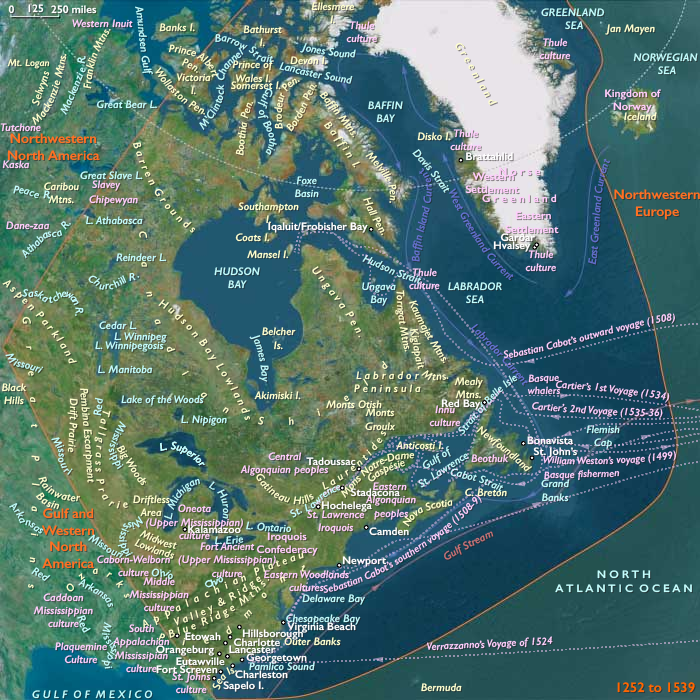
The Icelandic settlements in Greenland vanish during…
1420 CE to 1431 CE
The Icelandic settlements in Greenland vanish during the fourteenth and fifteenth centuries, possibly because the demand for walrus ivory has been drastically reduced by the availability of the better-quality elephant ivory, leaving the Greenlanders with little to trade.
The last written records of the Norse Greenlanders are of a marriage in 1408 in the church of Hvalsey—today the best-preserved Nordic ruins in Greenland.
The condition of human bones from this period indicates that the Norse population was malnourished, probably due to soil erosion resulting from the Norsemen's destruction of natural vegetation in the course of farming, turf-cutting, and woodcutting, pandemic plague, a decline in temperatures during the Little Ice Age, and/or armed conflicts with the Inuit.
Locations
Groups
Topics
Commodities
Regions

Northern North America
View →Subregions