The legendary Sesostris (likely either Pharaoh Senusret…
1917 BCE to 1774 BCE
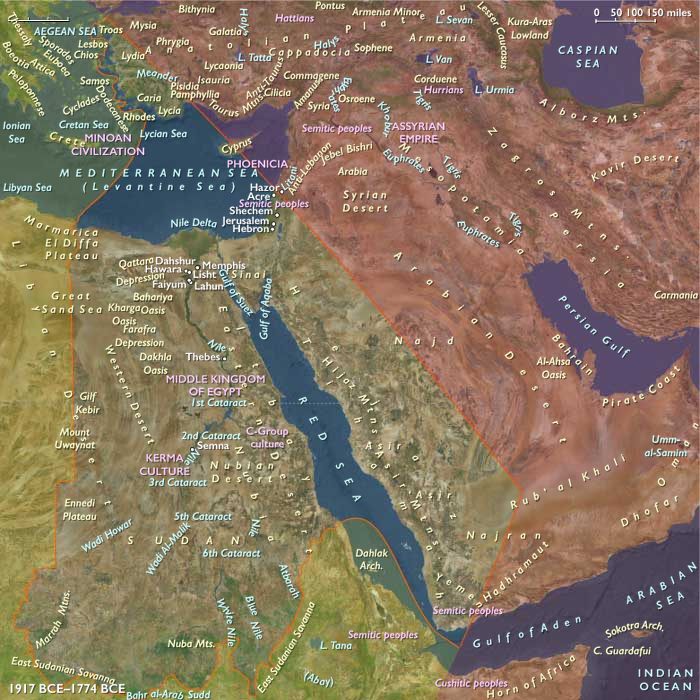
The legendary Sesostris (likely either Pharaoh Senusret II or Senusret III of the Twelfth dynasty of Egypt) is suggested to have perhaps started work on an ancient canal joining the River Nile with the Red Sea (1897 BCE–1839 BCE). (It is said that in ancient times the Red Sea reached northward to the Bitter Lakes and Lake Timsah.)
In his Meteorology, Aristotle will write: One of their kings tried to make a canal to it (for it would have been of no little advantage to them for the whole region to have become navigable; Sesostris is said to have been the first of the ancient kings to try), but he found that the sea was higher than the land.
So he first, and Darius afterwards, stopped making the canal, lest the sea should mix with the river water and spoil it.
Strabo will also write that Sesostris started to build a canal, and Pliny the Elder will write:
165. Next comes the Tyro tribe and, on the Red Sea, the harbor of the Daneoi, from which Sesostris, king of Egypt, intended to carry a ship-canal to where the Nile flows into what is known as the Delta; this is a distance of over 60 miles.
Later the Persian king Darius had the same idea, and yet again Ptolemy II, who made a trench 100 feet wide, 30 feet deep and about 35 miles long, as far as the Bitter Lakes.
French cartographers will discover the remnants of an ancient north-south canal running past the east side of Lake Timsah and ending near the north end of the Great Bitter Lake in the second half of the nineteenth century. (This ancient, second, canal may have followed a course along the shoreline of the Red Sea when it once extended north to Lake Timsah.)
In the twentieth century the northward extension of this ancient canal will be discovered, extending from Lake Timsah to the Ballah Lakes, which will subsequently be dated to the Middle Kingdom of Egypt by extrapolating the dates of ancient sites erected along its course.
However, it remains unknown whether or not this is the same as Sesostris' ancient canal and whether it was used as a waterway or as a defense against the east.
Locations
Topics
Subjects
Regions
The Near and Middle East
View →Subregions