The Dutch find themselves in a deep…
May 1787 CE
The Dutch find themselves in a deep economic crisis by the end of the eighteenth century, caused by the devastating Fourth Anglo-Dutch War.
Like in much of Europe, the people of the Netherlands gave grown increasingly discontent with the authoritarian regime of the stadtholder, William V.
During this time, the banks of the Dutch Republic hold much of the world's capital.
The government sponsored banks own up to forty percent of Great Britain's national debt.
This concentration of wealth (and the connections the government has to the House of Stuart) has led to the formation of the Dutch Patriots by a minor Dutch noble named Joan van der Capellen tot den Pol.
They are seeking to reduce the amount of power held by the stadtholder.
Thus, the division has emerged between the Orangists, who support the stadtholder, and the Patriots who, inspired by the ideals of the Enlightenment, desire a more democratic government and a more equal society.
The Patriots have built support from most of the middle-class, and founded militias (Exercitiegenootschappen) of armed civilians, which between 1783 and 1787 have managed to take over several cities and regions in an effort to force new elections that will oust the old government officials.
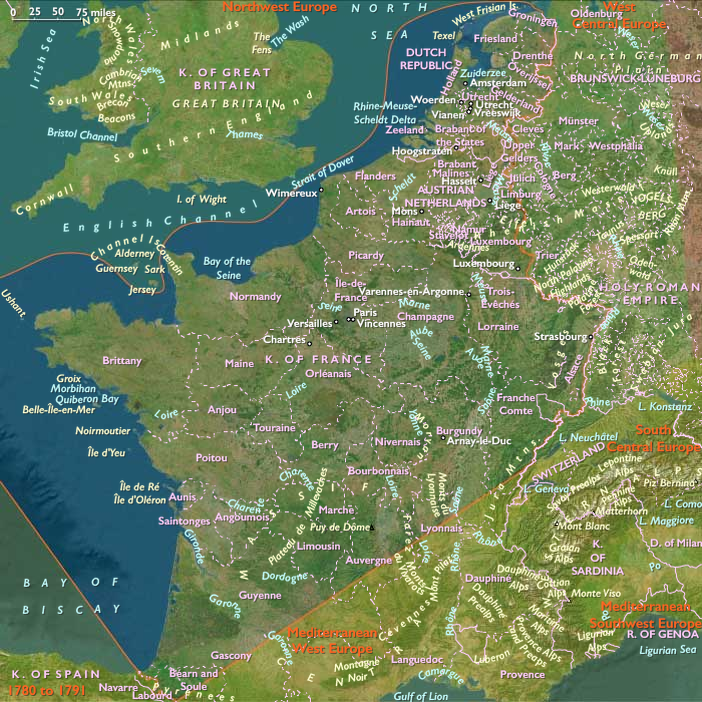
The Patriots hold Holland and the city of Utrecht, while the Orangists hold the states of Guelders and Utrecht (without the capital city).
In 1785, stadtholder William V had fled his palace in the west of the country for Nijmegen in the east, as the States of Holland were not willing to send their troops to fight the Patriots.
The stadholder's troops are defeated by the militia of Utrecht near Vreeswijk in May 1787.
Locations
Regions
West Europe
View →Subregions