The long episode of drought, flood, locust …
Years: 1448 - 1448
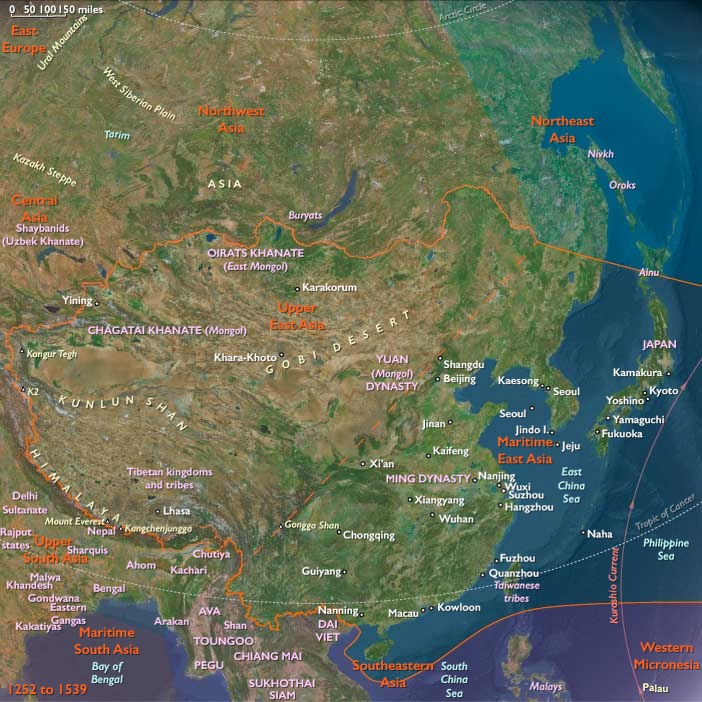
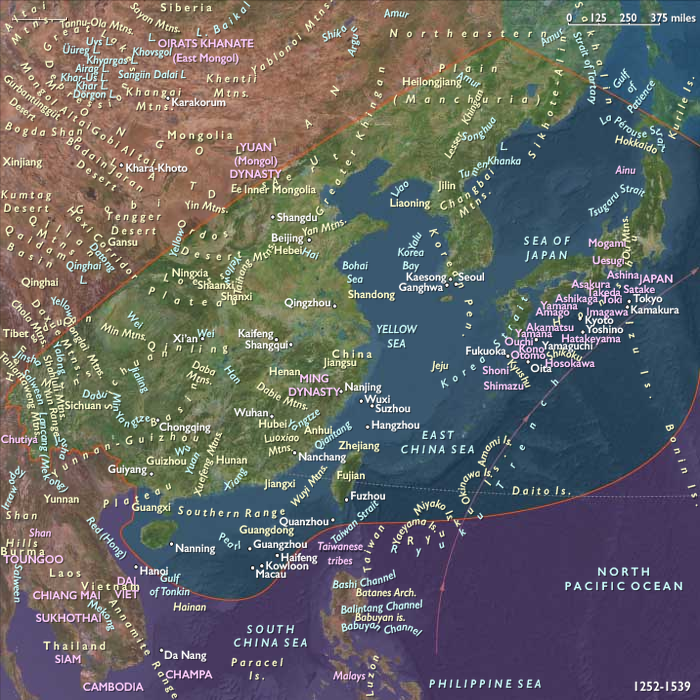
The long episode of drought, flood, locust infestation, and famine in Ming Dynasty China since the year 1434 finally wanes and agriculture and commerce return to a normal state in 1448.
Locations
People
Groups
Subjects
Regions
Subregions
Related Events
Filter results
Showing 10 events out of 41613 total
King Borommarachathira (Boromoraja) II of Ayutthaya leads a campaign against Chiang Mai in 1448, but dies before he can complete it.
Prince Ramesuan, who succeeds to the Ayutthayan throne as King Borommaratrailokanat, increasingly centralizes his government and militarily strengthens Ayutthaya to gain ascendancy over the smaller Chang Mai kingdom.
Frederick III, in reaching the Concordat of Vienna, or Aschaffenburg, with the newly installed Pope Nicholas V on February 17, 1448, regulates control of church offices and helps force the dissolution of the Council of Basel, which is asserting conciliar supremacy over the popes.
The decrees of the Council of Basel against papal annates and reservations are abrogated so far as Germany is concerned.
He hires as a secretary the distinguished diplomat and humanist scholar Enea Silvio Piccolomini, who first brings Renaissance influences to Germany.
Emperor John VIII Palaiologos had named his brother Constantine XI, who had served as regent in Constantinople in 1437–1439, as his successor.
Western efforts against the Turks have failed, and the religious union has stirred dissension among the Greeks, who refuse to submit their church to the papacy.
The Emperor’s spirit is broken, and intrigues over the succession, coupled with news of the Turkish victory over the Hungarians in the Second Battle of Kosovo in October 1448, hasten his death on the last day of the month.
Despite the machinations of his younger brother Demetrios Palaiologos, his mother Helena is able to secure Constantine XI's succession in 1448.
Ulugh Beg defeats his enemy at Tarnab and takes Mashhad, while his son 'Abd al-Latif conquers Herat.
Ala-ud-Daulah Mirza bin Baysonqor flees to southwestern Afghanistan.
However, Ulugh Beg considers Transoxiana, where he has already ruled for decades, to be more important, and soon leaves the area.
Babur sends a force that inflicts heavy losses on his army on the way back.
Ulugh Beg advances toward Herat and massacres its people in 1448, but Ala-ud-Daulah's brother Mirza Abul-Qasim Babur bin Baysonqor comes to his aid, defeating Ulugh Beg.
Babur is one of the many people involved in the succession struggle that takes place during Shah Rukh's last years.
Together with Khalil Sultan (a great-great-grandson of Timur), he had plundered the baggage-train of the army and has made his way to Khurasan.
Ulugh Beg retreats to Balkh, where he finds that its governor, his son 'Abd al-Latif, has rebelled against him.
Another civil war ensues.
Alesso Baldovinetti, apprenticed as a youth to Domenico Veneziano and influenced by Fra Angelico, has made important contributions to landscape painting.
The Florentine painter and mosaicist has won renown for his elegant Annunciation, painted in 1447, and the Madonna and Child painted around the same time, when he is about thirty-five.
A follower of the group of scientific realists and naturalists in art which includes Andrea del Castagno, Paolo Uccello and Domenico Veneziano, Baldovinetti uses precisely drawn elongated figures and subtle gradations of tone and light to produce paintings that combine sophistication and naiveté.
This is due to the forty-day isolation of ships and people practiced as a measure of disease prevention related to the plague.
Between 1348 and 1359, the Black Death had wiped out an estimated thirty percent of Europe's population, and a significant percentage of Asia's population.
Such a disaster led governments to establish measures of containment to handle recurrent epidemics.
A document from 1377 states that before entering the city-state of Ragusa (modern Dubrovnik in Croatia), newcomers had to spend thirty days (a trentine) in a restricted place (originally nearby islands) waiting to see whether the symptoms of Black Death would develop.
In 1448 the Venetian Senate prolongs the waiting period to forty days, thus giving birth to the term "quarantine".
The forty-day quarantine will prove to be an effective formula for handling outbreaks of the plague.
According to current estimates, the bubonic plague had a thirty-seven-day period from infection to death; therefore, the European quarantines would have been highly successful in determining the health of crews from potential trading and supply ships.
The Bafour or Bafur may have inhabited present-day Mauritania and the Western Sahara before the arrival of Islamic peoples.
They are at times referred to as the descendants of local pre-Berber peoples.
French art historian Jean Laude wrote, "In the pre-Islamic period (before the ninth century), according to oral tradition, Mauritania was occupied by the Bafur, a population of mixed origin from whom the eastern Songhai, the central Gangara, and the western Serer are derived.”
The Hassane, the traditionally dominant warrior tribes of the Saharan-Moorish areas of present-day Mauritania, southern Morocco and Western Sahara, are considered descendants of the Arab Maqil tribe Beni Hassan (hence the name), and hold power over Sanhadja Berber-descended zawiya (religious) and znaga (servant) tribes, extracting from these the horma tax in exchange for armed protection.
They dominate the gum arabic trade, as well as shipment of grain from the Wolof region to the Bidan (white North Africans), and a slave trade of Wolof people to the Maghreb for horses for their military campaigns.
Prince Henry the Navigator had set up a fortified trading post in 1445 on the island of Arguin, which acquires gum arabic and slaves for Portugal.
By 1455, eight hundred slaves are shipped from Arguin to Portugal every year.
A Portuguese expedition may have attempted to colonize the Canary Islands as early as 1336, but there is not enough hard evidence to support this.
The Castilian conquest of the islands had begun in 1402, with the expedition of French explorers Jean de Béthencourt and Gadifer de la Salle, nobles and vassals of Henry III of Castile, to Lanzarote.
From there, they had conquered Fuerteventura (1405) and El Hierro.
Béthencourt had received the title King of the Canary Islands, but still recognized King Henry III as his overlord.
Béthencourt had also established a base on the island of La Gomera, but it will be many years before the island is truly conquered.
The natives of La Gomera, and of Gran Canaria, Tenerife, and La Palma will resist the Castilian invaders for almost a century.
Maciot de Béthencourt in 1448 sells the lordship of Lanzarote to Portugal's Prince Henry the Navigator, an action that is not accepted by the natives nor by the Castilians.
Despite Pope Nicholas V ruling that the Canary Islands are under Portuguese control, a crisis swells to a revolt that will last until 1459 with the final expulsion of the Portuguese.