The long-reigning Kushite pharaoh Taharqa had been…
669 BCE to 658 BCE
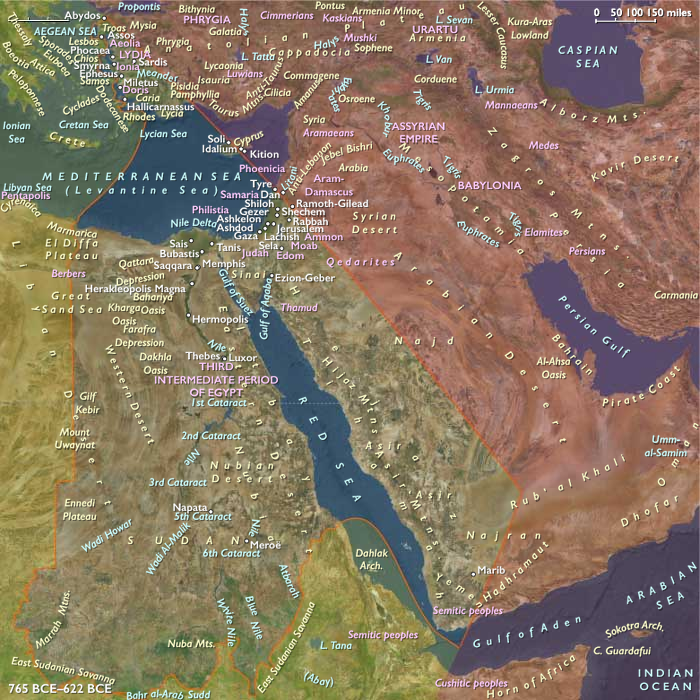
The long-reigning Kushite pharaoh Taharqa had been driven from power by Esarhaddon with surprising ease, and fled to his Nubian homeland.
Esarhaddon describes "installing local kings and governors" and "All Ethiopians I deported from Egypt, leaving not one to do homage to me".
However the local puppet rulers are unable to retain control for long, and two years later, Taharqa, having fanned numerous revolts, returns from Nubia and seizes control of Egypt as far north as Memphis.
Esarhaddon had set about returning to Egypt to once more eject Taharqa, but fell ill and died en route to Egypt, leaving his son and heir Ashurbanipal to once again invade Egypt.
Sending a general with a small army, Ashurbanipal defeats Taharqa, who afterwards flees to Thebes, a city still controlled by militaristic high priests, where he dies in 664 BCE and is succeeded by his appointed successor Tantamani, a son of Shabaka.
Taharqa is buried at Nuri (North Sudan).
Necho I, the prince or governor of the Egyptian city of Sais, is primarily known from Assyrian documents but is now also attested in one contemporary Egyptian document from his reign.
He is officially "installed" at Sais by Ashurbanipal around 670 BCE, but he already ruled Egypt as a local king prior to this event.
Once the Assyrians appoint Necho I as king and leave Egypt, Tantamani marches down the Nile from Nubia and reoccupies all of Egypt including Memphis.
According to historical records, Necho I is killed by an invading Kushite force in 664 BCE under Tantamani for being an Assyrian puppet In reaction, the Assyrians return to Egypt in force, defeat Tantamani's army in the Delta and advance as far as south as Thebes, which they sack to such an extent it will never truly recover.
The Assyrian reconquest effectively ends Nubian control over Egypt although Tantamani's authority is still recognized in Upper Egypt.
Necho’s son Psamtik is placed on Egyptian the throne as a vassal of Ashurbanipal.
Locations
People
Groups
Topics
Commodities
Subjects
Regions
The Near and Middle East
View →Subregions