
The loss of Belgrade (Nandorfehervar) in 1521 …
Years: 1523 - 1523
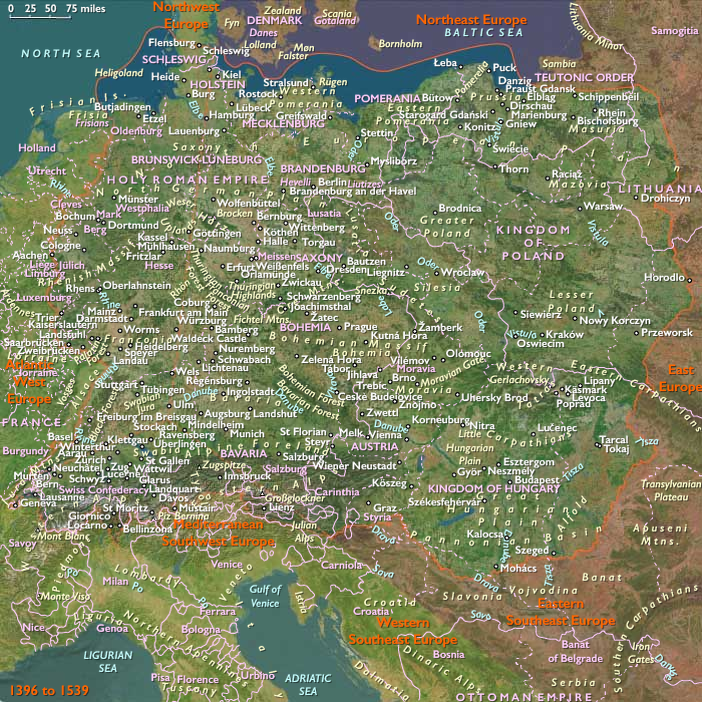
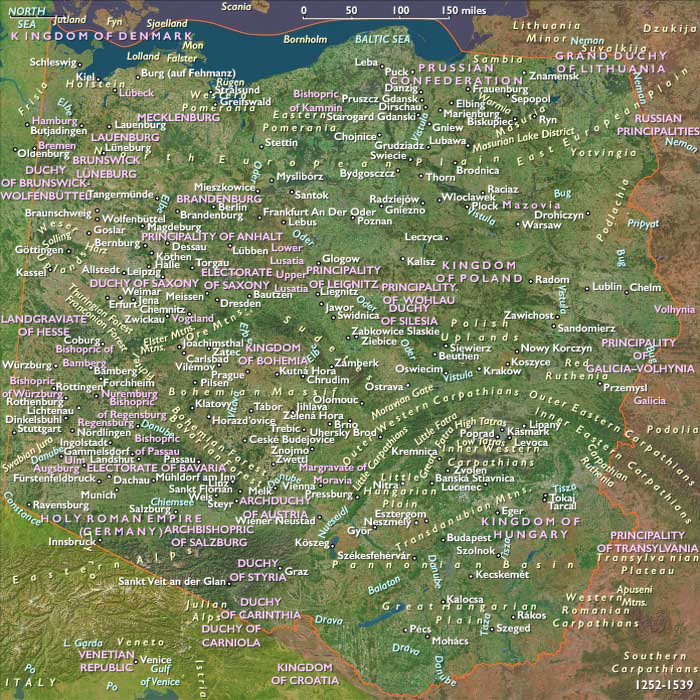
The loss of Belgrade (Nandorfehervar) in 1521 had caused great alarm in Hungary, but the too-late and too-slowly-recruited sixty-thousand strong royal army—led by the king—had forgotten to take food along, so the army therefore disbanded spontaneously under the pressure of hunger and disease without even trying to recapture Belgrade, the southern key of Hungary, from the newly installed Turkish garrisons.
In 1523, Archbishop Pál Tomori, a valiant priest-soldier, is made Captain of Southern Hungary.
The general apathy that had characterized the country forces him to lean on his own bishopric revenues when he starts to repair and reinforce the second line of Hungary's border defense system.
Locations
People
Groups
- Islam
- Christians, Roman Catholic
- Hungary, Kingdom of
- Brandenburg, (Hohenzollern) Margravate of
- Holy Roman Empire
- Teutonic Knights of Prussia, or Monastic state of the Teutonic Knights (House of the Hospitalers of Saint Mary of the Teutons in Jerusalem)
- Lutheranism
- Protestantism
Topics
Commodoties
Subjects
Regions
Subregions
Related Events
Filter results
Showing 9 events out of 9 total
The Spanish Invasion of Portugal and the Defense of Britain's Oldest Ally (1762)
As Britain and Spain entered open war in 1762, the most immediate threat was a Spanish invasion of Portugal, which had remained neutral for most of the conflict despite its historic alliance with Britain. Encouraged by France, Spain sought to open a new front that would force Britain to divert troops away from its campaigns against France, particularly in North America and the Caribbean.
Spain’s Strategy – Attacking Portugal Instead of Gibraltar
Although Spain had long sought the capture of Gibraltar, the heavily fortified British stronghold presented a formidable challenge. Instead, France persuaded Spain to invade Portugal, believing its long but rugged borderwas vulnerable and easy to overrun. By capturing key Portuguese cities, Spain hoped to force Lisbon to break its alliance with Britain and potentially gain strategic leverage in the broader war.
Britain Responds to the Threat
Recognizing the danger, Britain moved swiftly to reinforce Portugal, dispatching supplies, military officers, and troops to help organize its defense. The original Spanish plan was to capture Almeida, then advance toward the Alentejo and Lisbon, but the strategy shifted to Porto, aiming to strike directly at British trade interests.
The Spanish Advance and British-Portuguese Resistance
In the spring of 1762, under the command of the Marquis of Sarria, Spanish troops crossed from Galicia into northern Portugal, quickly capturing several towns. However, their advance on Porto was slow and disorganized, hampered by:
- Difficult terrain
- Heavy flooding of the River Esla
- Supply and coordination problems
By May 9, Spanish forces invested and captured the key border fortress of Almeida, dealing a serious blow to Portuguese defenses.
The British-Portuguese Counterattack
Britain responded by dispatching 8,000 troops to Portugal:
- 6,000 troops arrived from Belle Île, under Lord Loudoun
- 2,000 more troops came from Ireland
As reinforcements landed, a British-Portuguese counterattack, led by John Burgoyne, struck back at the Spanish, capturing the town of Valencia de Alcántara. This bold maneuver disrupted Spanish supply lines and demonstrated that Portugal’s defenses were stronger than anticipated.
French Intervention and the Bourbon Retreat
France, eager to support its Spanish ally, sent reinforcements, but these forces, like their Spanish counterparts, suffered high rates of attrition due to:
- Disease
- Desertion
- Logistical failures
By November 1762, with supply and communication lines stretched thin, the Bourbon allies recognized the futility of their campaign. Facing increasing resistance and unable to secure a decisive victory, they withdrew from Portugal and sued for peace.
A War Without Major Battles
Despite the large number of troops involved, the campaign saw no major battles. Instead, the Spanish invasion was characterized by logistical failures, difficult terrain, and an underestimation of British-Portuguese resistance. In the end, Britain's swift military response, Portugal’s resilience, and the Spanish-French inability to sustain the campaign ensured that Portugal remained unconquered, reaffirming its place as Britain’s oldest ally.
The Battle of the Douro – The Spanish Defeat at the Hands of Portuguese Peasants (May 25, 1762)
As part of the Spanish invasion of Portugal during the Seven Years’ War, a Spanish force of 3,000 to 6,000 men, commanded by General Alejandro O'Reilly, marched out of Chaves in northern Portugal, advancing toward Oporto. Their objective was to capture the strategic port city, striking a direct blow at British commerce while further isolating Lisbon from potential reinforcements.
Alarm in Oporto and British Evacuation Plans
The British community in Oporto, which had long established strong economic ties with the region through the wine trade, panicked at the prospect of a Spanish occupation. Their warehouses were filled with provisions and 30,000 pipes of wine awaiting shipment. Recognizing the imminent threat, the British Admiralty began preparing evacuation measures for British citizens and commercial interests.
Meanwhile, the Portuguese governor of Oporto was ordered to abandon the city, but he refused, choosing to remain at his post as the Spaniards approached the River Douro.
The Battle at the Douro – O’Hara’s Unlikely Defense
On May 25, 1762, the Spanish forces attempted to cross the Douro River between Torre de Moncorvo and Vila Nova de Foz Côa. However, they unexpectedly met resistance from a makeshift Portuguese force led by Colonel O’Hara, consisting of:
- Hundreds of armed peasants
- Some units of the Ordenanças (Portugal’s irregular militia)
- Women and children from local villages, positioned in the hills along the southern bank
Despite their numerical superiority and professional training, the Spanish troops failed to dislodge the defenders. Repeated assaults were repelled, with heavy losses inflicted on the invading force.
Spanish Panic and Retreat
As the battle turned against them, panic spread through the Spanish ranks. The disorganized force began a hasty retreat, fleeing back toward Chaves, the very town from which they had set out. Their withdrawal was anything but orderly, as they were pursued relentlessly by the local peasantry, who harassed them all the way to their starting point.
Significance of the Battle
The failed Spanish advance on Oporto was a major embarrassment for the Bourbon forces, demonstrating the unexpected resilience of Portuguese resistance. Even a force of armed civilians, using their knowledge of the terrain, had been able to halt a professional army, delivering a humiliating defeat that shattered Spanish morale.
This battle reinforced the idea that Spain had vastly underestimated Portugal’s ability to defend itself, even in the absence of a well-equipped standing army. The Bourbon invasion, which had initially been seen as a swift conquest, was proving to be a costly and frustrating campaign.
In the months to come, the combined British-Portuguese forces, led by the Count of Lippe, would further turn the tide, culminating in Spain’s ultimate failure to subdue Portugal and its withdrawal by the end of the year.
The Battle of Montalegre – Another Spanish Setback (May 26, 1762)
Following their failed attempt to cross the Douro River, another Spanish column marching from Chaves toward the province of Minho—with the ultimate objective of capturing Oporto—met unexpected resistance in the mountains of Montalegre on May 26, 1762.
The Spanish Advance and Portuguese Resistance
The Portuguese defense at Montalegre was primarily composed of Ordenanças (local militias), poorly equipped but highly motivated and experienced in mountain warfare. Taking advantage of the rugged terrain, the Portuguese militias and local inhabitants positioned themselves on the higher ground, ready to ambush the Spanish forces.
- The Spanish forces, unfamiliar with the difficult terrain, struggled to maintain cohesion and supply lines.
- As they moved through the mountainous region, they were harassed by Portuguese irregulars, who used skirmishing tactics, ambushes, and sniper fire to weaken the advancing column.
- The Spaniards launched direct assaults, but their efforts to break through Portuguese defensive positions were repelled with significant losses.
Spanish Retreat and Consequences
After failing to dislodge the defenders and suffering heavy casualties, the Spanish column was forced to retreat, abandoning its attempt to reach Oporto. The defeat at Montalegre, coming just a day after the disastrous Spanish defeat at the Douro River (May 25), was another embarrassing failure for the Bourbon war effort in Portugal.
Strategic Impact
- The defeat at Montalegre further shattered Spanish morale, reinforcing the idea that the Portuguese countryside was far from undefended.
- Spanish and French planners had grossly underestimated the effectiveness of Portuguese irregular forces and the difficult terrain of northern Portugal.
- With multiple Spanish columns failing, the Spanish invasion of Portugal was already showing signs of collapse, well before the main British-Portuguese forces could take full action.
By June 1762, the Spanish invasion had stalled, with multiple setbacks in the north weakening their position and raising questions about the viability of their entire campaign.
The Spanish Invasion of Trás-os-Montes and the Rising Popular Revolt (April–May 1762)
On April 30, 1762, a Spanish force crossed into Portugal through the province of Trás-os-Montes, marking the first incursion of the Franco-Spanish invasion during the Seven Years’ War. To justify their actions, the Spaniards posted a proclamation titled "Reasons for Entering Portugal," in which they claimed they were not invaders, but liberators, coming to free the Portuguese people from the "heavy shackles of England," which they denounced as the "tyrant of the seas."
However, these words were soon betrayed by actions, as Spain’s logistical failures led to widespread resentment and armed resistance among the Portuguese population.
The Main Invasion Begins (May 5, 1762)
On May 5, 1762, a major Spanish force of 22,000 men, led by the Marquis of Sarria, launched the full-scale invasion of Portugal. The response from Lisbon was immediate:
- On May 18, Portugal officially declared war on Spain and France, making its neutrality a thing of the past.
- British reinforcements were not yet in place, and the Portuguese army was still in disarray, forcing the defenders to rely on fortresses and guerrilla resistance.
The Spanish March Through Trás-os-Montes
The first target was the fortress of Miranda, the only well-fortified and provisioned stronghold in the province. However, fate turned against the defenders:
- On May 6, a catastrophic accidental explosion in the fortress's powder magazine—containing twenty tons of gunpowder—killed 400 Portuguese soldiers and opened two massive breaches in the walls.
- With no alternative, Miranda surrendered on May 9, giving the Spaniards their first victory.
With no remaining strongholds and no organized troops in Trás-os-Montes, the Spanish march became effortless:
- Bragança fell on May 12
- Chaves was occupied on May 21
- Torre de Moncorvo surrendered on May 23
These towns were undefended and surrendered without a single shot fired. Powder and provisions were nonexistent, and the Spanish general reportedly mocked Portugal’s lack of soldiers, joking:
"I cannot discover where these insects are."
Spanish Overconfidence and Logistical Failures
At first, the Spanish maintained good relations with the local population, even paying double for food and other provisions. Madrid had miscalculated, assuming that Portugal would quickly submit and that the mere presence of a powerful invading force would be enough to force surrender.
However, this assumption would prove to be a fatal error, for two critical reasons:
-
The Spanish Army Had Entered Portugal Without Enough Provisions
- Confident that Portugal would capitulate quickly, the Spanish had not brought adequate food and supplies.
- The campaign became unsustainable, as they were unable to feed their troops.
-
The Spanish Assumed That Portugal Could Sustain Their Army
- Spanish planners assumed local populations would be able to provide sufficient food and resources.
- When this proved an illusion, Spanish commanders resorted to forced requisitions, taking what they needed by force.
The Spark of Popular Revolt – "War for Food Feeding War"
The moment the Spanish began seizing food and supplies from the local populations, the relationship between the invaders and the Portuguese civilians collapsed.
- Peasants began resisting Spanish foraging parties, sometimes using improvised weapons.
- Local militias, supported by Portuguese irregulars, started attacking supply convoys, cutting off food to the Spanish troops.
- The initial goodwill was replaced by open hostility, turning Trás-os-Montes into a battleground of guerrilla warfare.
This "war for food feeding war" transformed the campaign. Instead of a swift and easy conquest, the Spanish found themselves bogged down, suffering from food shortages, harassment, and an increasingly organized resistance.
Strategic Consequences
The Spanish offensive, which had begun with little resistance, now faced a logistical nightmare:
- Troops were starving, forcing them to retreat to secure supply lines rather than advancing deeper into Portugal.
- The Portuguese irregulars and Ordenanças were gaining momentum, exploiting the terrain and Spanish weaknesses.
- The Bourbon plan for a quick Portuguese surrender unraveled, as the Portuguese populace refused to accept the invaders as "liberators".
While the Spanish and French still had a numerical advantage, their logistical failures and growing Portuguese resistance would ultimately doom the invasion. By the end of 1762, the Bourbon allies would be forced to withdraw, marking a humiliating failure in their attempt to bring Portugal into the Family Compact by force.
The Spanish Defeat at Almeida – Militia Resistance and Fortress Defense (1762)
As part of the 1762 Spanish invasion of Portugal, an army of 8,000 Spanish troops was dispatched toward Almeida, a key fortress town in the province of Beira. The Spanish strategy aimed to secure Almeida as a staging ground for further operations deeper into central Portugal, particularly targeting Lisbon.
The Spanish Advance and Militia Resistance
Expecting little resistance, the Spanish force advanced toward Almeida, assuming that Portugal’s poorly equipped army would be unable to mount a serious defense. However, as they approached the region, they encountered unexpected and fierce resistance from local militias:
- Portuguese irregular forces and Ordenanças (territorial militias) harassed the Spanish columns, engaging in hit-and-run tactics that inflicted heavy casualties.
- The Spanish force suffered 200 casualties during these skirmishes, as Portuguese militias exploited their superior knowledge of the terrain.
- The militia tactics slowed the Spanish advance, preventing a swift siege of Almeida.
The Failed Assault on Almeida Fortress
Despite these setbacks, the Spanish forces pressed forward, launching a full-scale assault on the fortress of Almeida. However, the attack ended in disaster:
- The fortress garrison, reinforced by British officers, mounted an effective artillery and musket defense, repelling the Spanish assault.
- The Spanish suffered 600 casualties in the failed attack, according to contemporary British sources.
- Demoralized and weakened, the invading force was forced to retreat, abandoning its objective.
Aftermath and Strategic Consequences
The failure to capture Almeida was a serious blow to the Spanish campaign in Portugal. It demonstrated that even key strongholds, despite Portugal’s weakened military, could hold out against a larger invading force.
This defeat, combined with previous failures, such as the Battle of the Douro, further eroded Spanish morale and exposed logistical weaknesses in the Bourbon war effort.
By the end of 1762, the Spanish invasion of Portugal had collapsed, forcing the Bourbon forces to withdraw, marking a significant failure in their attempt to bring Portugal under Bourbon control.
Reinforcements Arrive – The Spanish Retreat Becomes Inevitable (Summer 1762)
As the Spanish invasion of Portugal faltered, the arrival of reinforcements in Oporto and Trás-os-Montes turned the tide against the Bourbon forces. The newly organized British-Portuguese troops, alongside militias and irregulars, strategically occupied key mountain passes and defiles, effectively cutting off Spanish withdrawal routes and sealing their fate.
The Spanish Retreat Becomes Inevitable
By mid-1762, the Spanish forces, which had once marched unopposed through Trás-os-Montes, now faced multiple obstacles:
- Food shortages due to their own miscalculated supply strategy, compounded by guerrilla harassment from the local population.
- Portuguese militias, Ordenanças, and reinforcements were now blocking their withdrawal routes, making retreat dangerous.
- British and Portuguese regular forces, newly arrived, increased pressure on the demoralized Spanish army.
A Strategic Withdrawal Under Fire
With their supply lines collapsing and their positions becoming untenable, the Spanish began withdrawing from Portuguese territory. However, their retreat was far from orderly:
- Portuguese forces harassed them along the way, inflicting further losses.
- Many Spanish soldiers deserted, choosing to flee rather than continue the disastrous campaign.
- Morale plummeted, as the invaders realized they had lost not to a superior army, but to a weakened Portugal that had outmaneuvered them.
Strategic Consequences of the Spanish Failure
- The Spanish retreat from Trás-os-Montes was the final confirmation that the invasion had failed.
- The Bourbon plan to force Portugal into the Family Compact collapsed, as King Joseph I and the Marquis of Pombal refused to negotiate from a position of weakness.
- Britain had successfully kept Portugal in the war, forcing Spain and France into a humiliating withdrawal.
- By the end of 1762, the Spanish occupation of Portugal was over, marking the end of Spain’s military ambitions in the region.
Conclusion – A Campaign of Blunders and Resistance
The 1762 invasion of Portugal, intended as a swift conquest, ended as a disastrous failure for the Bourbon alliance. Despite Portugal’s initial military weakness, the combination of:
- Portuguese resilience
- Guerrilla warfare
- British military support
- Spanish logistical failures
ensured that the invaders never achieved their objectives. The reinforcements sent to Oporto and Trás-os-Montes, arriving just in time, sealed Spain’s fate, forcing a disorderly retreat that would forever tarnish Spain’s military reputation in the Seven Years’ War.
The Collapse of the Spanish Invasion – A Retreat Amidst Carnage (June 1762)
By June 1762, the Spanish invasion of Portugal had completely unraveled. Not only had the Spanish failed to achieve their main military objective—capturing Oporto—but their forces were now suffering catastrophic losses from disease, famine, and relentless guerrilla warfare.
A contemporary account describes the nightmare unfolding in Trás-os-Montes, stating that the stench of unburied Spanish corpses filled the mountains, as local peasants, motivated by hatred, refused to bury the dead. The scene bore striking similarities to the fate of Napoleonic soldiers decades later, who also met fierce Portuguese resistanceand suffered immense casualties.
Catastrophe in the Occupied Cities
Even inside Spanish-occupied cities, the invaders found no refuge. In Chaves, where 500 Spanish miqueletes had taken control on May 21, 1762, only 18 remained alive by the end of June—a stunning testament to the effectiveness of Portuguese irregular warfare.
Spanish Casualties and Desertions
According to the Spanish military historian José Luis Terrón Ponce, total Spanish losses during the first invasion of Portugal—from guerrilla attacks, disease, and desertion—exceeded 8,000 men.
Even more damning, General Charles-François Dumouriez, writing in 1766, estimated the figure at 10,000 casualties and explicitly recommended that Spain never again attempt an invasion through Trás-os-Montes, warning of the region's hostile terrain and population.
Final Collapse and Spanish Retreat (End of June 1762)
By the end of June, the Spanish position was untenable:
- The invasion’s primary objective—Oporto—remained out of reach.
- The Spanish army was decimated by starvation, disease, and guerrilla ambushes.
- Guerrilla forces had successfully cut off food supplies, worsening famine among Spanish troops.
- Portuguese regular forces, advancing from Lamego, threatened to cut the Spanish army in two—one force trying to cross to the southern bank of the Douro, the other still attempting to reach Oporto via the mountains.
Facing total collapse, the Spanish high command ordered a full retreat toward Spain, abandoning all their conquests except the city of Chaves, which they held on the frontier.
Conclusion: A Humiliating Defeat for Spain
The failure of the 1762 Spanish invasion of Portugal was one of the most disastrous campaigns in Spanish military history. Spain had underestimated Portuguese resistance, assuming that a swift invasion would force Lisbon to surrender. Instead, the Spanish lost thousands of men, saw their army harassed at every turn, and failed to achieve any meaningful strategic objectives.
By the end of June, the Spanish were not just retreating—they were fleeing for survival, marking the complete failure of their first attempt to bring Portugal into the Bourbon Family Compact by force.
British Reinforcements Arrive and the Reorganization of the Portuguese Army (1762)
As the Spanish invasion of Portugal collapsed, British reinforcements arrived, strengthening Portugal’s ability to counterattack and expel the remaining invaders.
British Expeditionary Force Lands in Portugal
Britain, committed to defending its oldest ally, dispatched a significant military force to Lisbon in two waves:
-
May 1762: The advance force, commanded by Major General George Townshend, included:
- The 83rd and 91st Regiments of Infantry
- The major portion of the 16th Light Dragoons
-
July 1762: The main force, arriving from Belle-Isle, consisted of:
- The 3rd, 67th, 75th, and 85th Regiments of Foot
- Two companies of the Royal Artillery
The total strength of the British force was 7,104 officers and men, a precise figure known from official records.
In addition to troops, Britain also provided:
- Provisions and munitions
- A loan of £200,000 to support the Portuguese war effort
Friction Between the Allies
Despite their common enemy, tensions arose between the British and Portuguese forces due to:
- Language barriers that complicated orders and coordination
- Religious differences, as Portugal remained strongly Catholic while Britain was Protestant
- Salary discrepancies, as British officers were paid double their Portuguese counterparts, maintaining their higher pay from British service
Lippe’s Leadership: Rebuilding the Portuguese Army
To ensure military effectiveness, Count Wilhelm von Schaumburg-Lippe, the Allied supreme commander, took decisive action to reform and integrate the Portuguese army with the newly arrived British forces.
- Out of 40,000 Portuguese soldiers, Lippe selected only 7,000–8,000 as fit for service, dismissing the rest as unfit for war.
- This restructured army, combined with British troops, formed a professional Allied force of approximately 15,000 regular soldiers (about half Portuguese, half British).
Portuguese Militia and Defense Strategy
- Militia and Ordenanças (second- and third-line troops), numbering around 25,000 men, were assigned to garrison fortresses rather than field operations.
- A small force of regular Portuguese troops remained in northern Portugal, keeping watch on Spanish forces in Galicia.
Facing Overwhelming Odds
The 15,000-strong Anglo-Portuguese army faced a formidable enemy, as Spain and France had gathered an invasion force of 42,000 men:
- 30,000 Spaniards, led by the Count of Aranda
- 10,000–12,000 French troops, commanded by Prince de Beauvau
Despite being vastly outnumbered, Lippe would successfully integrate the British and Portuguese armies, rebuild discipline and organization, and lead a defensive campaign that would ultimately secure Portugal’s survival and victory.
His strategic leadership and effective use of limited forces ensured that Spain and France would fail in their objectives, marking one of the most remarkable defensive victories of the Seven Years’ War.
A National Rebellion and the Collapse of the Spanish Invasion (June 1762)
By mid-1762, Madrid remained confident that Oporto would soon fall, and Spanish officials expected an imminent victory in Portugal. However, rather than submission, the invading forces were suddenly confronted with an escalating national rebellion—a popular uprising that would prove far more devastating than the Portuguese regular army.
Portuguese Resistance Turns into National Revolt
The spread of the rebellion throughout Trás-os-Montes and Minho changed the character of the war:
- Francisco Sarmento, the governor of Trás-os-Montes, issued a declaration ordering the population to resist the Spanish invasion or be branded as traitors.
- Entire villages were abandoned, leaving the Spanish troops with no food, guides, or laborers to help build roads and supply routes.
- Portuguese militias and Ordenanças, along with bands of armed civilians, ambushed the invaders, taking advantage of the rugged terrain.
- The Spanish army faced high casualties, suffering from disease, starvation, and relentless guerrilla attacks.
Eyewitness Accounts of Spanish Struggles
British newspapers published reports detailing the Spanish difficulties in the field. According to a British source from Almeida, dated June 12, 1762:
“The Enemy [Spaniards], to the number of eight thousand, has entered the frontier… several parties had rallied forth from the camp and had pillaged the villages upon that frontier, and had not even spared the churches; but these parties had been driven back by the Portuguese militia, who had killed and taken prisoners upwards of two hundred Spaniards.”
Similarly, from Minho, June 20, 1762:
“Those [Spaniards] who retired from Villa Real and Mirandela towards Miranda were attacked upon their march by the militia… who killed some of the Spaniards and took twenty odd prisoners… We have advice of the 22nd [June] that a convoy of sixty mules, laden with provisions, had been taken from the enemy about two leagues from Chaves.”
(Martin, Benjamin – Miscellaneous Correspondence, vol. IV, London, 1764, p. 904.)
A Crisis of Attrition: Disease, Starvation, and Guerrilla Warfare
As Spanish forces struggled to maintain control, the rebellion intensified, with severe consequences for the invading army:
- According to a French contemporary source, more than 4,000 Spanish soldiers perished in the hospitals of Braganza—killed by wounds, disease, and starvation.
- Convoys transporting food from Spain were intercepted and destroyed by the Portuguese militia, cutting off critical supplies.
- Small Spanish detachments, assigned to protect food foraging missions, were frequently ambushed and annihilated by local fighters.
Even King Charles III of Spain, in his formal declaration of war against Portugal on June 15, 1762, complained about the "treacherous" Portuguese peasants, who, according to his government, had been conducted by undercover officers to kill Spanish detachments in surprise attacks.
The Spanish Army Falls Apart
Facing a growing national rebellion, the Spanish army was forced to split its forces to:
- Defend occupied towns from guerrilla attacks.
- Find food, since Portuguese peasants refused to supply them.
- Escort convoys bringing provisions from Spain, which made them vulnerable to Portuguese ambushes.
Without a quick victory at Oporto, starvation and attrition would render the Spanish position untenable. The invasion was no longer a military operation—it had become a desperate fight for survival.
Conclusion: The Invasion on the Brink of Collapse
By June 1762, Spain and France realized that their strategy had failed. Rather than welcoming them as liberators, the Portuguese people had turned the countryside into a battlefield.
With food shortages, heavy losses, disease, and an escalating rebellion, the Spanish invasion of Portugal was unraveling—and unless they could secure a decisive victory soon, they would be forced into a humiliating withdrawal.
Years: 1523 - 1523
Locations
People
Groups
- Islam
- Christians, Roman Catholic
- Hungary, Kingdom of
- Brandenburg, (Hohenzollern) Margravate of
- Holy Roman Empire
- Teutonic Knights of Prussia, or Monastic state of the Teutonic Knights (House of the Hospitalers of Saint Mary of the Teutons in Jerusalem)
- Lutheranism
- Protestantism
Topics
Commodoties
Subjects
Regions
Subregions