
The Marquess of Hastings, Governor General of…
1822 CE
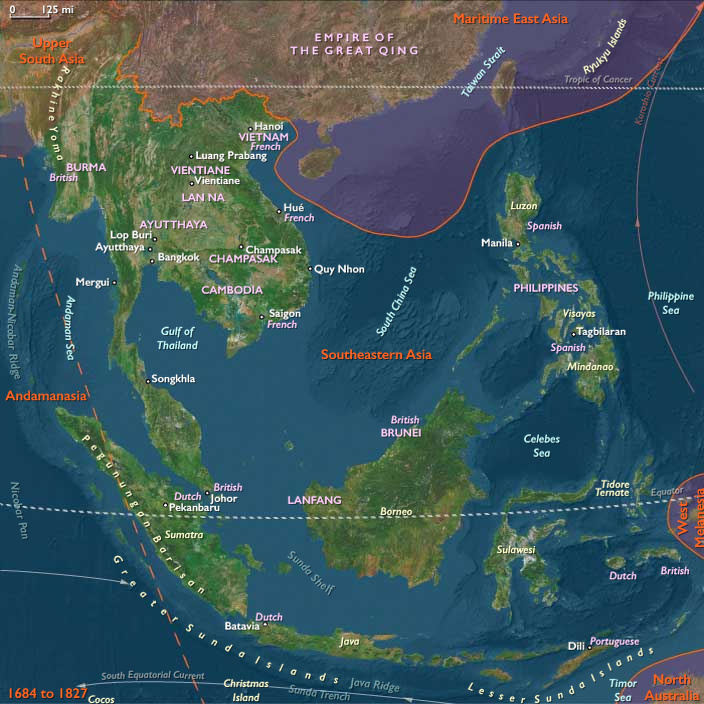
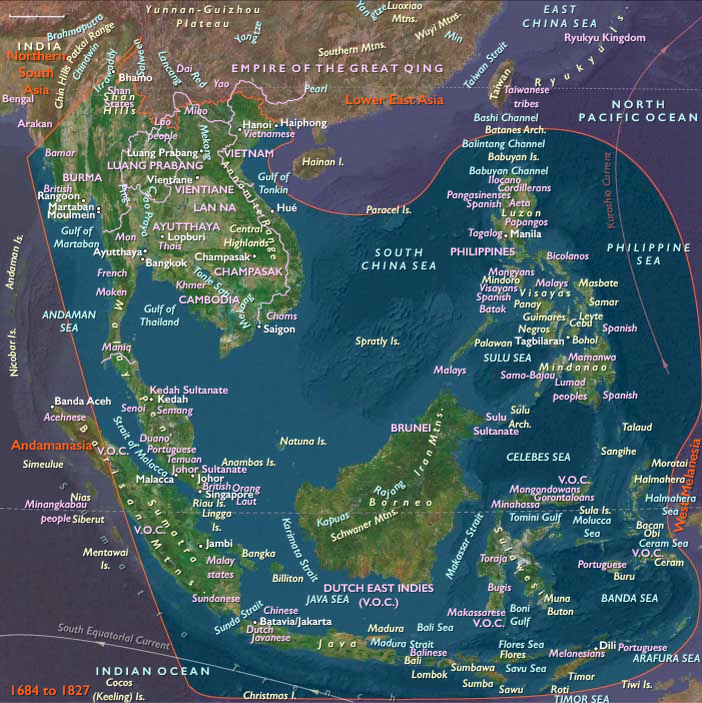
The Marquess of Hastings, Governor General of India, appoints John Crawford British envoy to Siam in 1822, but his negotiations prove fruitless.
Groups
Subjects
Regions
Southeast Asia
View →Subregions
Southeastern Asia
View →Related Events
No active filters.
Showing 10 events out of 20284 total
Okhotsk is ranked just after Barnaul as the neatest, cleanest and most pleasant town in Siberia, according to the observations of the English traveler Captain John Dundas Cochrane in 1822.
An illegitimate son of Scottish adventurer Andrew Cochrane-Johnstone, Cochrane comes from a large and adventurous family—he is a cousin of Admiral Thomas Cochrane, 10th Earl of Dundonald, and nephew of Admiral Sir Alexander Forrester Inglis Cochrane.
John Dundas Cochrane has crossed France, Spain, Portugal, Germany, Russia and Asia to Kamchatka on foot, hence his nickname of the "Pedestrian Traveller" ("voyageur pédestre" in France).
He marries Ksenia Ivanovna Loginova (1807-1870) in 1822; she is an adoptive daughter of Admiral Pyotr Rikord, the Russian governor of Kamchatka.
Honga Hika leads his force up the Waikato River where, after initial success, he is defeated in early 1822 by Te Wherowhero, before gaining another victory at Orongokoekoea.
Te Wherowhero ambushes the Ngāpuhi carrying Ngāti Mahuta women captives and frees them.
The Mermaid had been grounded in 1820.
Philip Parker King's fourth voyage is undertaken in the one hundred and fifty-four-ton sloop HMS Bathurst.
The ship heads north, through Torres Strait and to the northwest coast of the continent.
Further survey of the west coast is made after a visit to Mauritius.
Valuable contributions have been made to the exploration of Australia.
His replacement, Thomas Brisbane, has different views through which he begins asserting his authority.
Under Brisbane's hand settlement laws are changed leading to a flood of land grants across the Blue Mountains.
An enormous influx of the British onto the Wiradjuri lands puts great strain on traditional food sources, and destroys some of the Wiradjuri social and sacred sites.
In response, the Wiradjuri resistance is born.
Well aware that they have no chance against guns, they adopt a guerrilla-warfare approach, in which attacks are made against outlying and undefended stations.
Cholera is found in 1822 in Japan, in the Persian Gulf, in Baghdad, in Syria, and in the Transcaucacus.
A number of governments have treated Freemasonry as a potential source of opposition due to its secret nature and international connections.
After the founding of modern speculative Masonry in England in 1717, several Protestant states had restricted Masonic lodges: the Netherlands banned the lodge in 1735; Sweden and Geneva, in 1738; Zurich, in 1740; and Berne, in 1745.
Catholic Spain, Portugal, France and Italy had attempted to suppress Freemasonry after 1738.
Bavaria followed in 1784; Austria, in 1795; Baden, in 1813; Russia, in 1822.
Polish poet Adam Mickiewicz publishes his first volume of poetry, a collection largely containing ballads and romances expressing the cause of Polish nationalism, in 1822.
The ban has been renewed multiple times since the government once again tried to impose a ban on coffee in 1794, but it has never been successful in stamping out coffee-drinking.
With the ban lifted, coffee will become a dominant beverage in Sweden, which is today one of the countries with the highest coffee consumption per capita.
The Greek rebellion shocks the Porte, which will no longer appoint Phanariote princes to the Wallachian and Moldavian thrones and will choose instead native Romanians.
The Greek War of Independence has touched a chord in Western Europe.
Such figures as Lord Byron find a "noble cause" in the Greek struggle against the Ottoman Empire.
Philhellenes, as these sympathizers come to be called, play a critical role in the war.
The conflict attracts the physical, monetary, and moral support of a variety of West European idealists.
The Philhellenes raise money to support the insurgents, and they focus the attention of the outside world on the conflict until the powers of Western Europe decide to intervene.
In European Great Power politics after the final defeat of Napoleon in 1815, maintenance of the status quo is the first priority.
In such an atmosphere, the attention of the Great Powers (primarily France and Britain) can be drawn most quickly by situations that disrupt their common economic interests.
Indeed, in 1823, the war in Greece has already begun curtailing commerce in the eastern Mediterranean, but the European powers realize that the defeat of the Ottoman Empire will leave a power vacuum over a very large, strategically important region.
Therefore, they move cautiously to ensure an advantageous position after the anticipated collapse.
These calculations balance Britain and France.