
The Middle East: 1252–1263 CE Collapse of…
1252 CE to 1263 CE
The Middle East: 1252–1263 CE
Collapse of the Abbasid Caliphate and Mongol Dominance
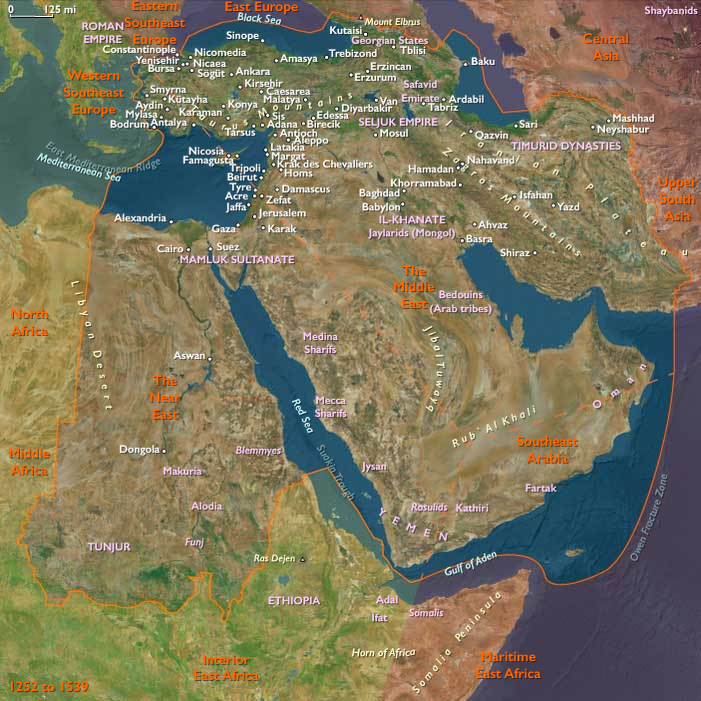
The era 1252–1263 CE is a critical period in the Middle East, marked by the catastrophic fall of the Abbasid Caliphate and the rise of Mongol power. In 1258, the Mongol forces under Hulagu Khan, grandson of Genghis Khan, capture and sack Baghdad, bringing an end to the Abbasid dynasty. This event sends shockwaves throughout the Islamic world, symbolizing the end of the classical Islamic Golden Age and initiating widespread political fragmentation across the region.
Decline of Seljuq Influence in Anatolia
The Seljuq Sultanate of Rûm, previously prosperous due to strategic control of Anatolia's trade routes and ports, faces significant decline following the decisive Mongol victory at the Battle of Köse Dağ (1243). Although Anatolian Seljuqs had earlier fostered trade with Genoese merchants and built numerous caravanserais to facilitate commerce, their power diminishes sharply as they become vassals to the Mongol Il-Khanate. Internal autonomy erodes, leading to increased regional fragmentation and local power struggles among Turkish beyliks.
Cultural Resilience: Persian Literature
Despite this widespread turmoil, Persian culture, particularly literature, flourishes. The renowned Persian poet Sheykh Moslehoddin Saadi composes two significant works during this era: Bostan (The Orchard) in 1257, a didactic epic promoting ethical and spiritual reflection, and Gulistan (The Rose Garden) in 1258, which combines prose and verse to impart wisdom through anecdotes and reflections on human experiences, especially love and morality.
Byzantine Restoration and Stability
The exiled Eastern Roman Empire in Nicaea continues to exhibit economic resilience and military stability, supported by well-managed frontier defenses in Anatolia. Trade with the Seljuqs, although diminished due to Mongol disruptions, remains viable, contributing to Nicaean stability. Nicaea thus serves as a critical regional power base, capable of supporting its defensive and economic interests despite lacking a naval force.
Hospitaller Fortifications in the Levant
The Knights Hospitaller sustain their influential presence in the Crusader states, notably through major fortifications such as Margat and the Krak des Chevaliers. The latter, significantly expanded by 1250, continues to symbolize military strength and Crusader resilience in the Levant, protecting strategic points against regional threats, including Mongol and Muslim forces.
Innovations in Arabic Musical Theory
Cultural innovation continues at the Abbasid court even as political power wanes. The musician and theorist Safi al-Din al-Urmawi contributes significantly to Arabic musical scholarship, developing an early example of Arabic musical notation and formulating a comprehensive system of twelve primary melodic modes. His theoretical advancements greatly influence subsequent Arabic and Persian musical traditions.
Thus, the period 1252–1263 CE represents a transformative epoch characterized by profound political upheaval, significant cultural innovation, and resilient pockets of stability amidst widespread turmoil in the Middle East.
Groups
Subjects
Regions
The Near and Middle East
View →Subregions
