The Middle East: 1336–1347 CE Continued Ottoman…
1336 CE to 1347 CE
The Middle East: 1336–1347 CE
Continued Ottoman Expansion and Consolidation
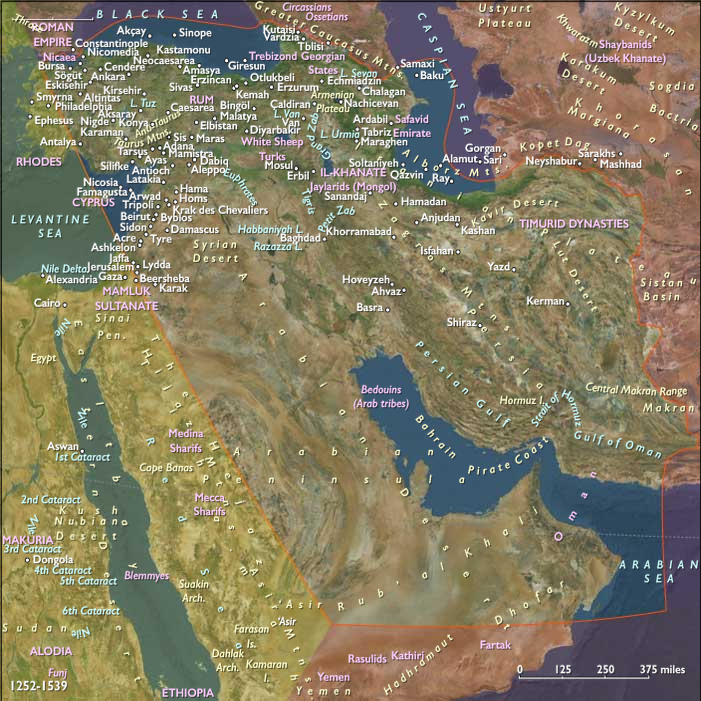
During the period 1336–1347 CE, the Ottoman Empire, under Sultan Orhan, continues to expand and consolidate its power in northwestern Anatolia. Orhan further solidifies his control over key territories, including the important cities of Nicaea (Iznik) in 1331 and Nicomedia (Izmit) in 1337. The capture of these cities significantly reduces Byzantine territorial holdings in Asia Minor, and Iznik becomes an essential administrative and military center for the burgeoning Ottoman state.
Military and Administrative Reforms
Orhan implements additional military reforms during this period, notably establishing the Janissaries around 1338, a professional and highly disciplined infantry force recruited primarily through the devshirme system (a levy on Christian youths converted to Islam and trained as elite soldiers). This force becomes instrumental in Ottoman military successes in subsequent decades and significantly enhances the stability and effectiveness of the Ottoman army.
Fragmentation and Turmoil in Post-Il-Khanid Persia
The collapse of the Mongol Il-Khanid dynasty in Persia in 1335 continues to have profound repercussions. The ensuing fragmentation results in significant political instability, as various local dynasties, including the Jalayrid Sultanate, a Mongol Jalayir dynasty originally from the Darliqin Mongol tribes along the Shilka River, vie for dominance in Iraq and western Persia. The Jalayrids, previously part of the broader Mongol dispersal throughout Central Asia and the Middle East, control substantially less territory than their predecessors, marking a significant departure from the centralized authority of the previous Mongol regime. This period is characterized by localized power struggles, shifting alliances, and the dispersal of Mongol influences into smaller political entities across the region.
Heightened Cultural and Scholarly Activity
Despite political disruptions, scholarly and cultural exchanges flourish throughout the Middle East. Notably, the Syrian scholar Gregory Bar Hebraeus enhances cultural and scholarly communication between the Christian and Muslim worlds through his extensive travels and writings. Persian literary and artistic traditions, fostered under previous dynasties, continue to influence regional culture, while significant intellectual exchange between Christian, Jewish, and Muslim scholars remains vibrant. Libraries, schools, and centers of learning in cities such as Baghdad, Damascus, and Shiraz continue their roles as hubs of cultural and intellectual engagement.
Pressure on the Remaining Crusader States
The remaining Crusader states, particularly the holdings of the Knights Hospitaller, increasingly struggle to withstand the military pressure exerted by the expanding Ottomans and other Muslim powers. Their fortresses, notably Krak des Chevaliers and other strategic locations, face ongoing threats and sieges, weakening their military and political influence in the Levant.
Prelude to Catastrophe: The Black Death
Toward the end of this period, the Middle East faces the looming threat of the Black Death, which, originating in Central Asia, will dramatically impact the region in subsequent years. The catastrophic epidemic will cause significant demographic and social disruption throughout the Middle East, reshaping political and economic structures profoundly.
In essence, the years 1336–1347 CE reflect the continued ascendancy of the Ottoman Empire under Orhan, marked by significant military reforms and territorial consolidation. Concurrently, post-Il-Khanid Persia enters a turbulent era of fragmentation, while the cultural and intellectual life of the Middle East remains robust despite political instability, the dispersal of Mongol tribes like the Jalairs, and the waning Crusader presence.
Groups
Topics
Subjects
Regions
The Near and Middle East
View →Subregions