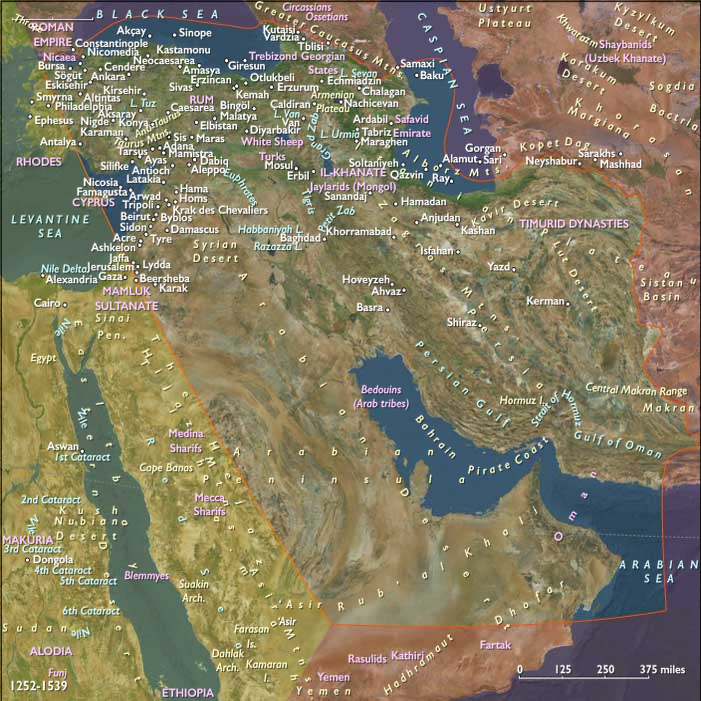
The Middle East: 1504–1515 CE Turmoil and…
1504 CE to 1515 CE
The Middle East: 1504–1515 CE
Turmoil and Territorial Expansion
Consolidation of Safavid Power
Shah Ismail I (r. 1501–1524) continues his ambitious project to consolidate Safavid power, spreading Twelver Shi'a Islam aggressively throughout Persia. By 1508, Ismail captures Baghdad, firmly placing Mesopotamia under Safavid control. His relentless campaigns significantly extend Safavid influence, embedding Shi'a Islam deeply into Persian society and setting the stage for sustained religious and cultural differentiation from neighboring Sunni realms.
Ottoman Confrontations with the Safavids
The expansion of the Safavid Empire increasingly threatens Ottoman dominance in eastern Anatolia. The continued propagation of Shi'a doctrines among Turkmen tribes intensifies regional revolts, leading Sultan Bayezid II (r. 1481–1512) to deploy further military resources to quell these disturbances. The situation becomes dire enough that his successor, Selim I (r. 1512–1520), shifts Ottoman policy to a more aggressive stance, determined to eradicate the Safavid influence in Anatolia and secure the eastern borders of the Ottoman state.
Selim I and the Ottoman Succession
In 1512, internal Ottoman struggles culminate in a dynastic shift as Sultan Selim I overthrows his father, Bayezid II, securing his rule through decisive and ruthless measures. His ascension marks a turning point toward a more militant Ottoman foreign policy, immediately directed against the perceived Shi'ite menace represented by Safavid Persia. Selim rapidly strengthens his military and reorganizes internal administration, setting the groundwork for extensive campaigns against both Safavid Persia and the Mamluks in the coming years.
Decline of the Mamluk Sultanate
In the wake of Sultan Qaitbay’s prosperous rule, the Mamluk Sultanate experiences rapid administrative decline and economic difficulties. European maritime advancements weaken Mamluk control of traditional trade routes, diminishing the Sultanate’s economic base and exposing it to greater external threats. Internal divisions and corruption further exacerbate these vulnerabilities, leaving the Sultanate ill-prepared for the looming confrontation with the increasingly assertive Ottoman Empire.
Georgia: Navigating the Great Powers
The Kingdom of Georgia, under King David X (r. 1505–1525), continues to deftly navigate the challenging geopolitical landscape. Facing intensified Safavid and Ottoman pressures, Georgia employs cautious diplomacy to maintain a fragile autonomy. Nevertheless, raids and encroachments by neighboring empires strain its resources, necessitating continual vigilance and defensive preparedness.
Intellectual and Cultural Flourishing
This era sees continued cultural and intellectual enrichment, particularly within Safavid Persia and Ottoman realms. Religious and philosophical scholarship flourishes, notably with scholars elaborating on Shi'ite theology under Safavid patronage. The vibrant artistic and literary production of this period significantly shapes Persian identity, enriching the cultural heritage that distinguishes it within the Islamic world.
Legacy of the Era
The period 1504–1515 is marked by significant shifts in power dynamics across the Middle East. The relentless Safavid expansion into Iraq and intensifying Ottoman-Safavid rivalry set the stage for prolonged regional conflict. The rise of Selim I inaugurates an assertive and militaristic Ottoman era, ultimately reshaping Middle Eastern geopolitics. Concurrently, the weakening Mamluk state foreshadows the transformative changes about to reshape Egypt and Syria in the early sixteenth century.
Groups
Subjects
Regions
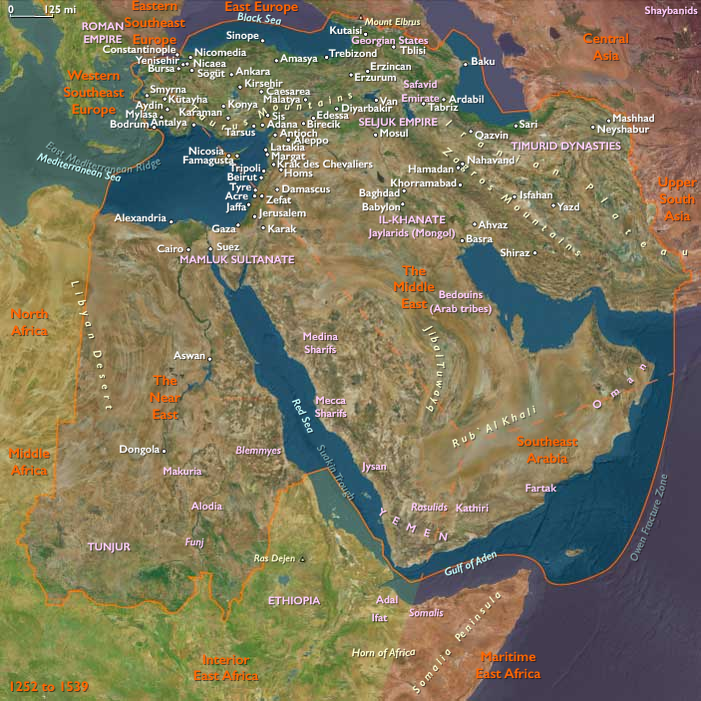
The Near and Middle East
View →Subregions