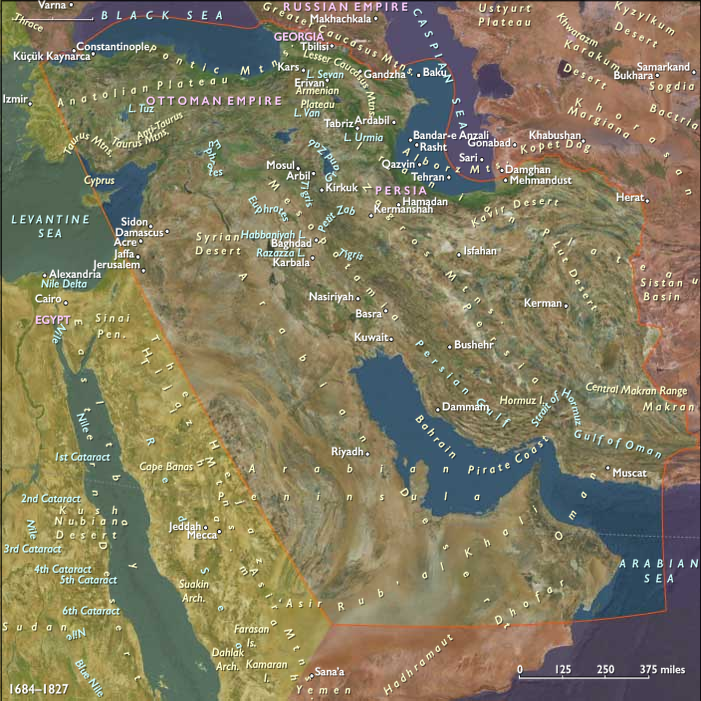
The Middle East: 1756–1767 CE Expansion of…
1756 CE to 1767 CE
The Middle East: 1756–1767 CE
Expansion of the Saudi-Wahhabi State
From 1756 to 1767, the Saudi-Wahhabi alliance, forged by Muhammad ibn Saud and Muhammad ibn Abd al Wahhab, continues to strengthen and expand its influence throughout central Arabia. Driven by the militant interpretation of Wahhabism, Saudi forces successfully annex surrounding tribes and settlements, spreading their austere version of Islam. Muhammad ibn Saud, alongside his son Abdul Aziz, vigorously leads armies into Najdi towns and villages, eradicating popular and Shia practices and unifying the tribes under their banner. By 1765, Wahhabi authority is established firmly over most of Najd, significantly threatening regional powers such as the Ottoman Empire and its local allies. Abdul Aziz continues this aggressive territorial expansion and ideological consolidation following Muhammad ibn Saud's death in 1765.
Stabilization and Economic Growth in Oman
In Oman, Ahmad bin Said al-Busaidi consolidates his rule, firmly establishing internal control after decades of instability. Ahmad emerges as undisputed ruler following the death of rival Imam Bal'arab bin Himyar in 1749. He distances himself from traditional Ibadi centers by moving the capital from Ar Rustaq to the bustling commercial port of Muscat, significantly reviving maritime trade. Under his leadership, Oman experiences notable economic rejuvenation, asserting its maritime influence in the Persian Gulf and Indian Ocean. His reign sees Muscat revitalized as a pivotal trading hub, marking a strategic shift towards commercial prosperity.
Persian Fragmentation and Regional Impact
The fragmentation of Persian authority following Nader Shah's assassination continues to severely impact regional stability. Mohammad Hasan Khan, leader of the Qajar tribe, extends his influence over Astarabad, Mazandaran, and Gilan amidst weakening central Persian authority. These internal divisions exacerbate instability across neighboring territories, creating opportunities for tribal and regional authorities in Iraq and the Persian Gulf to assert their autonomy. This declining Persian influence reshapes Gulf politics, fostering increased local governance and autonomy.
Ottoman Control and Tribal Independence
Ottoman authority remains compromised as local tribal autonomy increasingly challenges central governance. Tribes such as the Muntafiq and Bani Lam in southern Iraq, and the Kurdish Baban Dynasty in the north, further entrench their independence. Ottoman attempts to reassert control over these autonomous regions largely fail, reinforcing fragmented and decentralized rule throughout their Arab territories. This dynamic encourages local governance structures that resist Ottoman administrative centralization.
Prosperity and Tribal Settlement in the Persian Gulf
Economic prosperity continues in the Persian Gulf due to robust pearl harvesting, agriculture, and trade. The Al Khalifa and Al Jalahima sections of the Bani Utub tribe migrate from Kuwait to Qatar's northwest coast, establishing the prosperous trading and pearling settlement of Az Zubarah in 1766. Meanwhile, tribes such as the Al Thani further transition from nomadic life to settled communities involved in fishing, pearling, date cultivation, and trade. The popularity of Wahhabism among tribes such as the Al Thani heightens tensions, particularly with the Al Khalifa, who reject the movement. This tribal migration and settlement enhance the Gulf region's economic and social landscape, reinforcing its importance as a vibrant commercial and cultural crossroads.
Legacy of the Era
Between 1756 and 1767, the Middle East experiences profound political consolidation and economic rejuvenation, particularly in central Arabia and Oman. The Saudi-Wahhabi alliance expands its territorial and ideological reach, significantly reshaping regional religious and political dynamics. Oman stabilizes and economically prospers under Ahmad bin Said, emerging as a vital maritime power. Persian fragmentation deepens regional decentralization, while persistent tribal autonomy increasingly challenges Ottoman rule. These transformative developments lay critical foundations for subsequent political, economic, and social evolutions across the Middle East.
People
Groups
Regions
The Near and Middle East
View →Subregions