
The Middle East: 1768–1779 CE Continued …
Years: 1768 - 1779
The Middle East: 1768–1779 CE
Continued Saudi-Wahhabi Expansion
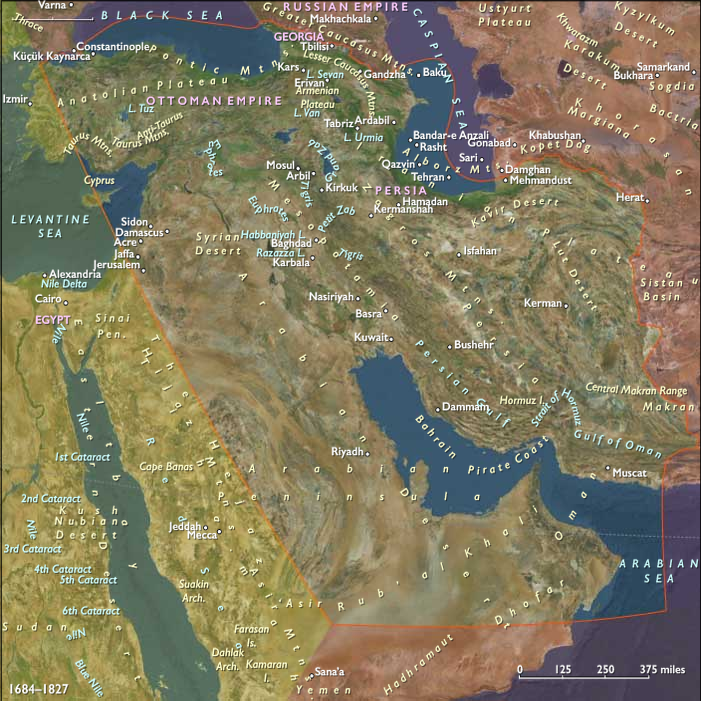
Between 1768 and 1779, the Saudi-Wahhabi state, under the vigorous leadership of Abdul Aziz ibn Muhammad ibn Saud, continues its aggressive expansion and consolidation efforts across the Arabian Peninsula. The austere and puritanical doctrines of Wahhabism further motivate the Saudi forces to confront both Sunni and Shia rivals, systematically enforcing religious orthodoxy across the territories they control. Under Abdul Aziz's command, significant efforts are made to subdue remaining resistant centers, notably the crucial city of Riyadh, which falls decisively into Saudi-Wahhabi hands in 1773. This victory enhances their political authority and facilitates further unification of Najdi tribes under their rigid religious and political framework.
Regional Struggles and the Rise of the Qajar Dynasty
In Persia, the weakening Zand dynasty, led by Karim Khan Zand until his death in 1779, maintains a tenuous hold on power amidst growing factionalism and tribal rebellion. This decline creates opportunities for ambitious tribal leaders like the Qajars, under Agha Mohammad Khan Qajar, to extend their influence. The Qajars consolidate power in Mazandaran, Astarabad, and parts of northern Persia, laying critical groundwork for their eventual dominance. Their rise intensifies regional instability, influencing political dynamics across adjacent territories.
Oman: Maritime Dominance and Internal Stability
Ahmad bin Said al-Busaidi continues to solidify Oman’s maritime power and internal stability, reinforcing Muscat as a prosperous trading hub in the Persian Gulf and Indian Ocean. His reign fosters economic and political consolidation, further distancing the capital from traditional Ibadi centers and strengthening centralized governance. Under Ahmad’s leadership, Oman asserts increasing maritime influence, securing trade routes and protecting its interests against regional competitors.
Persian Gulf: Tribes and Economic Rivalries
Economic prosperity driven by pearl harvesting and maritime trade continues to shape social and political dynamics in the Persian Gulf region. The settlement of the Al Khalifa and Al Jalahima clans in Qatar’s prosperous Az Zubarah deepens local rivalries, particularly with the Al Thani clan, who embrace Wahhabi doctrines. The competition over economic resources and ideological differences creates tension and sporadic conflict, notably between the Wahhabi-influenced Al Thani and the non-Wahhabi Al Khalifa. Such tribal competition characterizes the economic and political climate of the Gulf throughout this era.
Declining Ottoman Influence
Throughout the period, Ottoman control over its Arab provinces continues to weaken as tribal autonomy and local governance increasingly assert themselves. In southern Iraq and northern Kurdish territories, tribal leaders such as the Muntafiq, Bani Lam, and the Baban Dynasty reinforce their independence, successfully resisting centralized Ottoman authority. This period further entrenches decentralized governance, limiting the Ottoman Empire's capacity to effectively administer its distant Arab provinces.
Legacy of the Era
The years 1768 to 1779 witness critical transformations in regional power structures, characterized by the continued territorial and ideological expansion of the Saudi-Wahhabi state, the emerging dominance of the Qajar dynasty in Persia, and sustained maritime prosperity under Oman’s Al Bu Sa'id dynasty. These developments occur alongside increasing tribal autonomy and declining Ottoman influence, shaping enduring political, economic, and social landscapes across the Middle East.
People
- Abdul Aziz bin Muhammad bin Saud
- Agha Mohammad Khan Qajar
- Ahmad bin Said al-Busaidi
- Karim Khan Zand
- Muhammad bin Saud
- Muhammad ibn ʿAbd al-Wahhab
- Saud bin Abdul-Aziz bin Muhammad bin Saud
Groups
- Arab people
- Persian people
- Kurdish people
- Muslims, Sunni
- Muslims, Shi'a
- Muslims, Ibadi
- Banu Lam
- Al-Muntafiq
- Ottoman Empire
- Turkish people
- Baban
- Thani, House of
- Omani Empire
- Al Khalifa family
- Wahhabism
- Persia, Afsharid Kingdom of
- Oman, Sultanate of
- Persia, Zandid Kingdom of
- Al Jalahma family
- Saud, House of
Topics
Subjects
Regions
Subregions
Years: 1768 - 1779
People
- Abdul Aziz bin Muhammad bin Saud
- Agha Mohammad Khan Qajar
- Ahmad bin Said al-Busaidi
- Karim Khan Zand
- Muhammad bin Saud
- Muhammad ibn ʿAbd al-Wahhab
- Saud bin Abdul-Aziz bin Muhammad bin Saud
Groups
- Arab people
- Persian people
- Kurdish people
- Muslims, Sunni
- Muslims, Shi'a
- Muslims, Ibadi
- Banu Lam
- Al-Muntafiq
- Ottoman Empire
- Turkish people
- Baban
- Thani, House of
- Omani Empire
- Al Khalifa family
- Wahhabism
- Persia, Afsharid Kingdom of
- Oman, Sultanate of
- Persia, Zandid Kingdom of
- Al Jalahma family
- Saud, House of
Topics
Subjects
Regions
Subregions