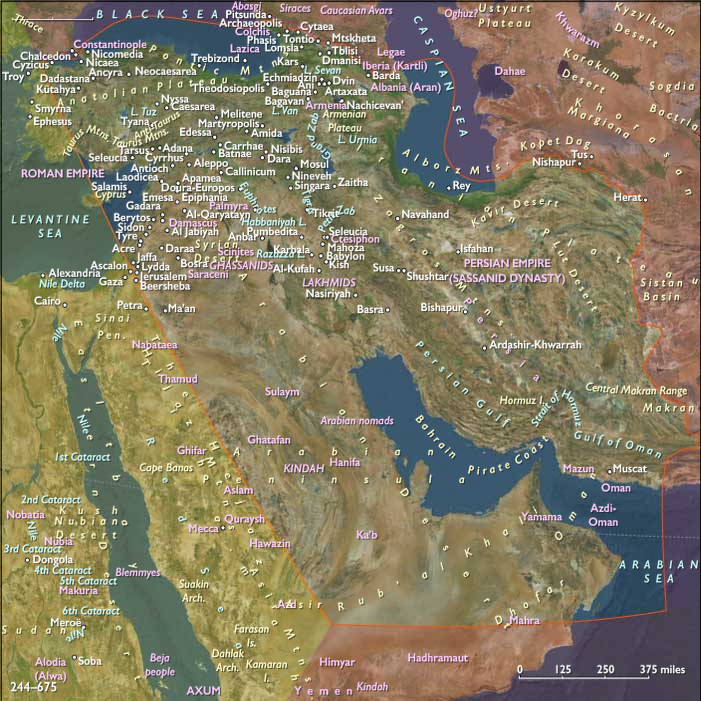
The Middle East: 628–639 CE Transformation and…
628 CE to 639 CE
The Middle East: 628–639 CE
Transformation and the Rise of Islamic Power
Collapse of Sassanian Authority
The conclusion of the prolonged and debilitating Byzantine-Sassanid War leaves both empires severely weakened, setting the stage for dramatic regional shifts. By 628, the exhausted Sassanian Empire, led by Khosrau II, is significantly diminished in both military and economic strength. The internal chaos following the overthrow and execution of Khosrau II plunges Persia into a period of rapid political fragmentation, marked by a succession of short-lived rulers and civil strife.
Rise of Islam
Concurrently, the Arabian Peninsula witnesses the remarkable rise and expansion of Islam under the leadership of the Prophet Muhammad and his immediate successors. Muhammad's death in 632 triggers a swift expansion of the new faith beyond Arabia. Under the Rashidun Caliphate, Arab armies decisively defeat both Byzantine and Sassanian forces, conquering key territories in Mesopotamia, Persia, and Syria. The decisive Battle of al-Qādisiyyah in 636 severely cripples the Sassanian Empire, paving the way for Arab control of Mesopotamia.
Conquest of Jerusalem
In 637, Arab armies under Caliph Umar ibn al-Khattab capture Jerusalem after a prolonged siege. Umar’s entry into Jerusalem symbolizes not only a strategic military victory but also the peaceful accommodation of the city's diverse religious communities. His policies set a precedent for religious tolerance and cohabitation, profoundly influencing the subsequent administration of Islamic-ruled territories.
Integration and Cultural Transition
By the close of this era, the rapid territorial expansion and consolidation of the Islamic Caliphate fundamentally reshapes the cultural, religious, and political landscape of the Middle East. This period signals the decline of classical Persian and Byzantine dominance, giving rise to a new Islamic civilization that blends Arab, Persian, and Byzantine traditions into a vibrant and enduring cultural legacy.
Groups
Topics
Regions
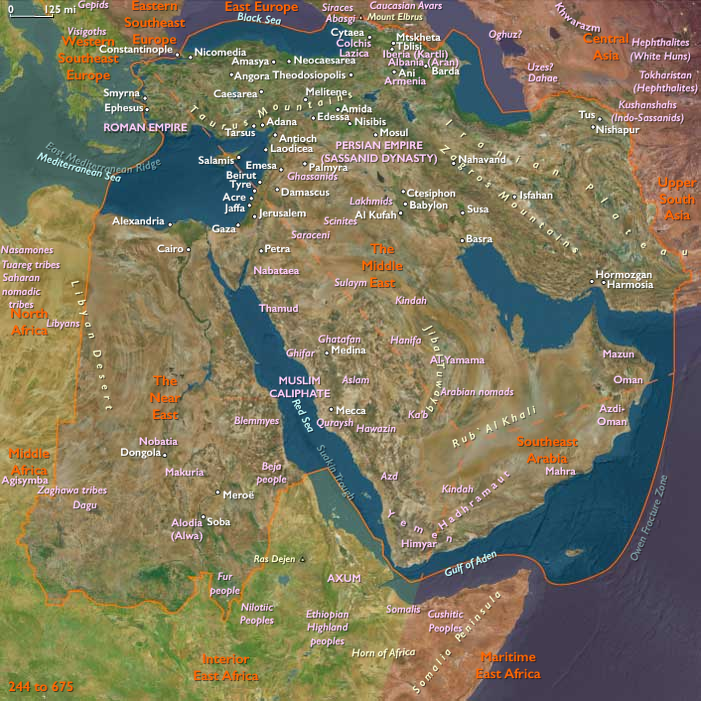
The Near and Middle East
View →Subregions