
The Chinese impact on Vietnamese culture is…
1396 CE to 1539 CE
The Chinese impact on Vietnamese culture is probably as great, or greater, in the centuries following independence as it was during the one thousand years of Chinese political domination.
Much of China's cultural and governmental influence on Vietnam dates from the Ming period.
Other aspects of Chinese culture are introduced later by Vietnamese kings struggling to bring a Confucian order to their unruly kingdom.
Chinese administrative reforms and traditions, when sponsored by Vietnamese kings and aristocracy, tend to be more palatable and hence more readily assimilated than those imposed by Chinese officials.
Although the Vietnamese upper classes during the Ming period study Chinese classical literature and subscribe to the Chinese patriarchal family system, the majority of the Vietnamese people recognize these aspects of Chinese culture mainly as ideals.
Less exposed to Chinese influence, the peasantry retains the Vietnamese language and many cultural traditions that predate Chinese rule.
Other factors also encourage the preservation of Vietnamese culture during the periods of Chinese rule.
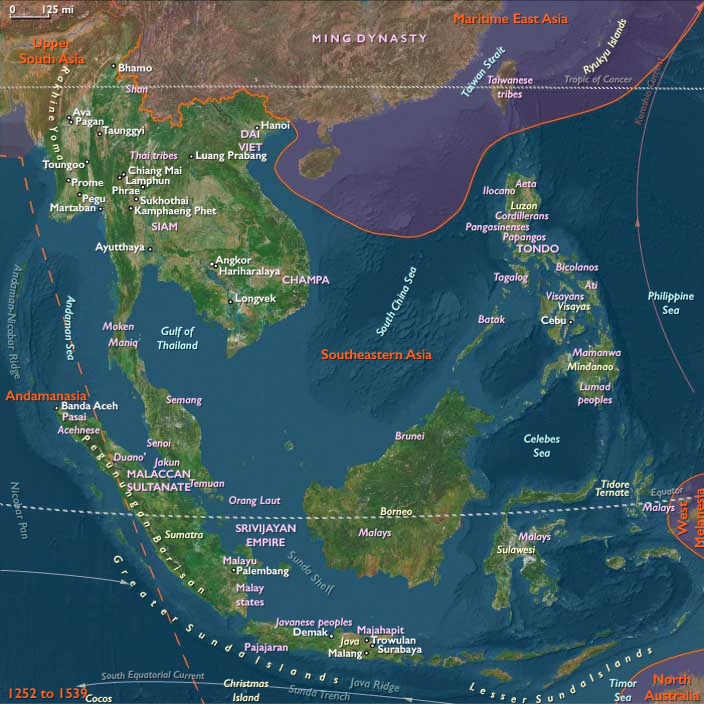
Contact with the Indianized Cham and Khmer civilizations, for example, widens the Vietnamese perspective and serves as a counterweight to Chinese influence.
Vietnam's location on the South China Sea and the comings and goings of merchants and Buddhists encourage contact with other cultures of South and Southeast Asia.
China, itself, once it develops the port of Guangzhou (Canton), has less need to control Vietnam politically in order to control the South China Sea.
Moreover, the Vietnamese who move southward into lands formerly occupied by the Cham and the Khmer become less concerned about the threat from China.
Locations
People
Groups
Regions
Southeast Asia
View →Subregions
