
The much married Henry VIII, the red-haired …
Years: 1547 - 1547
January
The much married Henry VIII, the red-haired king of England from 1509, has presided over the beginnings of the English Renaissance and the English Reformation, breaking his entire country from adherence to Roman Catholicism.
Greedy and despotic, Henry has squandered much of the nation’s resources on needless foreign wars, but has managed to the country together during a period of rapid change and factional strife.
He has also fostered the development of a sophisticated court in which fine artists and musicians find patronage.
His six wives are, successively, Catherine of Aragon (the mother of the future queen Mary I), Anne Boleyn (the mother of the future queen Elizabeth I), Jane Seymour (the mother of Henry's successor, Edward VI), Anne of Cleves, Catherine Howard, and Catherine Parr.
He had divorced Catherine of Aragon, his deceased elder brother's widow, who later died of natural causes, and executed, for alleged treasonable adultery, Anne Boleyn, who had also failed to produce a viable male heir.
Jane Seymour had died in childbirth, and Anne of Cleves, hated by Henry at first sight, had escaped him through a quick divorce.
Catherine Howard, who had foolishly continued her promiscuous ways despite being made Henry's queen, had ultimately followed Anne Boleyn to the executioner's block.
The calm and obedient Catherine Parr outlives Henry, who dies on January 28, 1547 at fifty-five, possibly from untreated Type II diabetes.
Henry Howard, who had introduced the sonnet form in England, had been beheaded a week earlier on a trumped-up charge of treason.
His father Thomas Howard, third duke of Norfolk, escapes execution because of Henry VIII's death, and is later pardoned.
Surrey leaves his translation of Books 2 and 4 of Vergil's Aeneid as the first example of blank, or unrhymed iambic pentameter, verse in English.
Upon Henry’s death, his nine-year-old son by Jane Seymour succeeds him as King Edward VI.
Henry’s will provides for the succession of his three children in the normal order, despite the fact that both daughters had earlier been excluded from the succession.
The will also provides that England shall be governed by a group of sixteen regents during Edward's minority.
Edward Seymour, earl of Hertford, sets this provision aside and assumes sole authority as his nephew’s protector.
John Dudley, another of the councilors named by Henry to rule during Edward’s minority, acquiesces in the assumption of power by Somerset.
Stephen Gardiner, the doctrinally conservative bishop of Winchester, does not, and is removed from the royal council, imprisoned, and deprived of his bishopric.
Protestant tutors continue the young king’s education.
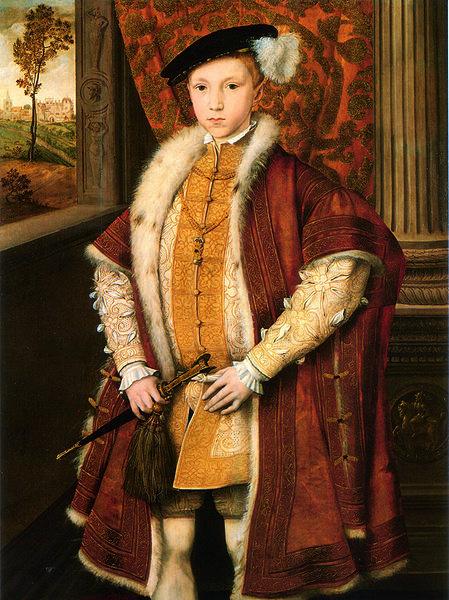
Unknown (?Flemish School): Edward VI of England (c. 1546 )
Locations
People
- Catherine Parr
- Edward Seymour
- Edward VI of England
- Henry Howard
- Henry VIII of England
- John Dudley
- Stephen Gardiner
- Thomas Howard
Groups
Topics
Subjects
Regions
Subregions
Years: 1547 - 1547
January
Unknown (?Flemish School): Edward VI of England (c. 1546 )
Locations
People
- Catherine Parr
- Edward Seymour
- Edward VI of England
- Henry Howard
- Henry VIII of England
- John Dudley
- Stephen Gardiner
- Thomas Howard
Groups
Topics
Subjects
Regions
Subregions