
The name Wallachia, generally not used by …
Years: 1290 - 1290
The name Wallachia, generally not used by Romanians themselves (but present in some contexts as Valahia or Vlahia), is derived from the word "walha" used by Germanic peoples to describe Celts, and later romanized Celts and all Romance-speaking people.
In northwest Europe this gave rise to Wales, Cornwall, Wallonia, among others, while in Southeast Europe it evolved into the ethnonym Valach, used to designate Germanic speakers' Romance-speaking neighbors, and subsequently taken over by Slavic-speakers to refer to Romanians.
The traditional Hungarian name for Wallachia is "Havasalföld", or literally "Snowy Lowlands" (the older form is "Havaselve", which means "Land beyond the snowy mountains", its translation to Latin - Transalpina - is used in the official royal documents of Kingdom of Hungary).
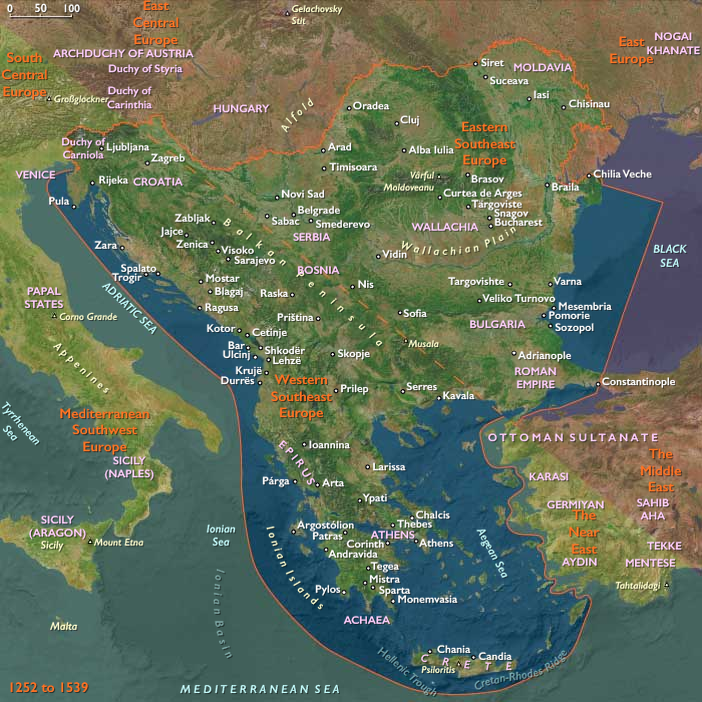
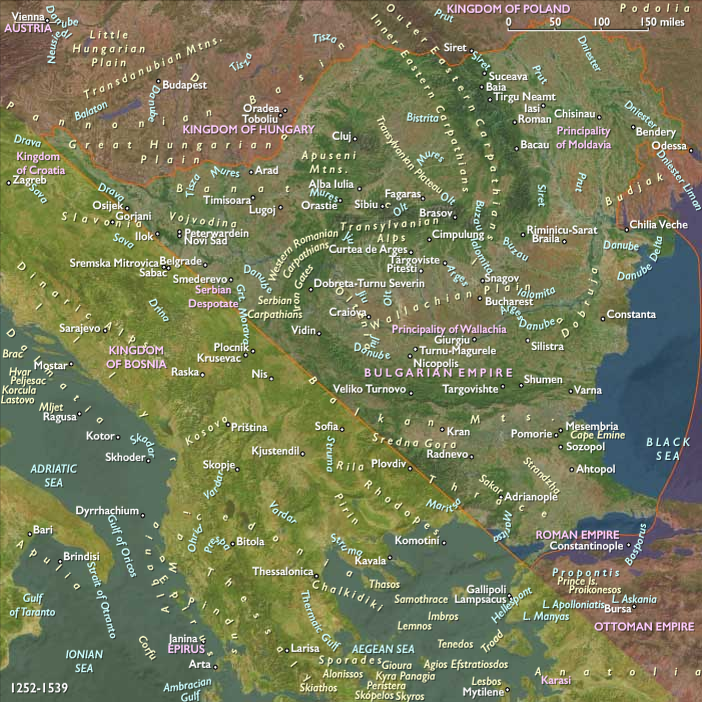
Vlach/Romanian settlers from Hungarian-ruled Transylvania have emigrated from the mountains into the plain north of the Danube.
Hungary organizes this new land of the Vlachs—Wallachia—into a province, appointing a ban (or voivode, as they are called locally) to govern.
According to Romanian tradition, Radu Negru-Voda, a leading Vlach nobleman, leaves Fagaras in southern Transylvania with a group of nobles in 1290 and …
Locations
Groups
- Vlachs
- Romanians
- Christians, Roman Catholic
- Hungary, Kingdom of
- Wallachia, Hungarian province of
- Moldavia, Hungarian province of
Subjects
Regions
Subregions
Years: 1290 - 1290
Locations
Groups
- Vlachs
- Romanians
- Christians, Roman Catholic
- Hungary, Kingdom of
- Wallachia, Hungarian province of
- Moldavia, Hungarian province of
Subjects
Regions
Subregions