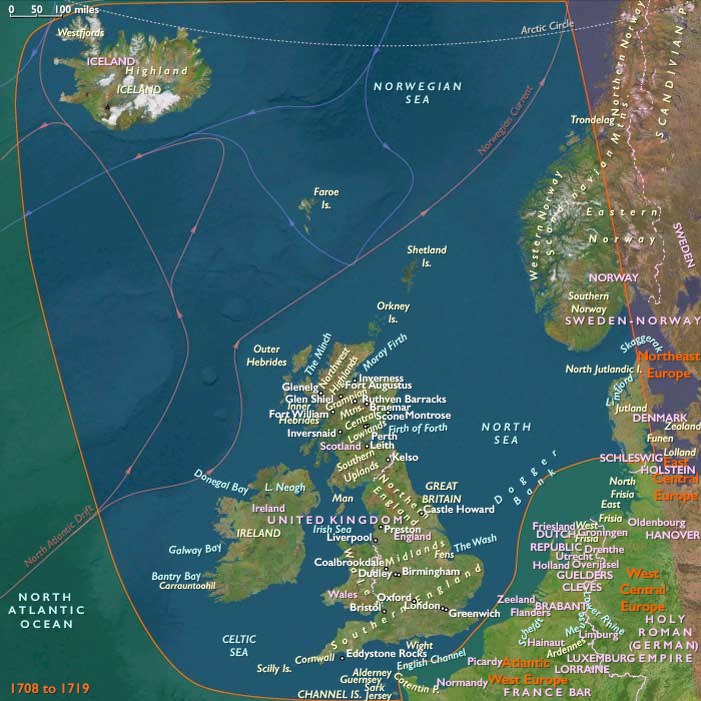
The national debt investigation had concluded that…
May 1711 CE
The national debt investigation had concluded that a total of nine million pounds is owed without any allocated income to pay it off.
Edward Harley and John Blunt together have devised a scheme to consolidate this debt in a similar manner to that previously performed by the Bank of England, although the Bank still holds the monopoly on operating as a bank.
All holders of the identified debt will be required to surrender this to a new company, the South Sea Company, which in return will issue shares to the same amount.
The government will pay the company £568,279 10s, (6% interest plus expenses) annually, which will be distributed as a dividend to shareholders.
The company is also given a monopoly to trade with South America, a potentially lucrative enterprise but one which is controlled by Spain, with whom Britain was at war.
At this time, when continental America is being explored and colonized, Europeans apply the term "South Seas" only to South America and surrounding waters, not to any other ocean.
The concession both holds out the potential for future profits and encourages a desire for an end to the war, necessary if any profits are to be made.
The original suggestion for the South Sea scheme has sometimes been credited to Daniel Defoe, but it is more likely the idea originated with William Paterson, one of the founders of the Bank of England and the Darien Scheme, the disastrous failure of which had contributed to Scotland agreeing to Unite with England.
Harley is rewarded for the scheme by being created Earl of Oxford on May 23, 1711, and is promoted to Lord High Treasurer.
With a more secure position, he begins secret peace negotiations with France.
From a commercial perspective, some of the debt consolidated under the scheme can be bought on the open market before the scheme is announced at a discounted rate of £55/£100 nominal value.
This allows anyone with advance knowledge to buy in debt and sell at an immediate profit, and allows Harley to bring further financial supporters into the scheme, such as James Bateman and Theodore Janssen.
Daniel Defoe commented: "Unless the Spaniards are to be divested of common sense, infatuate, and given up, abandoning their own commerce, throwing away the only valuable stake they have left in the world, and in short, bent on their own ruin, we cannot suggest that they will ever, on any consideration, or for any equivalent, part with so valuable, indeed so inestimable a jewel, as the exclusive trade to their own plantations".
The originators of the scheme know that there is no money to invest in a trading venture, and no realistic expectation there will ever be a trade to exploit, but the potential for great wealth is widely publicized at every opportunity so as to encourage interest in the scheme.
The objective for the founders is to create a company that they can use to become wealthy, and which offers future scope for further government deals.
People
Commodities
Subjects
Regions
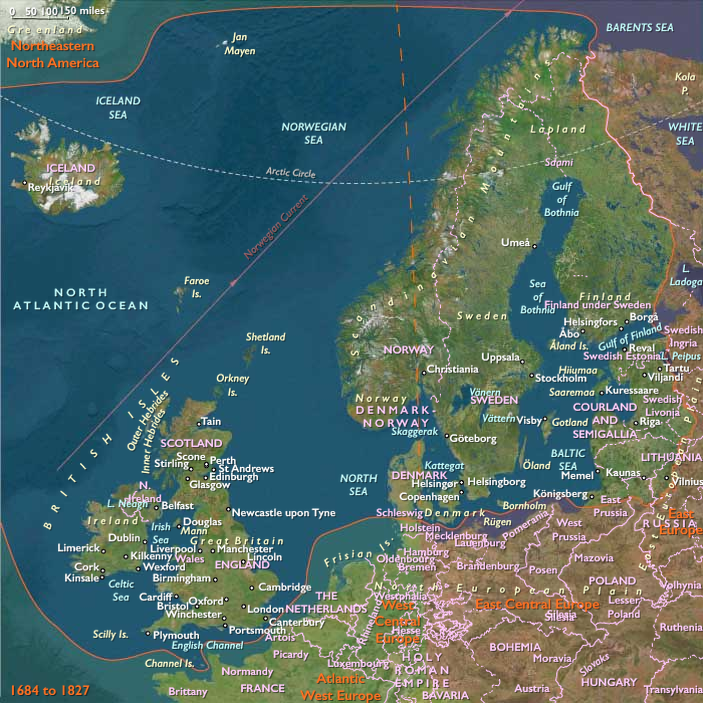
North Europe
View →Subregions