
The Near East, 1948 to 1959 CE:…
1948 CE to 1959 CE
The Near East, 1948 to 1959 CE: Decolonization, Conflict, and New National Realities
Independence and Conflict in Sudan
The period from 1948 to 1959 is marked by significant transformations in Sudan. On January 1, 1956, the British and Egyptian governments officially recognize Sudan's independence, with the United States among the earliest foreign powers to acknowledge the new state's sovereignty. However, tensions immediately arise as the Arab-led government in Khartoum fails to fulfill promises to southern leaders regarding the creation of a federal system. This breach triggers a mutiny by southern Sudanese army officers in 1955, igniting a protracted civil war that will persist until 1972. The early stages of this conflict are marked by severe violence, including massacres of hundreds of northern bureaucrats, teachers, and other officials stationed in the south.
Initially, the National Unionist Party (NUP), led by Prime Minister Ismail al-Azhari, dominates Sudan's first independent cabinet. This government is soon replaced by a coalition of more conservative political forces amid growing economic hardships and internal disputes. These troubles culminate in 1958, when Major General Ibrahim Abboud, Chief of Staff, seizes power in a bloodless military coup, suspending parliamentary democracy and imposing a military regime aimed at stabilizing the nation.
Egypt's Nationalist Resurgence and British Withdrawal
In Egypt, nationalist fervor intensifies as Prime Minister Mahmoud El Nokrashy demands the renegotiation of the Anglo-Egyptian Treaty and the immediate withdrawal of British forces. Britain's refusal leads to widespread civil unrest, characterized by student and worker riots and violent confrontations in Cairo and Alexandria. These tensions escalate into a broader call for a jihad against the British presence, spearheaded by groups like the Muslim Brotherhood.
The British Labour Party government under Prime Minister Clement Atlee agrees in principle to withdraw troops from Egyptian cities and bases by September 1949, but negotiations collapse over the unresolved status of Sudan. Although British troops eventually withdraw to the Suez Canal Zone, full resolution remains elusive, fueling ongoing nationalist tensions.
Arab-Israeli Conflict and Regional Tensions
The establishment of the State of Israel in 1948 dramatically reshapes the geopolitical landscape of the Near East. Violence between Jewish and Arab communities escalates sharply, resulting in the Arab-Israeli War of 1948. This conflict displaces hundreds of thousands of Palestinians, creating a refugee crisis that profoundly affects regional politics and socio-economic stability. The new Israeli state faces persistent hostility from neighboring Arab nations, embedding long-term divisions and confrontations in the regional dynamics.
Political Dynamics in Egypt
Internally, Egypt's political scene remains turbulent, dominated by the triangular interplay among the monarchy, the Wafd Party, and British interests. The Wafd, historically influential, is increasingly weakened by accusations of corruption and a perception of complicity with British interests. Radical nationalist groups, notably the Muslim Brotherhood and Young Egypt, grow stronger, advocating militant approaches to achieving independence and social reform.
Socioeconomic Developments in Sudan
Economically, Sudan undergoes significant changes with the implementation of the Gezira Scheme, initiated earlier in the century but greatly expanded in the 1950s. The scheme, supported by the Sudanese government and the private Sudan Plantations Syndicate, utilizes advanced irrigation techniques to significantly boost cotton production. The completion of an irrigation dam near Sennar in 1925 and further expansions during this period transform the Gezira region into Sudan's economic heartland, generating vital export revenues and spurring population growth.
Legacy of the Age: Foundations for Long-Term Conflict and Change
The era from 1948 to 1959 lays the groundwork for sustained political, social, and economic challenges in the Near East. Sudan's independence quickly reveals deep internal divisions, leading to a protracted and bloody civil war. In Egypt, nationalist forces intensify their demands for full sovereignty, setting the stage for future revolutionary movements. The establishment of Israel dramatically alters regional dynamics, embedding deep-seated conflicts whose consequences extend far beyond this period. Collectively, these developments underscore the profound transformations that characterize the Near East in the mid-twentieth century.
People
Groups
Topics
Commodities
Regions
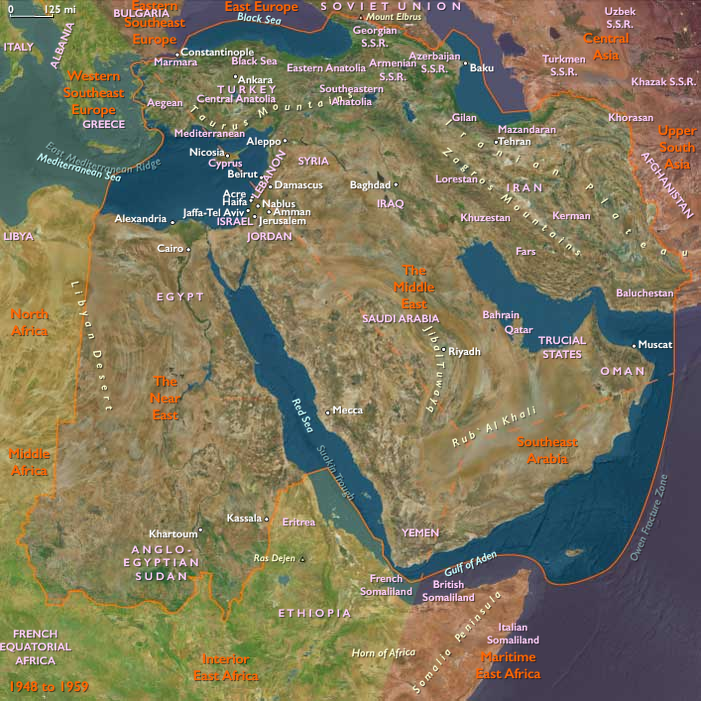
The Near and Middle East
View →Subregions
