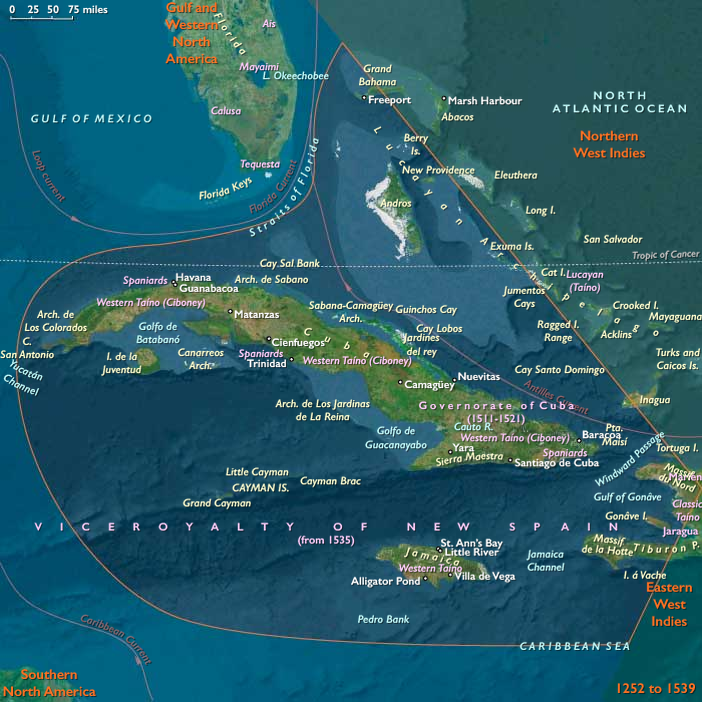
Knowledge about the early inhabitants of Cuba…
1396 CE to 1539 CE
Knowledge about the early inhabitants of Cuba is sketchy.
The people who inhabit the island at the time of Columbus's landing, estimated at about sixty thousand, have no written language.
Most of them, although peaceful, are annihilated, absorbed, or die out as a result of the shock of conquest.
Whatever information is available comes primarily from the writings of early explorers and from later archaeological discoveries and studies of village sites, burial places, and so forth.
These sources indicate that at least three cultures—the Guanahatabey, the Ciboney, and the Taino—swept through the island before the arrival of the Spaniards.
The first of these, the Guanahatabey, is the oldest culture on the island.
It is a shell culture, characterized by its use of shell gouge and spoon as its principal artifacts.
The Guanahatabey might have come from the south of the United States, for their artifacts display certain similarities with those of some early inhabitants of Florida, yet some archaeologists and anthropologists are more inclined to accept the theory that the Guanahatabey migrated from South America through the chain of islands in the West Indies until finally settling in Cuba.
By the time of the Spanish arrival, they have retreated to the most western part of Cuba.
The Guanahatabey build no houses and live mostly in caves.
They are fruit pickers and food gatherers and do little fishing or hunting.
They seem to have relied on mollusks as their principal foodstuff.
Their civilization apparently is in decline by the time the Europeans arrive.
People
Groups
Regions
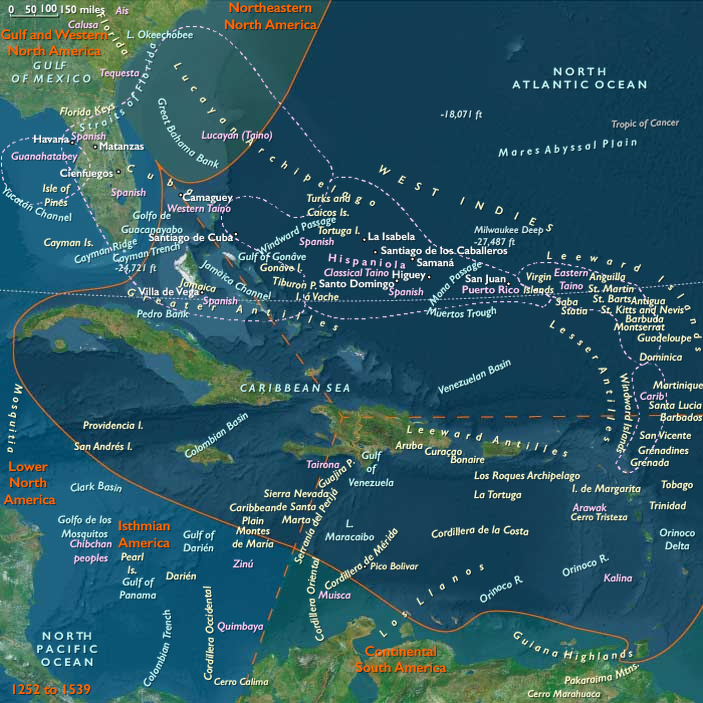
West Indies
View →Subregions