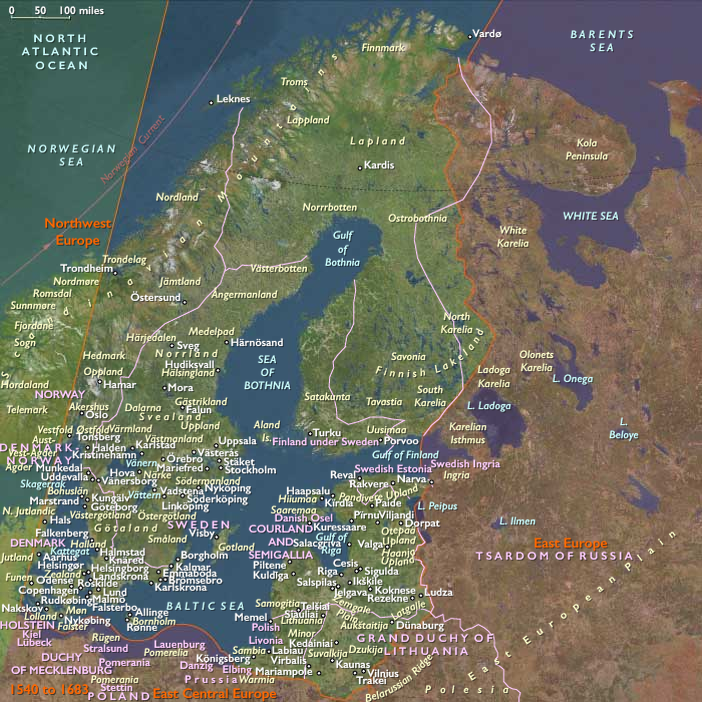
The origin of the Forest Finns lies…
1588 CE to 1599 CE
The origin of the Forest Finns lies in the Swedish colonization policy in Finland, a part of the Swedish Empire since the thirteenth century.
The powers to the east of Finland, Novgorod and later Russia, have constantly challenged the Swedish sovereignty of the often sparsely populated provinces of Eastern Finland.
To secure their realm, the Swedish kings, notably Gustav Vasa (r. 1528-60) and Eric XIV (r. 1561-8), have encouraged farmers to settle these vast wilderness regions, which in turn are used to the traditional slash-and-burn agriculture.
These settlements face several problems, from conflicts with the original populations of Sami people and Karelians to harsh conditions living in frontier lands during war times.
The fact that slash-and-burn itself requires a relatively low human population density or a continuing supply of new "frontier" lands, also causes overpopulation and by the late sixteenth century forces migration by Forest Finns from Savonia and Häme (Swedish: Tavastland).
The main part moves north to Ostrobothnia (Österbotten) and Kainuu (Kajanaland), east towards northern Karelia (Karelen), and south towards Ingria (Swedish land at that time, now part of Russia).
However, an estimated ten to fifteen percent cross the Baltic Sea in search of largely uninhabited lands suitable for their needs.
The first Forest Finn settlements in Sweden proper are established in Norrland, in the provinces of Gästrikland, Ångermanland and Hälsingland in the 1580s and 90s.
Locations
Groups
Subjects
Regions
North Europe
View →Subregions