Origins and Founding of the University of …
Years: 1134 - 1134
Origins and Founding of the University of Salamanca (1130–1134)
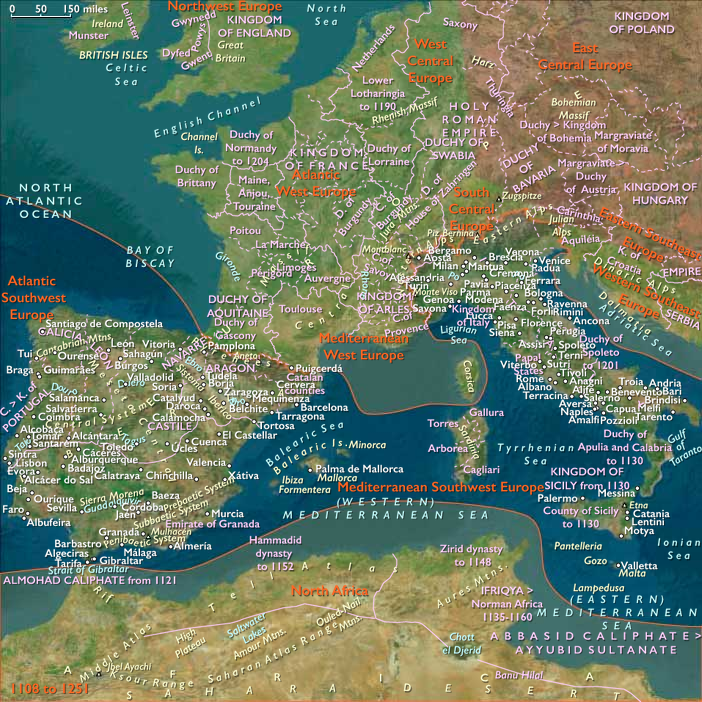
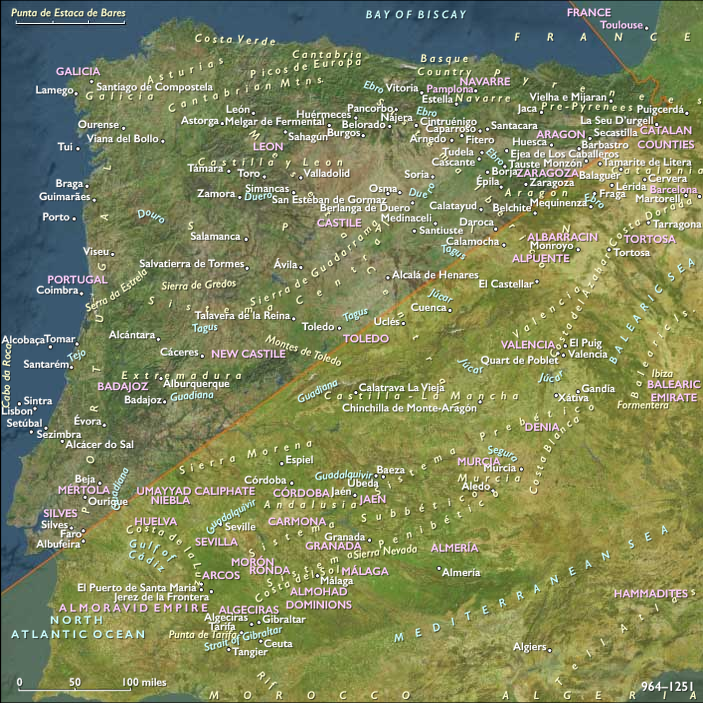
The University of Salamanca, like many of Europe's oldest centers of learning, traces its origins to a Cathedral School, which was already in existence by 1130. These ecclesiastical institutions served as the primary centers of higher education before the formal establishment of universities.
In 1134, the University of Salamanca was officially founded, marking the beginning of its transformation into one of the most prestigious academic institutions in the Iberian Peninsula. Over time, it would grow into a major center for scholarly and theological studies, playing a crucial role in the intellectual and cultural development of medieval Spain.
Locations
Groups
Topics
Subjects
Regions
Subregions
Related Events
Filter results
Showing 10 events out of 49152 total
Vsevolod leads an unsuccessful campaign in Vladimir in 1134, during which, according to the Novgorodians, he shows indecisiveness, one of the reasons for his dismissal a little over a year later.
Sknyatino, situated at the confluence of the Nerl and the Volga Rivers, about halfway between Uglich and Tver, is the site of the medieval town of Ksnyatin, founded by Yuri Dolgoruki in 1134 and named after his son Constantine.
Ksnyatin is intended as a fortress to defend the Nerl waterway, leading to Yuri's residence at Pereslavl-Zalessky, against Novgorodians.
The latter will sack it on several occasions, before the Mongols virtually annihilate the settlement in 1239.
Yaropolk has to deal with the many interests of his family, most of all his powerful half brother Yuri Dolgoruki.
Yaropolk had appointed Vsevolod Mstislavich to succeed him in Pereyaslav but Yuri Dolgoruki, with the consent of the Novgorodians, had soon driven out his nephew.
Yaropolk had appointed another son of Mstislav I: Iziaslav Mstislavich to Pereyaslav, who also received Turov.
He is replaced soon thereafter by Yaropolk's brother Viacheslav Vladimirovich.
The peace doesn't last.
Iziaslav has to transfer Turov to his uncle Viacheslav in 1134 to let him rule the principality once again.
Pereyaslav will come to Yuri Dolgoruki on the condition that Iziaslav is allowed to rule Rostov although Yuri keeps a large part of the principality under his influence.
Iziaslav also receives the rule over Volyn; another half brother of Yaropolk, Andrey Vladimirovich, is to rule Pereyaslav.
The German kings had reestablished control over the mixed Slav-inhabited lands on the eastern borders of the Holy Roman Empire in the beginning of the twelfth century.
Albert the Bear, son of Otto the Rich, count of Ballenstedt, and Eilika, daughter of Magnus Billung, Duke of Saxony, had on his father’s death in 1123 inherited his valuable estates in northern Saxony between the Harz Mountains and the middle reaches of the Elbe River.
The dynasty founded by Otto is known as the Ascanian House, named after the city of Aschersleben.
Albert has remained a loyal vassal of his relation, Lothair I, duke of Saxony, from whom, in about 1123, he had received the margravate of Lusatia, to the east; after Lothair became king of the Germans, Albert had in 1126 accompanied him on a disastrous expedition to Bohemia, where he had suffered a short imprisonment.
Albert's entanglements in Saxony stem from his desire to expand his inherited estates there.
His brother-in-law, Henry II, who had been margrave of a small area east of the junction of the Elbe and Havel rivers called the Saxon Northern March, or Nordmark, had died in 1128, and Albert, disappointed at not receiving this fief himself, had attacked Udo, the heir, and had consequently been deprived of Lusatia by Lothair.
In spite of this, he had gone to Italy in 1132 in the train of the king, and his services are rewarded in 1134 by the investiture of the Nordmark, the Holy Roman Empire's territorial organization on the conquered areas of the Wends, which was again without a ruler.
Lothair, while while battling the Hohenstaufens for control of the empire, encourages a policy of eastward expansion into Slavic lands and the conversion of the Slavs, by peaceful means or otherwise, to Christianity.
(Later historians will term this the Drang nach Osten, ”literally, “Drive to the East”).
A civil war had broken out in the Seljuq western territories at the death of sultan Mahmud II in 1131.
Zengi had been recalled to the East by certain rebel members, stimulated by the Caliph and Dubais.
Defeated, Zengi had fled.
The Caliph al-Mustarshid had pursued him to Mosul, and besieged him there but without success for three months.
It had nonetheless been a milestone in the revival of the military power of the caliphate.
Zengi now resumes operations in Syria and in 1134 lays siege to Damascus, but is induced, partly by the bravery of the enemy, partly at the instance of the Caliph, to whom Zengi had made some concession in the public prayers, to relinquish the attempt.
Recalled again by troubles in the East, he will be unable to do much against the Crusaders until after al-Mustarshid's death.
Jerusalem’s native nobles focus on Melisende's popular cousin, Hugh II de Le Puiset, count of Jaffa, who is devotedly loyal to the Queen.
After Hugh’s own stepson accuses him of disloyalty, Fulk, in order to expose his rival, in 1134 accuses him of infidelity with Melisende.
Hugh rebels in protest, secures his position in Jaffa, and allies himself with the Muslims of Ascalon.
He is able to defeat the army set against him by Fulk, but the Patriarch of Jerusalem intercedes in the conflict, perhaps at Melisende's behest.
Fulk agree to peace and Hugh receives a lenient three-year exile from the kingdom.
When an assassination attempt is made against Hugh, Fulk or his supporters are commonly believed responsible, though direct proof is never offered.
The scandal provides the pretext for the queen's party to take over the government in what is effectively a palace coup, giving Melisende direct and unquestioned control over the government.
Abu al-Salt has written an encyclopedic work of many treatises on the scientific disciplines known as quadrivium.
This work is probably known in Arabic as Kitāb al‐kāfī fī al‐ʿulūm.
His interests also include alchemy as well as the study of medicinal plants.
He is keen to discover an elixir able to transmute copper into gold and tin into silver.
His writings include Risāla fī al-amal bi‐l‐astrulab ("On the construction and use of the astrolabe"); a description of the three instruments known as the Andalusian equatoria; Ṣifat ʿamal ṣafīḥa jāmiʿa taqawwama bi‐hā jamīʿ al‐kawākib al‐sabʿa ("Description of the construction and Use of a Single Plate with which the totality of the motions of the seven planets"), where the seven planets refer to Mercury, Venus, earth, Moon, Mars, Jupiter, and Saturn; Kitāb al‐wajīz fī ʿilm al‐hayʾa ("Brief treatise on cosmology"); Ajwiba ʿan masāʾil suʾila ʿan‐ha fa‐ajāba or Ajwiba ʿan masāʾil fī al‐kawn wa‐ʾl‐ḥabīʿa wa‐ʾl‐ḥisāb ("Solution to questions on cosmology, physics, and arithmetic"); an introduction to astronomy; and A Summary of Ptolemy's Almagest.
Abu al-Salt was born in Denia, al-Andalus.After the death of his father while he was a child, he had become a student of al‐Waqqashi (1017–1095) of Toledo (a colleague of Al-Zarqali).
Upon completing his mathematical education in Seville, and because of the continuing conflicts during the reconquista, he had set out with his family to Alexandria and then Cairo in 1096.
In Cairo, he had entered the service of the Fatimid ruler Abū Tamīm Ma'add al-Mustanṣir bi-llāh and the Vizier Al-Afdal Shahanshah.
His service had continued until 1108, when, according to Ibn Abī Uṣaybiʿa, his attempt to retrieve a very large Felucca laden with copper, that had capsized in the Nile River, ended in failure.
Abu al-Salt had built a mechanical tool to retrieve the Felucca, and was close to success when the machine's silk ropes fractured.
The Vizier Al-Afdal had ordered Abu al-Salt's arrest, and he was imprisoned for more than three years, only to be released in 1112.
Abu al-Salthad then left Egypt for Kairouan in Tunisia, where he had entered the service of the Zirids in Ifriqiya.
He also occasionally travels to Palermo and works in the court of Roger I of Sicily as a visiting physician.
He dies in 1134 in Bejaia, in present Algeria.

The first abbey at Buckfast had been founded as a Benedictine monastery in 1018, believed to have been founded by either Aethelweard (Aylward), Earldorman of Devon, or King Cnut.
This first monastery was "was small and unprosperous", and it is unknown where exactly is was located.
The abbey is established in its current position in 1134 or 1136; King Stephen having granted Buckfast to the French Abbot of Savigny.
This second abbey is home to Savignac monks.
Eric, born around 1090 to king Eric I of Denmark and an unknown concubine, had been given some Danish isles by his half-brother Canute Lavard, and was jarl of Møn, Lolland, and Falster.
When Lavard was murdered in 1131, Eric had joined his half-brother Harald Kesja in a rebellion against the responsible king Niels of Denmark.
Eric had been elected Danish Antiking in Scania in April 1131, prompting Kesja to support Niels in jealousy.
Eric's army had lost several battles against Niels and his son Magnus the Strong, including Jelling in Jutland in 1131 and Værbro on Zealand, and he had fled to Scania.
His retreat had earned him the nickname Harefoot.
Eric had unsuccessfully tried to convince Lothair III, Holy Roman Emperor, to support his bid for kingship, and had had no luck asking Magnus IV of Norway for help.
He returns to Scania in 1134, where Archbishop Asser of Lund joins his cause, and Lothair eventually supports him as well.
Magnus, Margaret Fredulka’s son by King Niels of Denmark, had in 1125 claimed the Swedish throne as the eldest grandson of Inge the Elder at the death of Margaret's first cousin King Inge the Younger.
Magnus had been recognized by the Geats (Göterna) of Gothenland, but according to the Westrogothic law, had to be accepted also by the Swea, another tribe to the north of the Geats.
The Swea, however, had selected Ragnvald Knaphövde.
According to Saxo Grammaticus, Ragnvald had shown disrespect towards the Geats by not taking a Geat hostage.
As retaliation, Ragnvald had been murdered by Magnus's supporters not long after.
Magnus in around 1127 had married Richeza, daughter of Boleslaw III of Poland.
Magnus had in 1130 backed Boleslaw III in conquering Rügen.
The Polish forces, together with a Danish fleet, had compelled the Rani to recognize Polish rule over the island.
Magnus is not mentioned as King in the law of Västergötland and was probably ousted from Sweden by his successor Sverker I of Sweden around 1130.
Magnus had in 1131 arranged the murder of his cousin and potential rival for the Danish throne, Canute Lavard, in order to position himself as heir presumptive to his father King Niels.
Although Magnus is eventually backed by Niels, he finds himself in a civil war against Lavard's half-brother Eric Emune.
King Niels has his strongest base of support in Jutland, and the church also supports him.
Moreover, he has secured support from the Holy Roman Empire by agreeing to subordinate the Danish Archdiocese of Lund in Scania to the German Archdiocese of Hamburg-Bremen, which had prompted Archbishop Asser of Lund to support Eric.