The original lands of the Paeonians, who …
Years: 489BCE - 478BCE
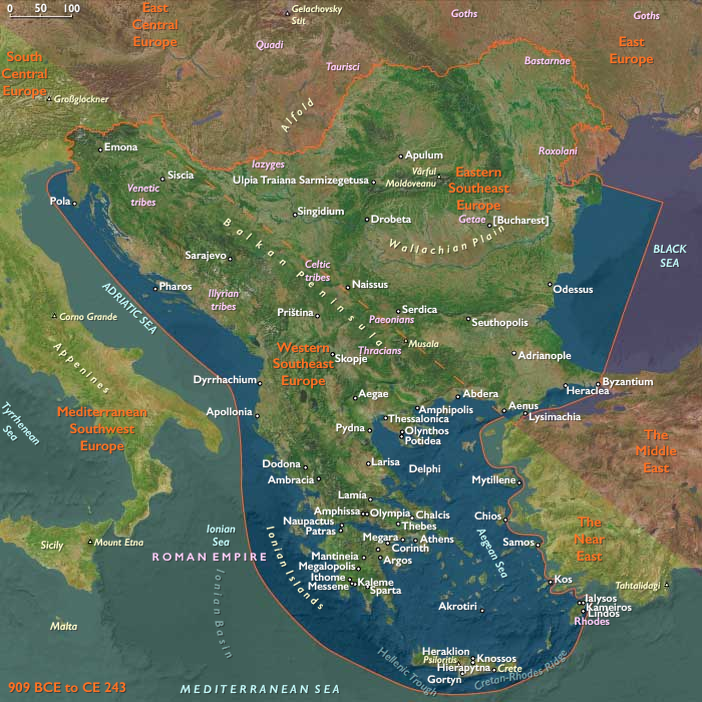
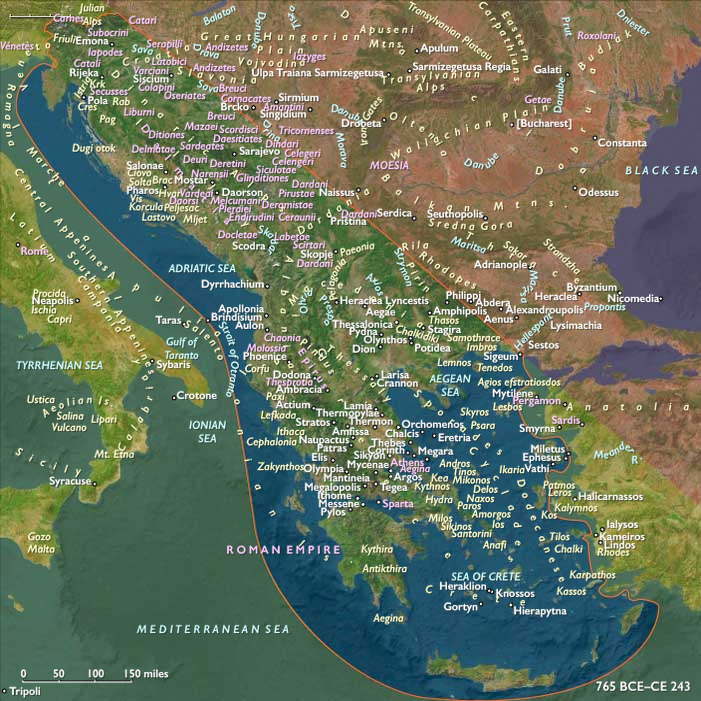
The original lands of the Paeonians, who are probably of mixed Thraco-Illyrian origin, include the whole Axius (Vardar) River valley and the surrounding areas, in what is now northern Greece, Macedonia, and western Bulgaria.
The Paeonians have been weakened by the Persian invasion of 490 BCE, and …
Locations
Groups
- Thracians
- Greece, classical
- Illyria, classical
- Paenonia (kingdom )
- Achaemenid, or First Persian, Empire
Topics
- Younger Subboreal Period
- Iron Age Europe
- Iron Age Cold Epoch
- Classical antiquity
- Greco-Persian Wars, Early
Commodoties
Subjects
Regions
Subregions
Related Events
Filter results
Showing 10 events out of 65624 total
China’s so-called “Spring and Autumn Period” ends in 476 BCE (or, by some authorities, in 403 BCE).
After the king of Wú died during an invasion of Yuè (496 BCE), his son, King Fuchāi of Wú, had nearly destroyed the Yuè state, defeated Qí, and threatened Jìn.
In 482 BCE, King Fuchāi holds an interstate conference to solidify his power base, but Yuè captures the Wú capital.
Fuchāi rushes back but is besieged by the Yue forces.
Panticapeum (modern Kerch), the major city of the Kingdom of the Bosporus situated on Kerch Strait in present-day southern Ukraine, comes under the rule of the Greek Archaeanactid dynasty in 480 BCE.
During the first centuries of the city's existence, imported Greek articles predominate: pottery, terra cotta works, and metal objects, probably from workshops in Rhodes, Corinth, Samos, and Athens.
Local production, imitated from the models, is carried on at the same time.
Athens manufactures a special type of bowl for the city, known as Kerch ware.
Local potters imitate the Hellenistic bowls known as the Gnathia style as well as relief wares—Megarian bowls.
The city mints silver coins from the mid-sixth century BCE.
The Middle East: 489–478 BCE
Transition and the Rise of Xerxes
Following the Persian defeat at Marathon in 490 BCE, Darius I is deeply committed to avenging the empire’s setback and begins meticulous preparations for a renewed offensive against the Greek city-states. However, these plans are interrupted by his death in 486 BCE, passing the throne to his son Xerxes I.
Xerxes immediately inherits not only his father’s expansive empire but also his intense ambition to subdue Greece. Early in his reign, Xerxes confronts rebellions in Egypt and Babylonia, swiftly suppressing them to reaffirm Persian authority. His decisive actions solidify his position and secure internal stability, setting the stage for a grand campaign against Greece.
Xerxes continues Darius's extensive infrastructural developments, notably completing construction at Persepolis, where monumental architecture epitomizes Persian grandeur and imperial authority. He invests heavily in military and logistical preparations, amassing resources and manpower on an unprecedented scale.
In 480 BCE, Xerxes leads a vast Persian army into Greece, sparking a series of iconic battles—Thermopylae, Artemisium, and Salamis—that profoundly shape the historical trajectory of both Greece and Persia. The Greek resistance, particularly the naval triumph at Salamis, significantly hinders Xerxes’ ambitions, marking a turning point in the Greco-Persian conflicts.
Despite initial successes, the Persian invasion ultimately fails, forcing Xerxes to retreat in 479 BCE. This defeat not only halts Persian expansion westward but also emboldens Greek confidence, laying the foundation for future Greek dominance in the Mediterranean region. The period thus concludes with Persia maintaining its vast territories, yet forced to reassess its ambitions toward Greece, signaling a critical transition in Middle Eastern geopolitics.
Buddha, having continued his ministry for forty-five years, dies around 480 at the age of eighty, after which he is supposed to have entered final nirvana.
His body is cremated.
Buddha’s community of followers, the sangha, immediately faces the critical question of what it is to do in the absence of the master.
Those followers who have remained householders enshrine his bodily relics in monuments called stupas, inaugurating a cult of devotion to the person of the Buddha.
(The practice, bhakti, will focus not only on stupas but on many holy sites, such as the bodhi tree, which become centers of pilgrimage, and eventually on Buddha images as well).
Those Buddhists who had become monks and nuns undertake the gathering and preservation of the dharma, their master's teachings.
According to tradition (the historicity of which many scholars contest), five hundred enlightened monks meet immediately after the Buddha's death in a great council at Rajagriha, where all the sutras (the Buddha's sermons) and the vinaya (the rules of the discipline) are remembered and recited.
Near East (489–478 BCE): Heraclitus and the Quest for Understanding
Heraclitus and Philosophical Innovation
This era witnesses the intellectual prominence of Heraclitus of Ephesus, a philosopher whose innovative and enigmatic teachings profoundly influence Greek philosophical tradition. Flourishing in the early fifth century BCE, Heraclitus introduces a deeper self-consciousness regarding method and language into philosophical inquiry. Emphasizing introspection and self-awareness, he urges meticulous attention to the polarities and concealed structures inherent in language, suggesting that understanding the world requires first understanding oneself and the faculties through which knowledge is gained.
Heraclitus is especially notable for his theory concerning the nature of identity and change. He famously illustrates this through his assertion that an individual can and cannot step into the same river twice: though the river’s waters are continuously changing, its essential identity persists. This insightful paradox encapsulates his central teaching that reality is in constant flux, and stability is but an apparent condition amidst perpetual change.
Central Concepts: Fire and the Logos
According to Heraclitus, fire symbolizes the primary and central element of the cosmos, representing constant transformation. Fire’s ceaselessly active nature embodies his vision of a world without definitive beginning or end, continuously evolving through cycles of destruction and rebirth.
Equally significant is Heraclitus’s concept of the logos, an underlying rational principle governing the cosmos. The logos, universal and ever-present, maintains order amidst perpetual change and connects all phenomena in harmonious tension. This concept profoundly influences later philosophical and theological thought, shaping ideas about reason, language, and cosmic unity for centuries to come.
Heraclitus and the Human Soul
Breaking from earlier Greek philosophy, Heraclitus presents the first developed theory of the human soul, highlighting its creative and transformative capabilities. His exploration of human consciousness and perception emphasizes the importance of recognizing hidden relationships and balances within oneself and the broader cosmos.
Intellectual Legacy and Challenges
More than one hundred of Heraclitus’s aphorisms survive, notable for their compressed, cryptic, and paradoxical style. The dense nature of his thought has challenged interpreters throughout history, inviting numerous and diverse readings. Nevertheless, Heraclitus’s insistence on flux, dialectical tension, and the centrality of reason provides foundational concepts that guide philosophical inquiry well beyond his own time.
Broader Context: Greek and Near Eastern Dynamics
While Heraclitus advances philosophy in Ephesus, the broader Near East and Aegean regions undergo significant political realignments in the aftermath of the Persian defeat at Marathon (490 BCE). The Persian Empire, under Xerxes I, reorganizes itself, preparing to mount a renewed campaign against Greece. Simultaneously, Greek city-states, buoyed by their recent victory, enter a phase of unprecedented cultural and political self-confidence. These developments set the stage for monumental conflicts and transformations, as the Near Eastern and Greek worlds become increasingly intertwined.
Era’s Enduring Influence
This era, thus marked by Heraclitus’s profound philosophical reflections and the dynamic geopolitical shifts following Marathon, becomes a watershed period. Heraclitus's teachings not only lay essential groundwork for later philosophical traditions but also reflect and influence the era’s intellectual atmosphere—a complex interplay of continuity and change, unity and diversity—that continues to resonate in philosophical and historical scholarship.
Heraclitus of Ephesus, who flourishes in the early fifth century BCE, introduces into philosophy a new self-consciousness about method and language, urging close attention to the polarities and concealed structures embodied in language.
Addressing the importance of self-exploration, he develops a new self-critical interest in the faculties used to gain knowledge.
He is the first Greek to develop a theory of the human soul, extolling its creative resources.
Displaying an interest in criteria of identity and unity, he makes his famous claim that an individual can and cannot step into the same river twice, because, even though all the river’s material constituents have in some way transformed, it is still, in a sense, the same river.
He declares fire to be the central element of the universe and holds the universe as being ruled by the logos, common to all. (Over on hundred of his enigmatic aphorisms survive in different sources, but his compressed and cryptic style has made interpretation difficult.)
Preoccupied with change, Heraclitus postulates a world with no beginning and no end.
…those tribes living along the Strymon River (in present western Bulgaria) fall under Thracian control.
The influential Athenian Greek vase painter Douris, who flourishes in the early fifth century BCE, works in the Red Figure style for three potters: Euphronius, Kleophrades, and Python, mostly for the last.
A prolific and skillful, if unoriginal painter, Douris generally prefers genre subjects but also paints mythological scenes, and his work displays an interest in spatial illusion and the female nude.
Douris signs thirty-nine known vases over his long career; approximately three hundred others have been attributed to him.
Mediterranean Southwest Europe (489–478 BCE):
Roman Consolidation, Greek-Carthaginian Relations, and Etruscan Decline
Between 489–478 BCE, Mediterranean Southwest Europe experiences significant shifts marked by Rome’s political stabilization, dynamic interactions between Carthaginian and Greek city-states, and signs of gradual Etruscan decline.
Roman Political and Military Strengthening
During this era, the Roman Republic solidifies its political foundations and military strength. In 486 BCE, Rome successfully engages and defeats the Volsci and the Aequi, securing regional stability in Latium. These victories allow Rome to reinforce its political influence and assert its leadership within the Latin League, laying groundwork for future territorial expansion.
Carthaginian and Greek Dynamics in Sicily
In 483 BCE, Gelo, now the powerful ruler of Gela, extends his influence by seizing the prominent city of Syracuse, becoming its tyrant and significantly consolidating Greek power in Sicily. This realignment heightens tensions with Carthaginian interests, notably around Carthaginian-aligned cities such as Motya, Panormus (Palermo), and Solus. Despite their rivalry, limited diplomatic engagements suggest cautious coexistence, as both Greek and Carthaginian powers seek to stabilize their respective territorial claims.
Decline of Etruscan Dominance
Etruscan influence, prominent earlier in the century, begins to wane. In 479 BCE, the city of Veii suffers defeat in a conflict with Rome, symbolizing diminishing Etruscan military prowess and political influence. Although Etruscan cities remain culturally significant, Rome’s growing assertiveness foreshadows a broader Etruscan decline in the coming decades.
Cultural and Artistic Continuity
Despite political and military upheavals, Mediterranean Southwest Europe continues its vibrant cultural development. Etruscan artisans maintain their renowned artistic traditions, notably producing bronze mirrors and sculptures characterized by sophisticated craftsmanship. Concurrently, Greek colonies in southern Italy and Sicily remain important cultural centers, sustaining flourishing artistic and intellectual exchanges with mainland Greece.
Legacy of the Era
The years 489–478 BCE establish critical precedents for the region’s future. Rome’s internal stability and external assertiveness, the cautious Greek-Carthaginian diplomacy, and early indications of Etruscan decline collectively influence Mediterranean Southwest Europe's evolving geopolitical landscape, setting the stage for subsequent transformations.
North Africa (489–478 BCE)
Carthaginian Dominance, Strategic Rivalries, and Regional Development
Carthage’s Continued Expansion and Military Strength
From 489 to 478 BCE, Carthage further asserts its influence across the Western Mediterranean, continuing its strategic expansion in western Sicily, Sardinia, and the Balearic Islands. Under continued leadership of the Magonid dynasty, Carthage’s powerful naval forces and extensive mercenary armies—including significant Greek contingents—ensure protection of its vital maritime trade routes and colonies, securing regional dominance.
Carthage, consistently seeking to remove Greek opposition, might have even considered an alliance with the Persian king Xerxes—though historical accounts remain uncertain—aimed at jointly defeating their common enemy. However, thwarted by persistent Greek resistance in Sicily, Carthage increasingly redirects its attention to consolidating control over North African territories, extending from west of Cyrene to the Straits of Gibraltar.
Diplomatic Maneuvering and Conflict in Sicily
Diplomatic relations remain essential to Carthaginian strategy, yet tensions and conflict with Greek city-states escalate, particularly on Sicily. Ongoing competition for control of this strategically critical island prompts intensified military engagements. Gelo, ruler of Syracuse, emerges as a particularly formidable opponent, maintaining effective resistance to Carthaginian ambitions. Battles during this period underline Carthage’s resolve to maintain its economic and strategic footholds against Greek incursions.
Cyrene’s Sustained Prosperity and Expansion
Cyrene continues its economic and cultural flourishing, reinforced by strong exports of grain, fruit, horses, and particularly the prized medicinal plant Silphium. Its wealth drives ongoing construction projects, prominently featuring temples and civic structures, signifying sustained prosperity. The interconnected cities of the Pentapolis—Barce (al-Marj), Taucheira (Tukrah), and Euhesperides (Benghazi)—further strengthen their regional importance through independent economic success and cultural integration.
Deepening Berber Integration and Autonomy
Coastal Berber communities remain deeply enmeshed in Carthaginian trade networks, leveraging advanced Phoenician agricultural practices, maritime skills, and artisanal crafts. Economic integration enhances coastal prosperity and reinforces stability while preserving distinct Berber cultural identities. Inland Berber populations, largely insulated from direct coastal political dynamics, maintain traditional social structures and continue to benefit indirectly from expanded regional trade.
Cultural Vibrancy and Religious Syncretism
Cultural interactions among Berber, Carthaginian, and Greek communities continue to thrive, enriching regional artistic and artisanal traditions. Hybrid cultural forms flourish notably in pottery, textiles, and metalwork. Religious syncretism expands further, integrating Berber spiritual beliefs with Phoenician and Greek traditions, underscoring the region’s complex cultural identity.
Foundation for Ongoing Influence
By 478 BCE, North Africa remains politically stable and economically vibrant, supported by Carthaginian maritime dominance, Cyrene’s continued prosperity, and thriving integrated Berber communities. Diplomatic and military strategies effectively manage regional tensions, laying a robust foundation for continued regional prominence and enduring influence within the broader Mediterranean geopolitical landscape.

Years: 489BCE - 478BCE
Locations
Groups
- Thracians
- Greece, classical
- Illyria, classical
- Paenonia (kingdom )
- Achaemenid, or First Persian, Empire
Topics
- Younger Subboreal Period
- Iron Age Europe
- Iron Age Cold Epoch
- Classical antiquity
- Greco-Persian Wars, Early