
The origins of the family owned construction…
578 CE
The origins of the family owned construction company Kongō Gumi Co., Ltd., in 2006 the world's oldest continuously operating company, date to the year 578, when Prince Shotoku brings Kongō family members from Baekje, Korea to Japan to build the Buddhist Shitennoji Temple, which still stands today.
Locations
Groups
Topics
Regions
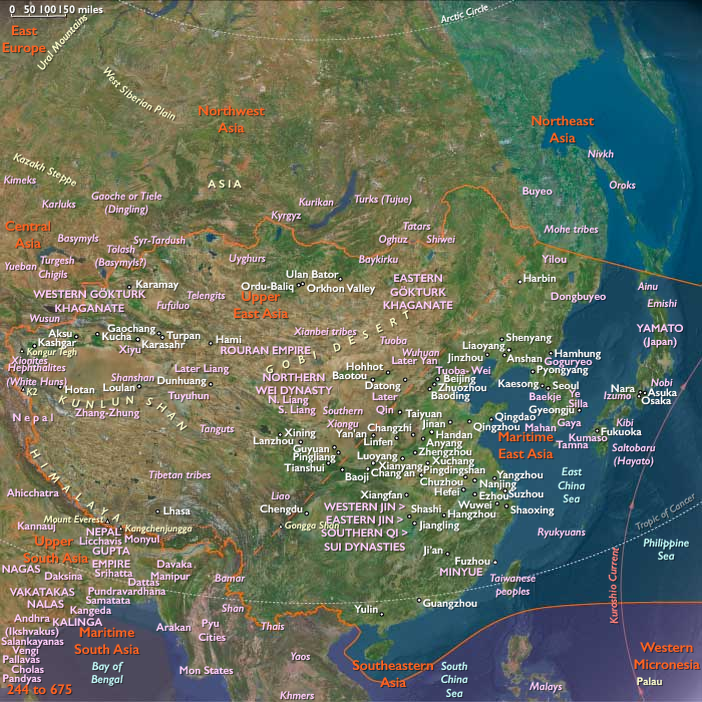
East Asia
View →Subregions
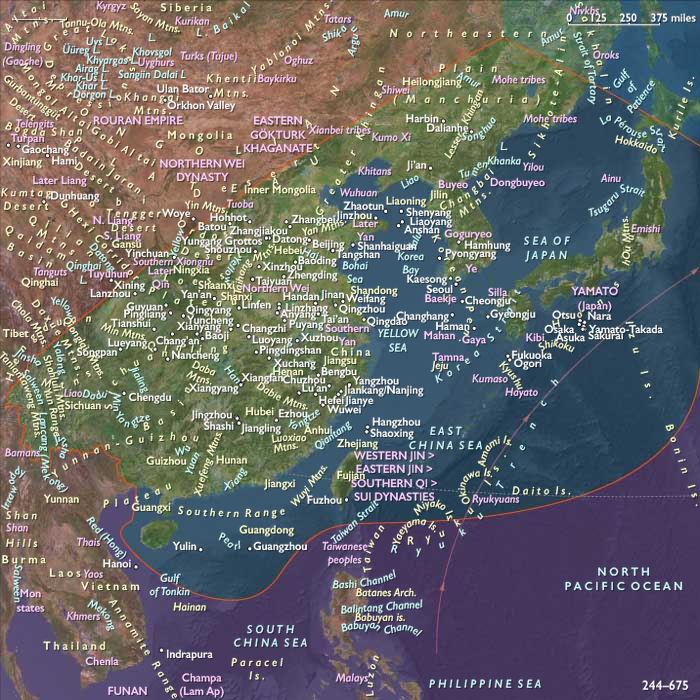
Maritime East Asia
View →Related Events
No active filters.
Showing 10 events out of 57408 total
The Korean kingdom of Baekje under its king, Wideok, who has reigned since the disastrous battle of Gwan Mountain Fortress in 554, in which his father and nearly thirty thousand men died fighting the Silla army, is inimical to both Silla and Goguryeo, launching various battles and border incursions against the rival kingdoms.
To avoid isolation, and to strengthen the royal position against the power of the aristocracy, Wideok maintains friendly relations with the Chinese dynasties of Chen and Northern Qi.
Although ties had been largely broken following the cataclysmic events of the 550s, he had in 567 sent Baekje's first mission to Northern Qi; this may have been facilitated by an improved relationship with Goguryeo.
In 570, the Northern Qi had granted him titles including "Duke of Daifang prefecture", and he had sent another tribute mission in 572.
After Northern Qi had been conquered by Northern Zhou in 577, Baekje had also sent a congratulatory mission including musicians to the Zhou court.
The following year a second and final embassy is sent to Northern Zhou.
The special privileges of China’s Buddhist monasteries (such as exemption from taxes) had again become a main source of tension between clergy and government and led to another round of anti-Buddhist movements and harsh restrictive measures imposed upon the Buddhist church from 574 to 578.
Justin's successor, crowned by him Tiberius II Constantinus on September 26, 578, nine days before the death of Justin himself, removes the taxes and, choosing between his enemies, awards subsidies to the Avars while taking military action against the Persians.
Constantinople and Persia now enter into peace negotiations to settle the Armenian question.
Tiberius, to increase his popularity, immediately begins spending money that Justin had reserved in his treasury.
Jacob (James) Baradai, Monophysite Christian bishop of Edessa, organizes a separate church, which comes to be called Jacobite, in opposition to the Orthodox episcopate of Eastern Christendom.
The Jacobite church, together with the Copts of Egypt, the Armenians, and the Ethiopians, rejects the doctrine of the 451 Council of Chalcedon on the "two natures in one person" of Christ and prefers to define Christ's person as "one nature."
Jacob dies in Homs, Syria, in 578.
Greece had experienced a raid in Macedonia in 479 and another in 482 by the Ostrogoths under their king, Theodoric the Great.
The Bulgars in 540 and on repeated other occasions had raided Thrace and the rest of northern Greece.
These continuing Bulgar incursions had required the Empire to protect Constantinople by building the "Anastasian Wall," which extends for some thirty miles, or more, from the city of Selymbria (now Silivri) to the Black Sea.
There is no such protection, however, for the provinces in front of the walls.
The Huns and Bulgars in 559 had raided Greece until the imperial army returned from Italy, where Justinian I had been attempting to capture the heart of the Roman Empire.
The Slavs, alone or in association with the Kutrigur Bulgars, have steadily occupied imperial lands in the Balkan peninsula in the fifty years since their initial occupation of lands south of the Danube.
Already a presence in Thrace, Macedonia, Epirus, and Thessaly, the Slavs have by 578 penetrated as far as Achaea in the Peloponnese.
Basque highland clans from the Pyrenees driven northward by the Visigoths in 578 settle in Novempopulana (that is, "land of the nine tribes"), which has been under loose Frankish control since 507.
Novempopulana will become known as Vasconia (that is, "land of the Vascones", the Latin word "Vasco" later evolving into the word "Basque").
The word Vasconia will evolve into Wasconia, and then into Gasconia, or Gascony.
Further campaigns to control independent territories had lasted another four years after the Visigothic campaigns in Toledo and Évora.
Hermenegild, who had been raised in the Arian belief, is sent by Liuvigild to Seville.
Hermenegild's Frankish wife Ingund, who is Catholic, has been pressured by Leovigild's wife Goiswinth, but she will not abandon her faith.
The musical performance tradition of the Christian Church has grown out of the liturgical tradition of Judaism.
The melodic formulas for the singing of psalms and the sung recitation of other scriptural passages are clearly based on Hebraic models.
Music in the Roman Catholic liturgy is performed mainly for the mass.
Originally, the music had been performed by the priest and the congregation, until, in time, there emerged from the congregation a special group of singers, called the choir, who assumed the musical role of answering and contrasting the solo singing of the priest.
Women have participated actively in musical performances in the ancient Christian Church until 578, when older Hebraic practices excluding them are restored.
From this time until the twentieth century, Roman Catholic Church choirs will be composed solely of men and boys.
Frankish Rule in Eastern Brittany and Breton Raids (6th Century CE)
During the sixth century, the Franks maintain control over eastern Brittany, integrating it into their expanding kingdom. However, they must continually defend their territory against Breton raids, as the Bretons establish heavily populated settlements in the western part of the peninsula.
1. Frankish Control of Eastern Brittany
- Following Clovis I’s expansion, the eastern part of Brittany comes under Frankish rule, particularly along the borderlands near Rennes, Nantes, and Vannes.
- The Franks establish military outposts and administrative centers, securing nominal control over the region.
- Frankish influence is strongest in the bishoprics of eastern Brittany, where the Church plays a key role in governance.
2. Breton Settlements and Raids
- Since the fifth century, Romano-British migrants fleeing Anglo-Saxon invasions have settled in western Brittany (now known as Bretagne), where they establish independent Breton-speaking communities.
- These settlements, heavily populated and culturally distinct, resist Frankish integration and retain strong ties to Britain.
- The Bretons frequently launch raids into Frankish-controlled territories, challenging Frankish rule along the eastern frontier.
3. The Ongoing Frankish-Breton Conflict
- The Franks struggle to maintain full control, as Breton resistance remains strong in the western part of the peninsula.
- Neustrian kings, such as Chilperic I and his successors, periodically attempt to subdue the Bretons, but with limited success.
- The conflict continues for centuries, shaping the political and cultural divide between Frankish-controlled eastern Brittany and independent Breton western settlements.
Conclusion: A Divided Peninsula
Despite Frankish control of the eastern region, Brittany remains a divided land, with the Bretons in the west maintaining their independence and launching raids against Frankish territories. This ongoing struggle defines the relationship between the Franks and Bretons for centuries, contributing to the eventual rise of the independent Duchy of Brittany in the medieval period.