
The other two forces achieve little of …
Years: 831 - 831
The other two forces achieve little of consequence in the already repeatedly devastated area, but Abbas meets with more success: he forces the town of Tyana to capitulate and razed it, and met and defeats the imperial army under the emperor Theophilos in a minor skirmish.
Locations
People
Groups
- Arab people
- Greeks, Medieval (Byzantines)
- Anatolic Theme
- Armeniac Theme
- Abbasid Caliphate (Baghdad)
- Roman Empire, Eastern: Phrygian or Armorian dynasty
Topics
Commodoties
Subjects
Regions
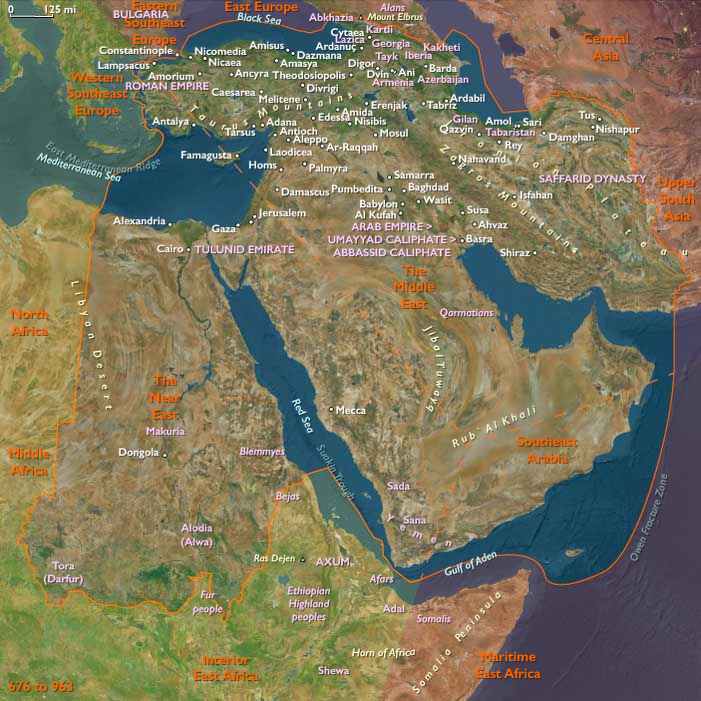
Subregions
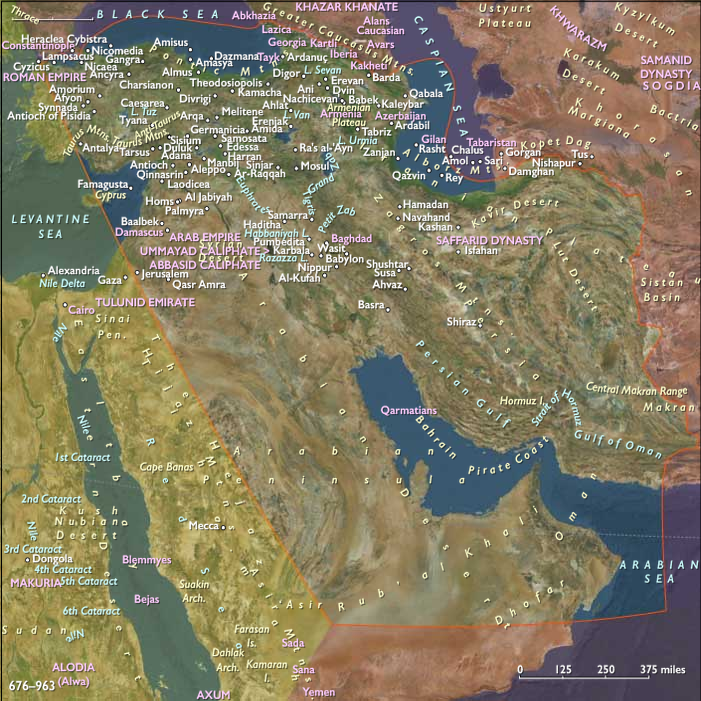
Related Events
Filter results
Showing 10 events out of 54358 total
The anti-Islam Khurramites, an Iranian religious and political movement which had appeared in Azerbaijan and the rest of Iran in 814, had been founded by the Persian cleric Sunpadh and is a revitalization of an earlier sect that had mixed Shi'ism and Zoroastrianism; however, its true claim to fame is its adoption by Bābak Khorram-Din as a basis for rebelling against the Abbasid Caliphate.
The sect had grown out of a response to the Abbasids’ execution of Abū Muslim of Khurasan, a famous and popular Persian nationalist, and its adherents deny that he had died, rather claiming that he would return as the messiah.
This message had been further confirmed by the appearance of a prophet named al-Muqanna who claimed that the spirit of God had existed in Muhammad, Ali and Abu Muslim.
Under the leadership of Bābak, the Khurammites had proclaimed the breakup and redistribution of all the great estates and the abolition of Islam.
They had begun making attacks on Muslim forces in Iran and Iraq in 816.
These continue, as the Khurramites fight hey not only against the Caliphate, but also for the preservation of Persian language and culture.
The sect, known alternatively as Muhammrira, "those who wear a red headgear"— a reference to their symbolic red headgear, will continue to attract followers until the sixteenth century when the Safavids take control of Iran and reasserted the Iranian identity of the region, thus becoming the first native dynasty since the Sassanids to establish a unified Iranian state.
(According to Turkish scholar Abdülbaki Gölpinarli, the "Kizilbash" ("Red-Heads"), a religious and political movement in Azerbaijan that helped to establish the Safavid dynasty, were "spiritual descendants of the Khurramites".)
Abbas is the only son of Ma'mun, who in 828–829 had appointed him as governor of Al-Jazira (Upper Mesopotamia) and the Mesopotamian military frontier zone (thughur) with the Empire.
Abbas had distinguished himself by his bravery in the expeditions against the imperial forces.
An expedition led by Abbas against the Khurramite rebels of Babak Khorramd in in Azerbaijan in summer 830 had been accompanied by a contingent of Greek captives under the renegade general Manuel the Armenian, who, given Abbas's relative inexperience, may have been the actual commander of the army.
Abbas's force had met with some success against the Khurramites, and began its return.
As it passed near the frontier at Adata, Manuel, having earned the confidence of Abbas and his Arab officers, had persuaded Abbas to cross the nearby passes and raid imperial territory.
Once there, Manuel had taken advantage of a hunt to disarm Abbas and his entourage and defect back to the Empire, along with some of the other captives.
Abbas with his men had been left behind and after rejoining their army, they had retreated back over the mountains into the Caliphate.
In the next year, however, Abbas accompanies his father and uncle in a major expedition into imperial Anatolia.
After the Arab army crosses the Cilician Gates and takes Heraclea Cybistra in early July, it divides in three corps, headed by the Caliph, Mu'tasim and Abbas, and proceeds to raid across Cappadocia.
Iran’s native Tahirid dynasty, which had come to power in 821, rules increasingly independent of the Abbasid caliphate’s central government.
The lands in the east of Persia that had been awarded by Caliph al-Ma'mun to the dynast Tahir ibn Husayn, who had been succeeded on his death in 822 by his son Taljha, will subsequently be extended by his successors as far as the borders of India until their overthrow by the Saffarid dynasty, who in 873 will annex Khurasan to their own empire in eastern Persia.
Talha’s governorship had lasted until 828.
Tahir's other son, Abdullah, had been instated as the wali of Egypt and the Arabian Peninsula, and when Talha died in 828, he had been given the governorship of Khurasan.
Although Abdallah had been made the governor of Khorasan following his brother's death in 828, he had only arrived in Nishapur in 830; in the meantime he had been busy fighting more revolts.
He had been assigned for a brief time in 829 to stop the Khurramite Babak, but then was given new orders by the caliph to move to Khurasan and stop the Kharijites.
Abdallah's brother 'Ali had acted as deputy governor of Khurasan until he was ready to take up residence in Nishapur.
Abdullah is considered one of the greatest of the Tahirid rulers, as his reign witnesses a flourishing of agriculture in his native land of Khurasan, popularity among the populations of the eastern lands of the Abbasid caliphate, and the extension of Khurasanian influence due to Abdullah’s experience with the western parts of the caliphate.
The schismatic Jewish Karaites, Biblical literalists centered in Babylonia, develop into sects, including the Ukbarites, Tiflisites and Malik al Ramli.
As each chooses its own interpretation of the Bible, these sects further split the Karaite movement.
Palermo falls to the Muslims in 831 after a long siege.
The invaders establish the Emirate of Sicily, under nominal Aghlabid rule.
Giustiniano had recalled his brother Giovanni from Constantinople, because he has no sons by his wife, and has appointed him to continue the construction of the new church for Venice's new patron saint.
Giovanni succeeds the aged Giustiniano, by election of the assembly, on the latter's death in 829.
The rest of his reign will be occupied by quarrels and problems, internal and external.
The first problem is the return of Obelerio degli Antenori, Doge of Venice from 804 to 811, from Constantinople after twenty years of exile.
He disembarks at Vigilia, near Malamocco, with a band of followers and lays claim to the dogeship.
Malamocco and Vigilia declare for him and both are burned by Giovanni.
Obelerio is killed and his head displayed to the people.
As the community continues to develop and as imperial power wanes, an increasingly anti-Eastern character will emerge, leading to the growth of autonomy and eventual independence.
Louis has had to control the Lombard princes of Benevento, whom Charlemagne had never subjugated, on the far southern edge of his great realm.
He had extracted promises from Princes Grimoald IV and his successor Sico, but to no effect.
Sico, who has tried to extend the principality at the expense of Constantinople, besieges Naples at an unknown date, perhaps around 831, but cannot take the city.
He does, however, remove the body of the sainted Januarius, who had been bishop of Benevento.
Lothair is to spend the succeeding decade in constant strife over the division of the Empire with his father.
He will alternately be master of the Empire, and banished and confined to Italy, at one time taking up arms in alliance with his brothers and at another fighting against them, while the bounds of his appointed kingdom will in turn be extended and reduced.
In 831, Louis is reinstated; he deprives Lothair of his imperial title and gives Italy to the young Charles.
Pepin of Aquitaine’s Revolt Against Louis the Pious (November 831)
In November 831, Pepin of Aquitaine, the second son of Emperor Louis the Pious, rebels against his father, further escalating the dynastic conflicts that have plagued the Carolingian Empire since 830.
Divided Counsel: Berengar vs. Bernard
- Berengar the Wise, Count of Toulouse, a trusted and experienced noble, advises against rebellion, likely recognizing the instability it would bring to the empire and the potential consequences for Pepin’s own rule.
- Bernard of Septimania, on the other hand, encourages the rebellion, likely seeking to undermine imperial authority and restore his influence at court after his exile earlier that year.
The Motives Behind Pepin’s Revolt
- Dynastic Discontent → Pepin fears that his position in Aquitaine is being weakened in favor of his elder brother, Lothair I, whom Louis the Pious increasingly favors.
- Court Intrigues → Bernard of Septimania sees Pepin’s rebellion as an opportunity to strike back against his political rivals, including Empress Judith and the loyalist faction at court.
- Regional Power Struggles → The nobility of Aquitaine, a historically independent-minded region, may have supported the revolt, resenting imperial interference.
Consequences and the Escalation of Civil War
Pepin’s revolt is part of a larger pattern of dynastic conflict that will continue to destabilize the empire:
- The rebellion sparks renewed infighting, drawing Louis’ other sons into shifting alliances.
- The empire descends into a cycle of revolts, depositions, and restorations, ultimately culminating in the Treaty of Verdun (843), which permanently divides the Carolingian Empire.
By 833, the tensions erupt again, leading to the infamous Field of Lies, where Louis the Pious is betrayed and briefly deposed. This marks the beginning of the end for the Carolingian dynasty’s unified rule over Western Europe.
The Utrecht Psalter: A Masterpiece of Carolingian Art (820–832)
The Utrecht Psalter, produced between 820 and 832, stands as one of the most innovative and influential manuscripts of the Carolingian Renaissance. It is particularly renowned for its 166 lively pen-and-ink illustrations, each accompanying a psalm or other texts, displaying a dynamic and expressive visual style that is unique among medieval manuscripts.
Distinctive Features of the Utrecht Psalter
- Expressive, energetic line drawings → The illustrations are marked by activity, fluttering drapery, and leaping creatures, set within faintly sketched landscapes that stretch across full-page compositions.
- Multi-narrative depictions → Several different episodes from the same psalm are often depicted within a single illustration, blending literal interpretations with symbolic Christian iconography.
- Biblical and Christian motifs → Many illustrations contain New Testament scenes or elements from Christian tradition, building a visual theology alongside the psalm texts.
Despite its cohesive style, the manuscript appears to have been executed by eight different artists, each contributing to the individuality and variety found within its pages.
Artistic Influence and Historical Context
Origins and Artistic Controversy
- The origin of the Utrecht Psalter has been widely debated among art historians.
- Some scholars argue that its expressive, sketch-like style draws on earlier Late Antique models, possibly classical prototypes from the Eastern Roman world.
- Others contend that it reflects a wholly Carolingian invention, demonstrating the intellectual and artistic vibrancy of the early 9th-century Frankish court.
- The umbrella motif depicted in the illustration for Psalm 27—where a king stands before a temple while Christ and his angels appear above—has been cited as evidence that the manuscript was not produced by an Anglo-Saxon artist (Walter de Gray Birch, 1876).
The Psalter's Journey and Influence on Anglo-Saxon Art
- Around 1000, the Utrecht Psalter arrives in England, where it will remain until 1640.
- During this period, it profoundly influences Anglo-Saxon manuscript illumination, giving rise to the "Utrecht Style", a dynamic and expressive approach that departs from the more rigid and structured Insular traditions.
- The manuscript's influence is particularly evident in later English Psalters, which adopt its vivid narrative approach and gestural figures.
Legacy and Importance
Today, the Utrecht Psalter is considered one of the most valuable manuscripts in the Netherlands, housed at the University Library of Utrecht. It stands as a testament to the artistic inventiveness of the Carolingian Renaissance, bridging Late Antiquity and the High Middle Ages, and leaving a lasting impact on the development of European manuscript illumination.
Years: 831 - 831
Locations
People
Groups
- Arab people
- Greeks, Medieval (Byzantines)
- Anatolic Theme
- Armeniac Theme
- Abbasid Caliphate (Baghdad)
- Roman Empire, Eastern: Phrygian or Armorian dynasty
