
Ottoman power revives by the 1420s to …
Years: 1444 - 1455
Ottoman power revives by the 1420s to the extent that fresh campaigns are undertaken in Greece.
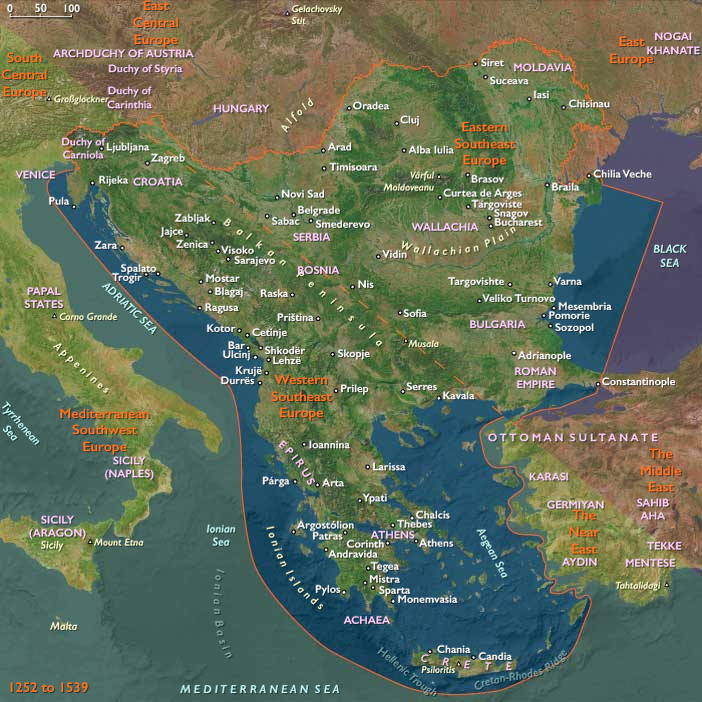
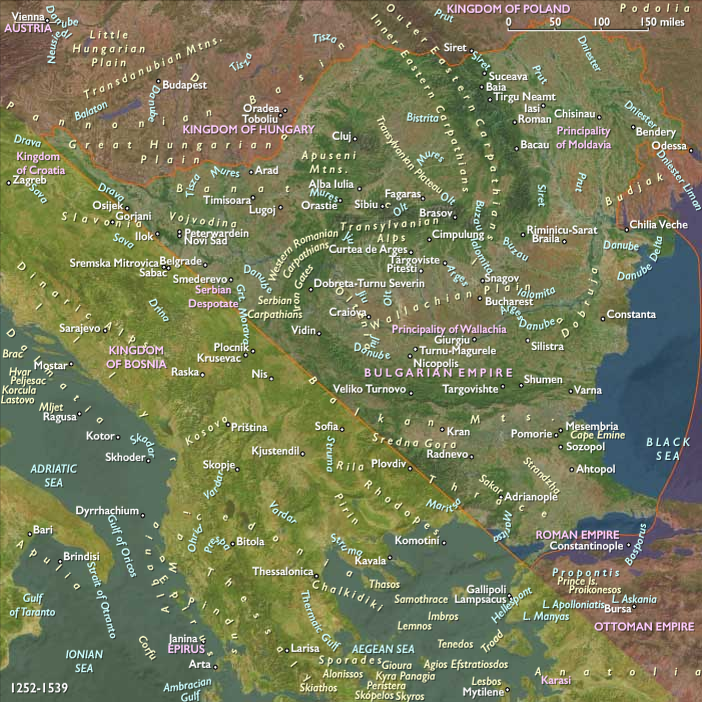
Aside from scattered outposts in Greece, all that remains of the Empire is its capital, Constantinople.
Cut off by land since 1365, the city, despite long periods of truce with the Turks, is supplied and reinforced by Venetian traders who control its commerce by sea.
Mehmed II (r. 1444-46, 1451-81), on becoming sultan in 1444, immediately sets out to conquer the city.
The military campaigning season of 1453 commences with the fifty-day siege of Constantinople, during which Mehmed II brings warships overland on greased runners into the Bosporus inlet known as the Golden Horn to bypass the chain barrage and fortresses that had blocked the entrance to Constantinople's harbor.
The Turks fight their way through the gates of the city on May 29 and bring the siege to a successful conclusion.
As an isolated military action, the taking of Constantinople does not have a critical effect on European security, but to the Ottoman Dynasty the capture of the imperial capital is of supreme symbolic importance.
Mehmet II regards himself as the direct successor to the Roman emperors.
He makes Constantinople the imperial capital, as it had been under his Greek and Latin predecessors, and sets about rebuilding the city.
The cathedral of Hagia Sophia is converted to a mosque, and Constantinople—which the Turks call Istanbul (from the Greek phrase eis tin polin, "to the city")—replaces Baghdad as the center of Sunni Islam.
The city also remains the ecclesiastical center of the Greek Orthodox Church, of which Mehmet II proclaims himself the protector and for which he appoints a new patriarch after the custom of the former emperors.
Locations
People
Groups
- Oghuz Turks
- Greeks, Medieval (Byzantines)
- Muslims, Sunni
- Muslims, Shi'a
- Christians, Eastern Orthodox
- Ottoman Empire
Topics
- Byzantine-Ottoman wars
- Constantinople, Siege of (Byzantine-Ottoman Turk War of 1422)
- Byzantine-Ottoman Turk War of 1453-61
- Constantinople, Fall of
Subjects
Regions
Subregions
Related Events
Showing 10 events out of 41742 total
Years: 1444 - 1455
Locations
People
Groups
- Oghuz Turks
- Greeks, Medieval (Byzantines)
- Muslims, Sunni
- Muslims, Shi'a
- Christians, Eastern Orthodox
- Ottoman Empire
Topics
- Byzantine-Ottoman wars
- Constantinople, Siege of (Byzantine-Ottoman Turk War of 1422)
- Byzantine-Ottoman Turk War of 1453-61
- Constantinople, Fall of
Subjects
Regions
Subregions