American politics is divided at the national…
November 1794 CE
President George Washington sides with Hamilton.
Hamilton devises a framework for negotiations, and Washington has sent Chief Justice of the Supreme Court John Jay to London to negotiate a comprehensive treaty.
The American government has several outstanding issues:
The British are occupying forts on U.S. territory in the Great Lakes region, at Detroit and Mackinac in modern-day Michigan, Niagara and Oswego in New York, and Maumee (also Miamis) in modern-day Ohio.
The British ware continuing to impress American sailors into the Royal Navy to fight against France.
American merchants want compensation for two hundred and fifty merchant ships that the British have confiscated in 1793 and 1794.
Southern interests want monetary compensation for slaves owned by Loyalists who had been taken away to the West Indies along with their masters in 1781–83.
American merchants want the British West Indies to be reopened to American trade.
The boundary with Canada is vague in many places, and needs to be more sharply delineated.
The British are providing munitions to First Nations peoples in armed conflict with settlers in the Northwest (Ohio and Michigan).
Both sides achieve many objectives.
Several issues are sent to arbitration, which (after years of discussion) will be resolved amicably mostly in favor of the U.S.
Britain pays $11,650,000 for damages to American shipping and receives £600,000 for unpaid pre-1775 debts.
While international arbitration is not entirely unknown, the Jay Treaty gives it a strong impetus and is generally taken as the start of modern International arbitration.
The British agree to vacate its forts in United States territory—six in the Great Lakes region and two at the north end of Lake Champlain—by June 1796; which will be done.
The treaty allows Americans to trade with Great Britain on a most-favored-nation basis.
In return, the United States gives most favored nation trading status to Britain, and acquiesces in British anti-French maritime policies.
American merchants obtain limited rights to trade in the British West Indies.
Two joint boundary commissions are set up to establish the boundary line in the Northeast (it agrees on one) and in the Northwest (this commission will never met and the boundary will be settled after the War of 1812).
Jay, a strong opponent of slavery, drops the issue of compensation for slaves, which angers Southern slaveholders and is used as a target for attacks by Jeffersonians.
Jay is unsuccessful in negotiating an end to the impressment of American sailors into the Royal Navy, which will later become a key issue leading to the War of 1812.
Locations
People
Groups
Topics
Regions
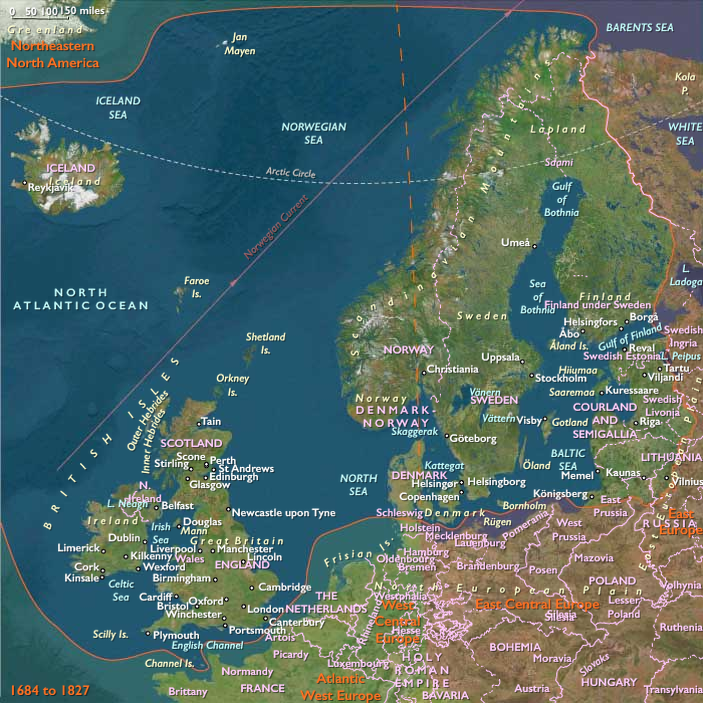
North Europe
View →Subregions