The Palais Garnier, a 1,979-seat opera house…
1867 CE
The Palais Garnier, a 1,979-seat opera house built from 1861 to 1875 for the Paris Opera, was originally called the Salle des Capucines because of its location on the Boulevard des Capucines in the ninth arrondissement of Paris, but soon becomes known as the Palais Garnier in recognition of its opulence and its architect, Charles Garnier.
The theater is also often referred to as the Opéra Garnier, the Opéra de Paris or simply the Opéra.
The Palais Garnier is a building of exceptional opulence.
The style is monumental and considered typically Beaux-Arts, with use of axial symmetry in plan, and its exterior ornamentation.
Its audience sits under a central chandelier which weighs more than six tons, and it has a huge stage with room to accommodate as many as four hundred and fifty artists.
It is decorated with very elaborate multicolored marble friezes, columns, and lavish statuary, many of which portray deities of Greek mythology.
Gilded galvanoplastic bronze busts of many of the great composers are located between the columns of the theater's front façade and depict from left to right: Rossini, Auber, Beethoven, Mozart, Spontini, Meyerbeer, and Halévy.
On the left and right lateral returns of the front facade are busts of the librettists Eugène Scribe and Philippe Quinault, respectively.
The sculptural group Apollo, Poetry, and Music, located at the apex of the south gable of the stage flytower, is the work of Aimé Millet, and the two smaller bronze Pegasus figures at either end of the south gable are by Eugène-Louis Lequesne.
The two gilded figural groups—L'Harmonie (Harmony) and La Poésie (Poetry)—crown the apexes of the principal facade's left and right avant-corps, respectively, were both designed by Charles Gumery.
They are both made of gilt copper electrotype.
The bases of the two avant-corps are decorated (from left to right) with four major multi=figure groups sculpted by: François Jouffroy (Harmony), Jean-Baptiste Claude Eugène Guillaume (Instrumental Music), Jean-Baptiste Carpeaux (The Dance), criticized for indecency), and Jean-Joseph Perraud (Lyrical Drama).
The facade also incorporates other work by Gumery, Alexandre Falguière, and others.
Images

The façade of the Palais Garnier opera house (Photo taken 1 May 2009 by Peter Rivera)
Locations
People
Regions
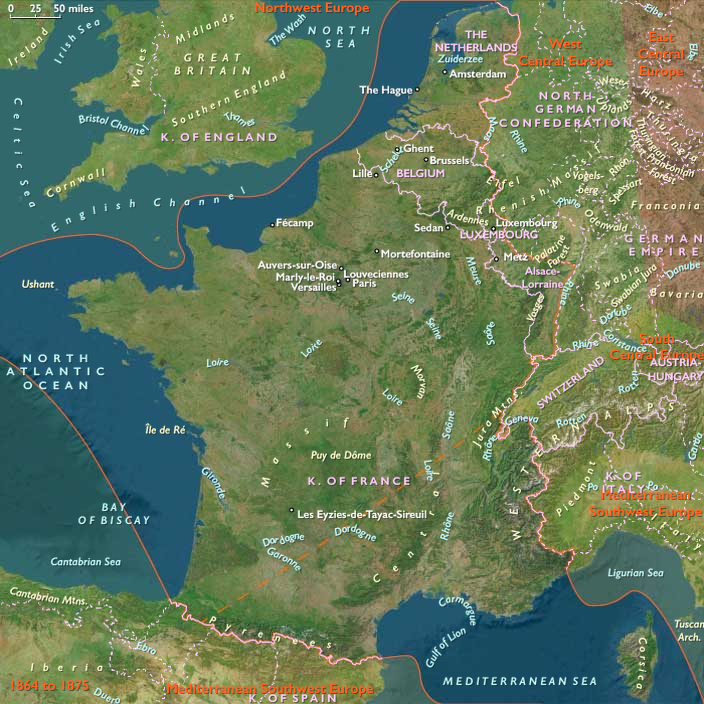
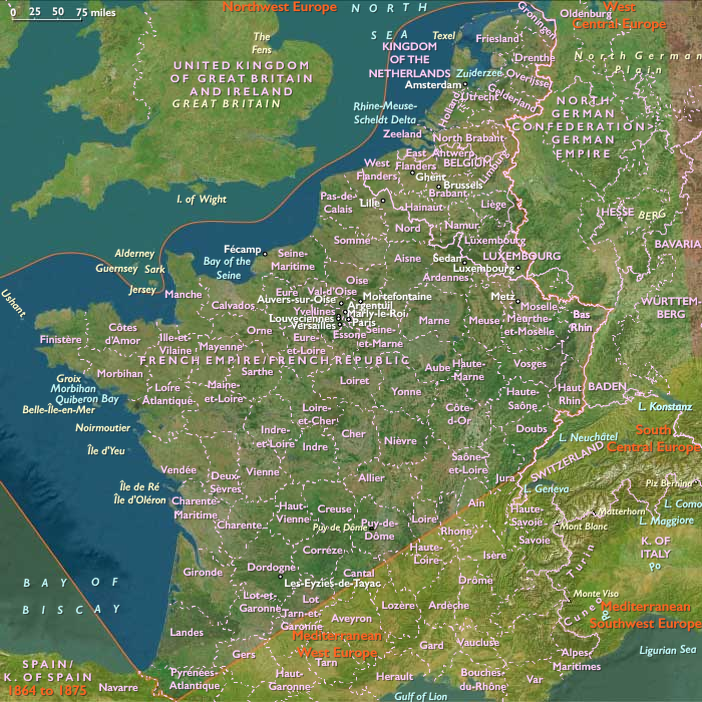
West Europe
View →Subregions