The First French Republic and Prussia stipulate…
April 1795 CE
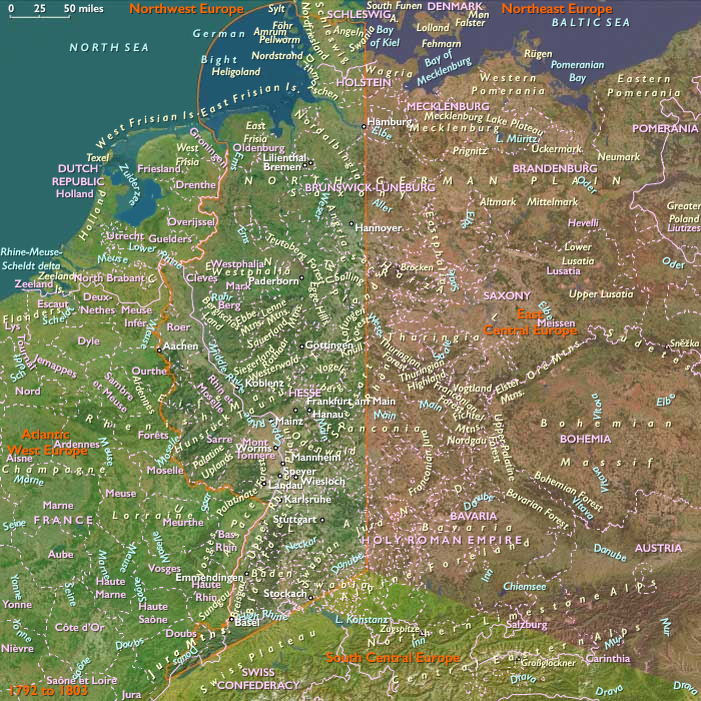
The First French Republic and Prussia stipulate in the Peace of Basel, negotiated from April to August 1795, that the latter will ensure the Holy Roman Empire's neutrality in all the latter's territories north of the demarcation line of the river Main, including the British continental dominions of the Electorate of Hanover and the Duchies of Bremen-Verden.
To this end, Hanover (including Bremen-Verden) also has to provide troops for the so-called demarcation army maintaining this state of armed neutrality.
There is also an agreement to exchange the Austrian troops that had been captured in Belgium.
In a maneuver of great diplomatic cunning, the treaties made in the Peace of Basel enable France to placate and divide its enemies (the allies of the First Coalition) one by one, and thereafter revolutionary France emerges as a major European power.
The agreement of April 5, 1795, between France and Prussia has been under discussion since 1794.
Prussia withdraws from the coalition that is working on the impending partition of Poland, and where appropriate, withdraws its troops that are aligned against Austria and Russia.
In secret, Prussia recognizes French control of the west bank of the Rhine, pending a cession by the Imperial Diet, while France returns all of the lands east of the Rhine captured during the war.
On the night of April 6th, the document is signed by the representatives of France and Prussia, François de Barthélemy and Karl August von Hardenberg.
They are not face to face; each is in his own accommodation in Rosshof or the Markgräflerhof, and the papers are passed around by a courier.
The contract that cedes the left bank of the Rhine is in a secret article, along with the promise that it will indemnify the right bank, if the left bank of the Rhine should be covered in a final general peace in France.
Peter Ochs draws up the Treaty and serves as a mediator for a significant proportion of these financial statements.
People
Groups
Topics
Regions
Central Europe
View →Subregions