The plague kills about half of Naples' …
Years: 1656 - 1656
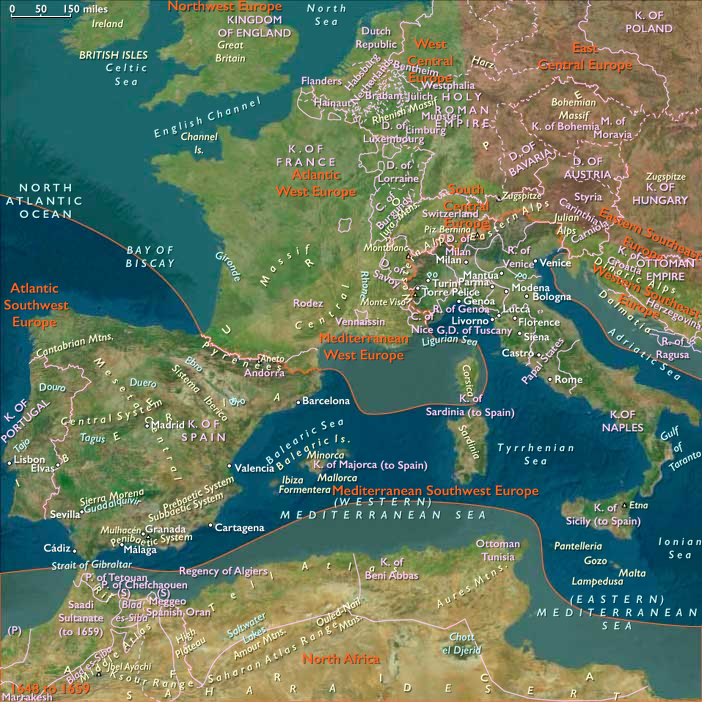
The plague kills about half of Naples' three hundred thousand inhabitants in 1656.
Locations
Groups
Subjects
Regions
Subregions
Related Events
Filter results
Showing 10 events out of 31487 total
The combination of church and state severely persecutes Russia’s Old Believers, making martyrs of many of them, including the archpriest Avvakum Petrov, a Russian protopope of Kazan Cathedral on Red Square who leads the opposition to Patriarch Nikon's reforms of the Russian Orthodox Church.
Avvakum and others strongly reject these changes, seeing them as a corruption of the Russian Church, which they consider to be the "true" Church of God.
The other Churches are more closely related to Constantinople in their liturgies and Avvakum argues that Constantinople had fallen to the Turks because of these heretical beliefs and practices.
The principled Old Believers chafe at the notion that contemporary Greeks and westernized Ukrainians have preserved the correct usages while the Russians have not.
Avvakum is repeatedly imprisoned for his opposition to the reforms.
Samuel Stockhausen is considered by some to be the first occupational physician.
Unlike his near contemporary, Paracelsus, who also wrote about diseases of miners, Stockhausen recognizes litharge-derived dust as the causative factor and recommends avoiding inhaling it.
This is the first time that the ancient syndrome known to Romans as morbi metallici is attributed specifically to chronic poisoning with lead.
A German physician in the mining town of Goslar, has studied the ancient miner's disease, called Hüttenkatze, among workers in the nearby mines of Rammelsberg in the Harz mountains.
He publishes in 1656, a book, in Latin, attributing the disease to noxious fumes from litharge (a lead compound), Libellus de lithargyrii fumo noxio morbifico, ejusque metallico frequentiori morbo vulgò dicto die Hütten Katze oder Hütten Rauch (“Treatise on the Noxious Fumes of Litharge, Diseases caused by them and Miners’ Asthma”).
The Portuguese, following the fall of the Kingdom of Kotte in 1593, had been able to establish complete control over the entire coastal area, with Colombo as their capital.
The Dutch in 1638 had signed a treaty with King Rajasinha II of Kandy which had assured the king assistance in his war against the Portuguese in exchange for a monopoly of the island's major trade goods.
The Portuguese had resisted the Dutch and the Kandyans, but have been gradually defeated in their strongholds beginning in 1639.
The Dutch capture Colombo in 1656 after an epic siege, at the end of which a mere ninetey-three Portuguese survivors are given safe conduct out of the fort.
Although the Dutch initially restore the captured area back to the Sinhalese Kings, they later refuse to turn them over and gain control over the island's richest cinnamon lands, including Colombo, which now serves as the capital of the Dutch maritime provinces under the control of the Dutch East India Company.
The complex and enigmatic composition of Velázquez’s Las Meninas (Spanish: The Maids of Honor) raises questions about reality and illusion, and creates an uncertain relationship between the viewer and the figures depicted.
Because of these complexities, Las Meninas has been one of the most widely analyzed works in Western painting.
The painting shows a large room in the Madrid palace of King Philip IV of Spain, and presents several figures, most identifiable from the Spanish court, captured, according to some commentators, in a particular moment as if in a snapshot.
Some look out of the canvas towards the viewer, while others interact among themselves.
The young Infanta Margarita is surrounded by her entourage of maids of honor, chaperone, bodyguard, two dwarves and a dog.
Just behind them, Velázquez portrays himself working at a large canvas.
Velázquez looks outwards, beyond the pictorial space to where a viewer of the painting would stand.
In the background there is a mirror that reflects the upper bodies of the king and queen.
They appear to be placed outside the picture space in a position similar to that of the viewer, although some scholars have speculated that their image is a reflection from the painting Velázquez is shown working on.
Las Meninas has long been recognized as one of the most important paintings in Western art history.

Aachen had started to lose its power and influence from the early 16th century,
First the coronations of emperors were moved from Aachen to Frankfurt.
This had been followed by the religious wars, and the great fire of 1656.
After the destruction of most of the city in 1656, the rebuilding is mostly in the Baroque style.
An English Fifty Shillings coin, the only one ever to have been minted, is struck in the year 1656.
It is a milled gold coin weighing 22.7 grams and with a diameter of thirty millimeters.
The obverse of the coin depicts Oliver Cromwell as a Roman Emperor, with the inscription OLIVAR D G R P ANG SCO HIB &c PRO -- Oliver, by the grace of God Protector of the Republic of England, Scotland, Ireland, etc..
The reverse depicts a crowned shield bearing the Commonwealth arms, with the inscription PAX QVAERITUR BELLO 1656 -- Peace is sought through war, while there is an edge inscription PROTECTOR LITERIS LITERAE NVMMIS CORONA ET SALVS -- A protector of the letters, the letters are a garland and a safeguard to the coinage.
Today, only eleven examples are known to exist, and they have a current value of approximately fifteen thousand to twenty thousand pounds each.
Jews are finally allowed to own their own homes in New Amsterdam in 1656, thirty-five years after the arrival of the first Jewish immigrant in the North American colonies.
The war between the Erie and the Iroquois has lasted for two years.
The Iroquois have by 1656 almost completely destroyed the Erie confederacy, who have refused to flee to the west.
The Erie tribe no longer exist as a unit, but dispersed groups will survive a few more decades before being absorbed into the Iroquois.
Anthropologist Marvin T. Smith (1986:131–32) has theorized that some Erie fled in the late 1650s to Virginia and then South Carolina, where they become known as the Westo.
Subsequent work by John Worth (1995:17) and Eric Bowne (2006) strongly supports Smith’s hypothesis.
Frederick William I, Elector of Brandenburg and Duke of Prussia, takes the Duchy of Prussia, formerly a Polish fief, as a fief from Charles X Gustav under the terms of the Treaty of Königsberg on January 17, 1656.
The Brandenburgian garrisons in Royal Prussia are withdrawn.
Both Charles X of Sweden and Frederick William, Elector of Brandenburg, agree to establish an alliance against Poland under the terms of the Treaty of Königsberg, signed in Königsberg (Królewiec) on January 17, 1656.
Charles is responsible for forcing the prince-elector to become his ally and vassal.