
The political system devised by the original…
1262 CE
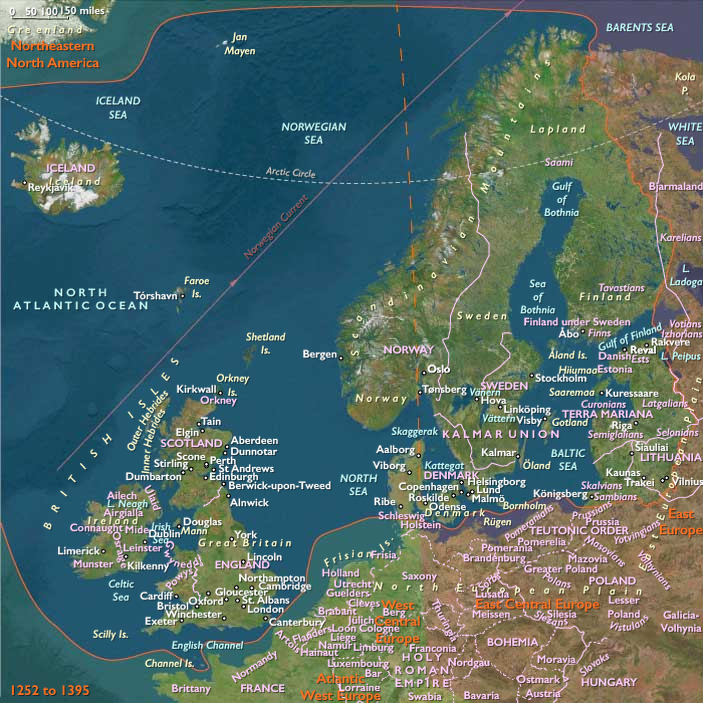
The political system devised by the original settlers of the Free State of Iceland proves unable to cope with the increasing power of Icelandic chieftains.
The Norwegian king Haakon IV has from 1220 tried to exert his influence through the Icelandic family clans, most notably the Sturlungs.
The internal struggles and civil strife of the Sturlung Era, perhaps the bloodiest and most violent period in Icelandic history, is documented in the Sturlunga saga.
Many Icelandic chieftains have become Haakon’s vassals and are obliged to do his bidding—in exchange, they receive gifts, followers, and a status of respect.
Consequently, the greatest Icelandic chieftains were soon affiliated with the King of Norway in one way or the other.
The king in 1252 had sent his vassal Gissur Þorvaldsson, the chief of the Haukdælir clan, to Iceland.
The followers of Dórdur kakali, the Sturlung leader, were displeased and tried unsuccessfully to kill him by putting his residence in Flugumýri in Skagafjörður to the torch—this incident is known as Flugumýrarbrenna.
Gissur, despite his influence and power, had proved unable to find the leader of the arsonists, and was forced to return to Norway in 1254 to bear the censure of the king, who was displeased with his failure in bringing Iceland under the Norwegian throne.
Minor conflicts have continued throughout Iceland.
Meanwhile, Gissur has been given the title of Jarl and sent back home to negotiate.
Only when the king sends his special emissary, Hallvarður gullskór, in 1262 do the Icelanders agree on Norwegian kingship.
This leads to the signing of the Old Covenant, which is to bring Iceland under the Norwegian crown; it will subsequently led to Iceland's union with Denmark in 1380, by way of the Kalmar Union.
The country is to remain under the rule of Norwegian and Danish kings until 1944, when it will finally achieve independence.
Locations
People
Groups
Commodities
Subjects
Regions
North Europe
View →Subregions
