
Fort L'Huillier, a short-lived fortification in New…
1700 CE
It is named in honor of a metallurgical assayer, Remy-François L'Hullier.
The fort is southwest of the present city of Mankato (from mah kato: "blue earth" in the Sioux language).
Its exact location is unknown today, although attempts have been made to find it.
Pierre-Charles Le Sueur had come to Canada with the Jesuits to their mission at Sault Sainte Marie, but very soon he turned himself to fur trade and became a coureur des bois.
He is fluent in several Native languages, which is crucial to his success in trade.
Around 1683, he received some samples of bluish clay from the middle reaches of a tributary of the Mississippi and took it back to France to be analyzed.
L'Huillier had deemed it to be copper ore.
Le Sueur had returned to New France to mine this ore, but was waylaid by, among other things, a prison term for overreaching his trade privileges.
He had been present at the formal assertion of French sovereignty of Canada, declared in 1689 by Nicholas Perrot at Green Bay.
Eventually, however, he had been given a royal commission to open a copper mine (although some suggested he was more interested in "mining furs").
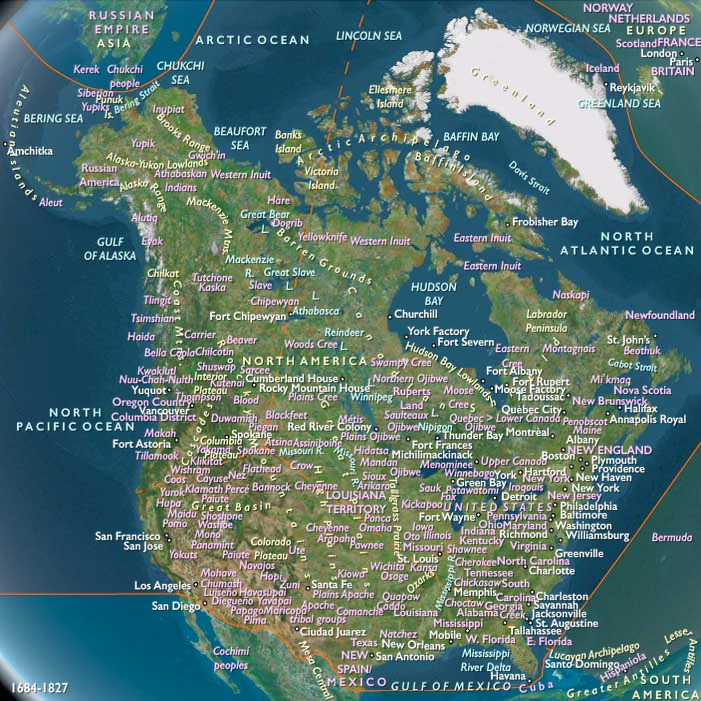
He was with the group that ascended the Mississippi River from Biloxi to the "country of the Nadouessioux" in 1699, stopping to overwinter at Isle Pelée or Fort Perrot above Lake Pepin.
He went upstream as far as Saint Anthony Falls.
After trading with the local Dakota bands (the Mdewankantons, Wahpetons and Wahpekutes) in the area, in the summer and fall of 1700 he and a group of twenty men went further up the river known to the native population as "minisota", or "cloud reflected water".
This river will be known to later voyageurs as the St. Pierre, but it is unclear if Le Sueur knows it by that name at this time.
The group continues to the Blue Earth River, where they build Fort L'Huillier, named for the chemist who declared it to be copper ore.
They overwinter at Fort L'Huillier, trading furs and other merchandise with the local native bands.
They find the prairies full of bison, and learn to subsist largely on a meat diet.
Groups
Subjects
Regions
Northern North America
View →Subregions
