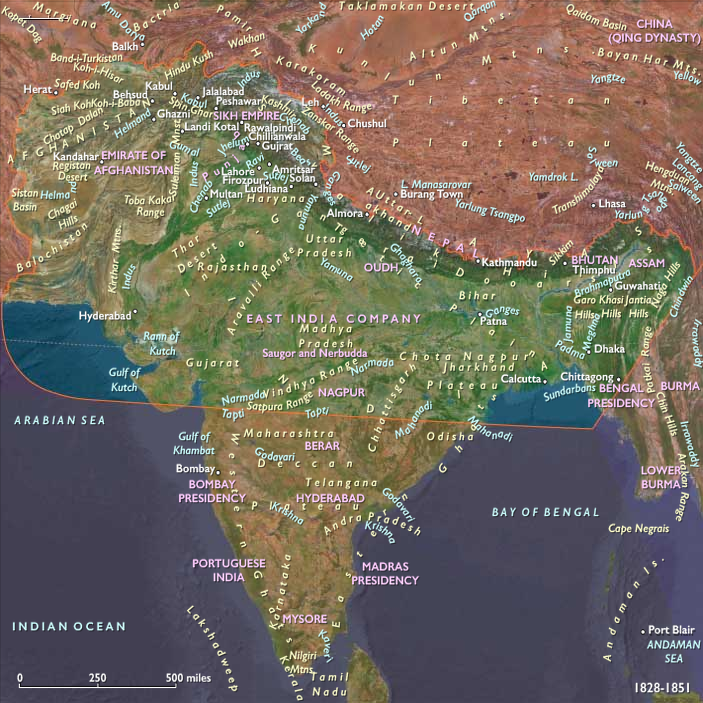
The fall of Bhimsen Thapa had done…
1840 CE to 1851 CE
The fall of Bhimsen Thapa had done nothing to solve the factional fighting at the Nepalese court.
The Pandes are dismissed, and Fateh Jang Chautaria is appointed prime minister in November 1840.
His ministry is unable to control renewed competition between a resurgent Thapa coalition and the disgraced Pandes, who prefer the abdication of the king in favor of the heir apparent.
The king becomes increasingly attentive to the advice of his wives.
Under intense pressure from the aristocracy, the king decrees in January 1843 that he will rule the country only with advice and agreement of his junior queen, Lakshmidevi, and commands his subjects to obey her even over his own son, Surendra.
The queen, seeking support of her own son's claims to the throne over those of Surendra, invites back from exile Mathbar Singh Thapa, who is popular in army circles.
Upon his arrival in Kathmandu, an investigation of his uncle's death takes place, and a number of his Pande enemies are executed.
By December 1843, Mathbar Singh has been appointed prime minister, but he proves no more capable of extinguishing court intrigues than had his predecessors.
Against the wishes of the queen, he supports heir apparent Surendra.
Once Mathbar Singh has alienated the person who officially wields state authority, his days are numbered.
On May 17, 1845, he is killed, most likely on the queen's orders.
The assassin apparently is Jang Bahadur Kunwar, his nephew, at this time a minor but rising star in court politics.
Locations
Groups
Regions
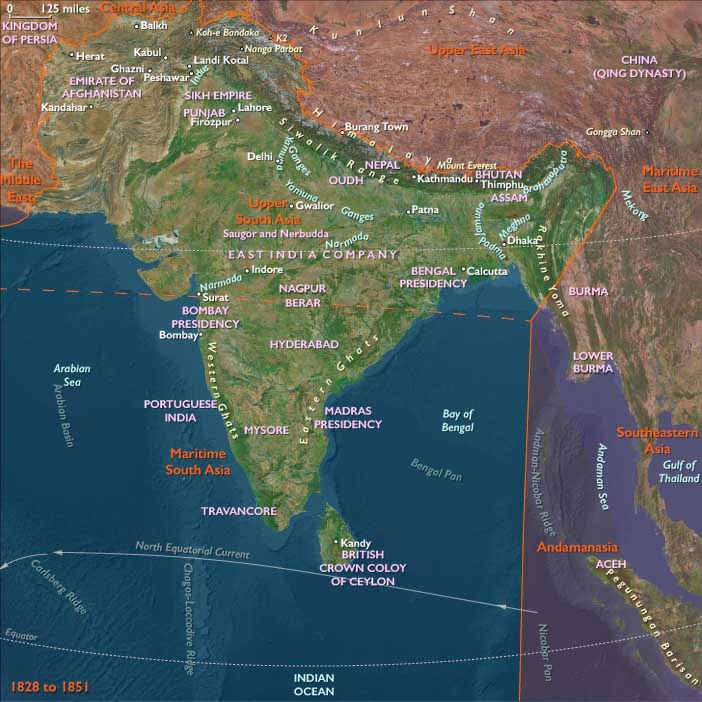
South Asia
View →Subregions