
…the prince himself, now known as Ptolemy…
79 BCE
…the prince himself, now known as Ptolemy XII Auletes (Greek: “Flute Player”), arrives in Egypt, and shortly afterwards marries Cleopatra V Tryphaeana, who is perhaps his sister.
Groups
Topics
Subjects
Regions
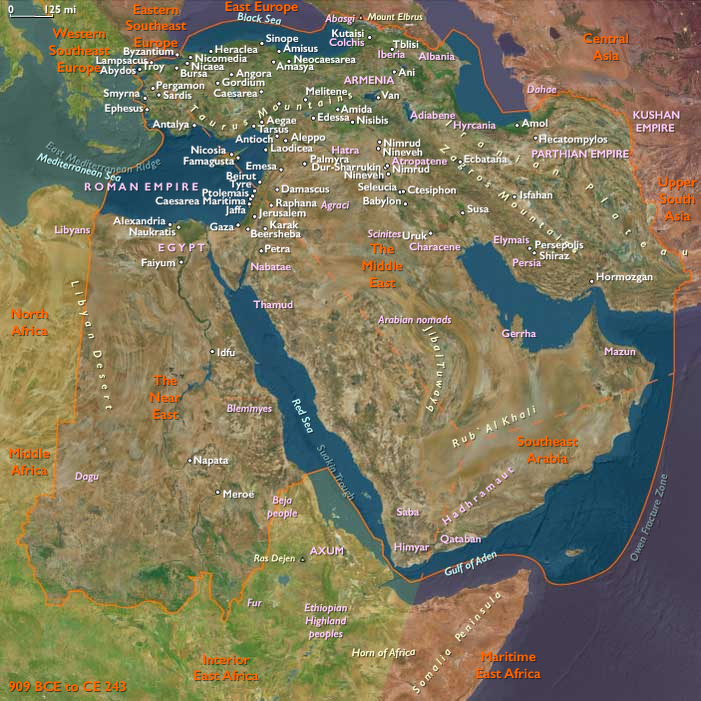
The Near and Middle East
View →Subregions
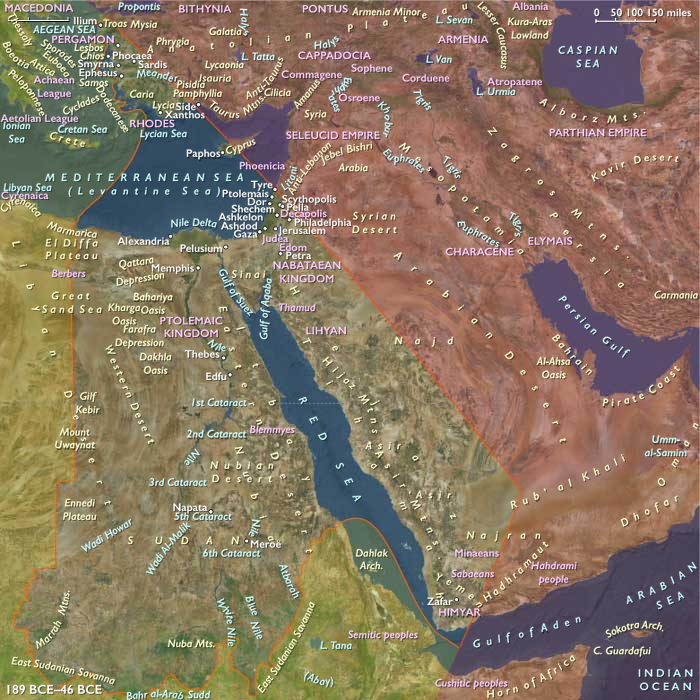
Near East
View →Related Events
No active filters.
Showing 10 events out of 62744 total
The Ptolemid prince's brother becomes, according to the Roman historian and politician Cicero, king of Cyprus, while …
Cicero, whose father is a well-to-do member of the equestrian order with good connections in Rome but as a semi-invalid cannot enter public life, has compensated for this by studying extensively.
He has used his knowledge of Greek to translate many of the theoretical concepts of Greek philosophy into Latin, thus translating Greek philosophical works for a larger audience.
It is precisely his broad education that ties him to the traditional Roman elite.
Cicero according to Plutarch was an extremely talented student, whose learning attracted attention from all over Rome, affording him the opportunity to study Roman law under Quintus Mucius Scaevola.
Cicero's fellow students were Gaius Marius Minor, Servius Sulpicius Rufus (who became a famous lawyer, one of the few whom Cicero considered superior to himself in legal matters), and Titus Pomponius.
The latter two became Cicero's friends for life, and Pomponius (who later received the nickname "Atticus") would become Cicero's longtime chief emotional support and adviser.
Cicero had wanted to pursue a public civil service career along the steps of the Cursus honorum.
An intellectual first and foremost with no taste for military life, he had nevertheless served both Gnaeus Pompeius Strabo and Lucius Cornelius Sulla in 90 BCE–88 BCE as they campaigned in the Social War.
Cicero in around 83-81 BCE had started his career as a lawyer.
His first major case, of which a written record is still extant, was his defense of Sextus Roscius in 80 BCE on the charge of patricide.
Taking this case was a courageous move for Cicero; patricide was considered an appalling crime, and the people whom Cicero accused of the murder, the most notorious being Chrysogonus, were favorites of Sulla.
It would have been easy for the dictator Sulla at this time to have the unknown Cicero murdered.
Cicero's defense was an indirect challenge to Sulla, and on the strength of his case, Roscius had been acquitted.
Cicero leaves in 79 for Greece, Asia Minor and Rhodes, perhaps because of the potential wrath of Sulla.
He journeys first to Athens, where he becomes reacquainted with his old classmate Titus Pomponius, who so loves Athens and its culture that he has taken upon himself the nickname "Atticus", or "Man of Attica.”
Atticus introduces Cicero to some significant Athenians, where his his chief instructor is the rhetorician Apollonius Molon of Rhodes.
Sertorius, brave, noble, and gifted with eloquence, is just the man to impress the Lusitanians favorably, and the native warriors, whom he organizes, speak of him as the "new Hannibal."
His skill as a general is extraordinary, as he repeatedly defeats forces many times his own size.
Many Roman refugees and deserters join him, and with these and his Hispanian volunteers he completely defeats several of Sulla's generals (Fufidius, Lucius Domitius and to some less-direct extent Thoranius) and drives Quintus Caecilius Metellus Pius, who had been specifically sent against him from Rome, out of Lusitania, or Hispania Ulterior as the Romans call it at this time.
The formative years of Gaius Julius Casear had been a time of turmoil, though little is recorded of his childhood.
Caesar's father, also called Gaius Julius Caesar, governor of the province of Asia, had died suddenly in 85 BCE, leaving young Caesar head of the family at sixteen.
He had been nominated in the following year to be the new high priest of Jupiter, a position that not only requires the holder to be a patrician but also be married to a patrician. For this reason Caesar had broken off his engagement to a plebeian girl he had been betrothed to since boyhood and married Cornelia, the daughter of Lucius Cinna.
Casear as Cinna's son-in-law had in 81 BCE been one of the targets of Sulla’s purges and fled Rome.
Stripped of his inheritance, his wife's dowry and his priesthood, he had refused to divorce Cornelia and was forced to go into hiding.
Escaping harm through the intervention of such people as his mother's relative, Gaius Aurelius Cotta, and the Vestal Virgins, Caesar had left Rome and joined the army, where he had won the Civic Crown for his part in an important siege, that of Mytilene.
On a mission to Bithynia to secure the assistance of King Nicomedes's fleet, he had spent so long at his court that rumors had arisen of an affair with the king, which Caesar will vehemently deny for the rest of his life.
Ironically, the loss of his priesthood had allowed him to pursue a military career, as the high priest of Jupiter is not permitted to touch a horse, sleep three nights outside his own bed or one night outside Rome, or look upon an army.
Many of Caesar’s relatives are Sulla's supporters, but Sulla notes in his memoirs that he regretted sparing Caesar's life, because of the young man's notorious ambition.
The historian Suetonius records that when agreeing to spare Caesar, Sulla warned those who were pleading his case that he would become a danger to them in the future, saying "In this Caesar there are many Mariuses."
Caesar, hearing of Sulla's death in 78 BCE, feels safe enough to return to Rome.
The weakening of Rhodes in the Mithridatic Wars has resulted in rampant piracy in the eastern Mediterranean, one of the symptoms of the anarchy into which the Roman nobility have allowed the Mediterranean world to fall.
Cesar, captured by pirates on the way across the Aegean Sea and held prisoner, maintains an attitude of superiority throughout his captivity.
When the pirates think to demand a ransom of twenty talents of silver, he insists they ask for fifty.
After the ransom is paid, Caesar raises a fleet, pursues and captures the pirates, and imprisons them.
He has them crucified on his own authority, as he had promised while in captivity—a promise the pirates had taken as a joke.
As a sign of leniency, he had first had their throats cut.
Sulla had succeeded in restoring the rule of the oligarchs, but he had failed to remedy the socioeconomic conditions that had undermined their rule in the first place.
After his second consulship, Sulla had withdrawn to his country villa near Puteoli to be with family.
From this distance, he remains out of the day-to-day political activities in Rome, intervening only a few times when his policies are involved.
His goal now was to write his memoirs, which he finishes in 78 BCE, just before his death.
They are now largely lost, although fragments from them exist as quotations in later writers.
Ancient accounts of Sulla's death indicate that he died from liver failure or a ruptured gastric ulcer (its symptoms a sudden hemorrhage from his mouth followed by a fever from which he never recovered) caused by chronic alcohol abuse.
His funeral in Rome (at Roman Forum, in the presence of the whole city) is on a scale unmatched until that of Augustus in CE 14.
His epitaph reads "No friend ever served me, and no enemy ever wronged me, whom I have not repaid in full".
Marcus Aemilius Lepidus had gained wealth and power by politically allying himself with Sulla, but once the dictator had resigned in 79 BCE, Lepidus attempts to undermine the Sullan constitution.
Elected consul for the year 78 BCE with the support of Pompey, he tries to stop Sulla from being buried in the Campus Martius.
However, Pompey turns against his candidate and uses his influence to ensure that the full funeral and burial goes ahead.
Lepidus passes several resolutions during his term that firmly place him in the camp of the populares.
His offer to restore to the Italians land that had been taken by Sulla puts him at odds with his fellow consul, Quintus Lutatius Catulus.
The two factions come so close to war that the senate makes them swear not to fight, and sends Lepidus to administer the province of Transalpine Gaul.
Sertorius owes some of his success to his prodigious ability as a statesman.
His goal is to build a stable government in Hispania with the consent and cooperation of the people, whom he wishes to civilize along the lines of the Roman model.
He establishes a senate of three hundred members, drawn from Roman emigrants (probably including some from the highest nobles of Hispania) and keeps a Hispanian bodyguard.
For the children of the chief native families he provides a school at Osca (Huesca), where they receive a Roman education and even adopt the dress and education of Roman youths, following the Roman practice of taking hostages.
Although he is strict and severe with his soldiers, he is particularly considerate to the people in general, and makes their burdens as light as possible.
It seems clear that he had a peculiar gift for evoking the enthusiasm of the native tribes, and we can understand well how he was able to use the famous white fawn, a present from one of the natives that was supposed to communicate to him the advice of the goddess Diana, to his advantage.
The Latin name Cyrenaica, centered upon the North African city of Cyrene, dates to the first century BCE.
Although some confusion exists as to the exact territory Rome inherited, by 78 BCE it is organized as one administrative province together with Crete.
Tigranes of Armenia reoccupies Cappadocia in 78 BCE-77 BCE.
Lepidus’ fellow rebel, Marcus Junius Brutus the Elder, the father of Caesar's famous murderer of the same name, and the founder of the colony in Capua, remains at Mutina, in Gaul.
Pompey marches to destroy him, but Brutus, for reasons unknown, surrenders before a battle has to be fought, putting himself and his troops in the power of Pompey, on the understanding that their lives should be spared.
Brutus is soon killed by one of Pompey's men, named Geminius.
Pompey, who had ordered Brutus’ death, forwards to Rome the news of his surrender and execution.
The senate blames Pompey for the perfidious act.