
The Khmer, following the abandonment of the…
1396 CE to 1539 CE
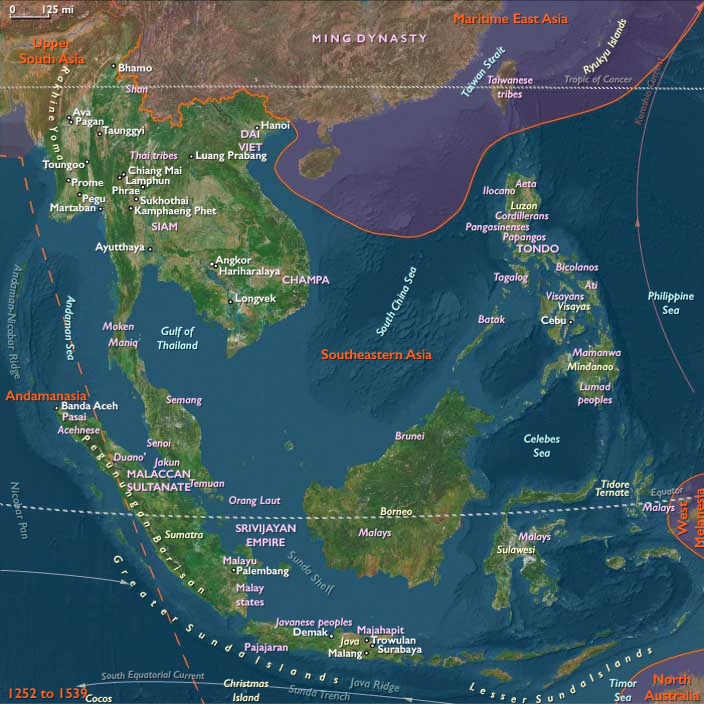
The Khmer, following the abandonment of the Angkorian sites, establish a new capital several hundred kilometers to the southeast on the site of what is now Phnom Penh.
This new center of power is located at the confluence of the Mekong and the Tonle Sab rivers.
Thus, it controls the river commerce of the Khmer heartland and the Laotian kingdoms and has access, by way of the Mekong Delta, to the international trade routes that link the China coast, the South China Sea, and the Indian Ocean.
A new kind of state and society emerges, more open to the outside world and more dependent on commerce as a source of wealth than its inland predecessor.
The growth of maritime trade with China during the Ming dynasty (1368-1644) provides lucrative opportunities for members of the Cambodian elite who control royal trading monopolies.
The appearance of Europeans in the region in the sixteenth century also stimulates commerce.
Groups
Subjects
Regions
Southeast Asia
View →Subregions
