
The Capitulation of Dom Miguel and the…
May 1834 CE
The Capitulation of Dom Miguel and the End of the Liberal Wars (May–July 1834)
By May 1834, the Portuguese Civil War (1828–1834), also known as the Liberal Wars, was nearing its conclusion. Despite still commanding 18,000 troops, Dom Miguel’s officers refused to risk a final battle, as nearly two years of conflict had exhausted Miguelite forces.
Realizing that defeat was inevitable, Miguel sought terms of surrender, bringing an end to the war and absolutist rule in Portugal.
Miguel Seeks Terms of Capitulation (May 27, 1834)
- With Queen Maria II’s constitutional forces controlling Lisbon, Porto, and the majority of Portugal, Miguel’s position was untenable.
- His officers, weary of war, refused to engage in further battles, effectively forcing him to seek peace.
- On May 27, 1834, Miguel formally requested negotiations to end hostilities.
The Convention of Évora-Monte (May 26–May 30, 1834)
- The Convention of Évora-Monte, signed between liberal and Miguelite representatives, officially ended the war.
- Miguel agreed to surrender his forces and abdicate any claim to the Portuguese throne.
- In exchange, he was allowed to go into exile rather than face execution or imprisonment.
Miguel Renounces the Throne and Goes into Exile (July 24, 1834)
- On July 24, 1834, Dom Miguel renounced all claims to the throne of Portugal.
- He went into permanent exile, initially in Genoa, then later in Austria, where he remained until his death in 1866.
- The Miguelite cause was defeated, and absolutist rule in Portugal was permanently abolished.
Conclusion – The Final Victory of Constitutionalism
- The Portuguese Civil War ended with the triumph of Queen Maria II and the liberal constitutionalists.
- The Constitutional Charter of 1826 was reinstated, securing Portugal’s future as a constitutional monarchy.
- Though Miguel’s supporters remained a political force, Portugal would never again be ruled by an absolutist monarch.
The Liberal Wars had reshaped Portugal, cementing constitutional government as the foundation of the nation’s political system and ensuring that liberalism, not absolutism, would define its future.
Locations
Groups
Regions
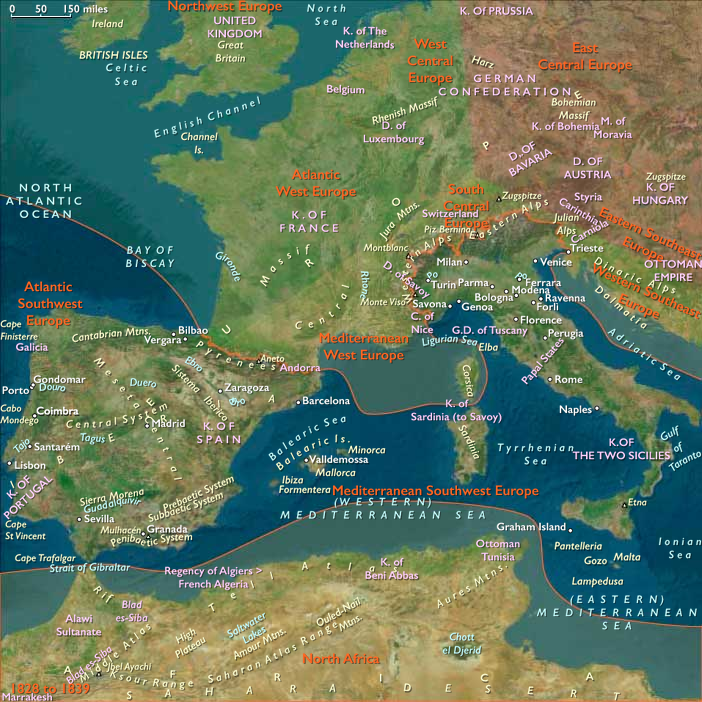
Southwest Europe
View →Subregions
