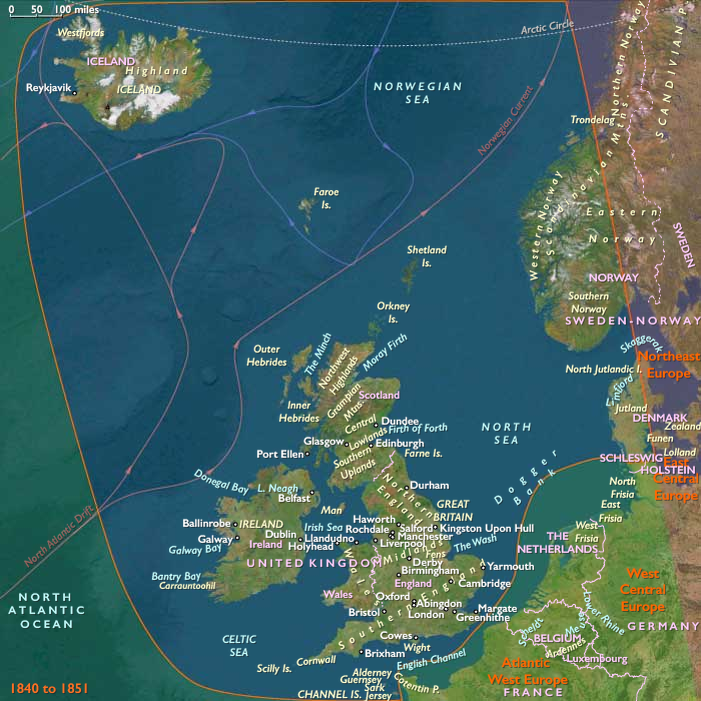
The Free Church of Scotland is disrupted…
May 1843 CE
The Free Church is formed by Evangelicals who break from the Church of Scotland in protest against what they regarded as the state's encroachment on the spiritual independence of the Church.
Leading up to the Disruption many of the issues have been discussed in Hugh Miller's widely circulating newspaper The Witness.
Robert Candlish is influential perhaps second only to Thomas Chalmers in bringing about the Disruption.
The Disruption of 1843, a bitter, nationwide division that splits the established Church of Scotland, is larger than the previous historical secessions of 1733 or 1761.
The evangelical element had been demanding the purification of the Church, and it attacks the patronage system, which allows rich landowners to select the local ministers.
It has become a political battle between evangelicals on one side and the "Moderates" and gentry on the other.
The evangelicals had secured passage by the church's General Assembly in 1834, of the "Veto Act", asserting that, as a fundamental law of the Church, no pastor should be forced by the gentry upon a congregation contrary to the popular will, and that any nominee could be rejected by majority of the heads of families
This direct blow at the right of private patrons had been challenged in the civil courts, and was decided (1838) against the evangelicals.
In 1843, four hundred and fifty evangelical ministers (out of twelve hundred ministers in all) break away, and form the Free Church of Scotland.
Led by Dr. Thomas Chalmers (1780–1847), a third of the membership walks out, including nearly all the Gaelic-speakers and the missionaries, and most of the Highlanders.
The established Church keeps all the properties, buildings and endowments.
The seceders create a voluntary fund of over four hundred thousand pounds to build seven hundred new churches; four hundred manses (residences for the ministers) will be erected at a cost of £250,000; and an equal or larger amount will be expended on the building of five hundred parochial schools, as well as a college in Edinburgh.
After the passing of the Education Act of 1872, most of these schools will be voluntarily transferred to the newly established public school-boards.
Groups
Topics
Regions
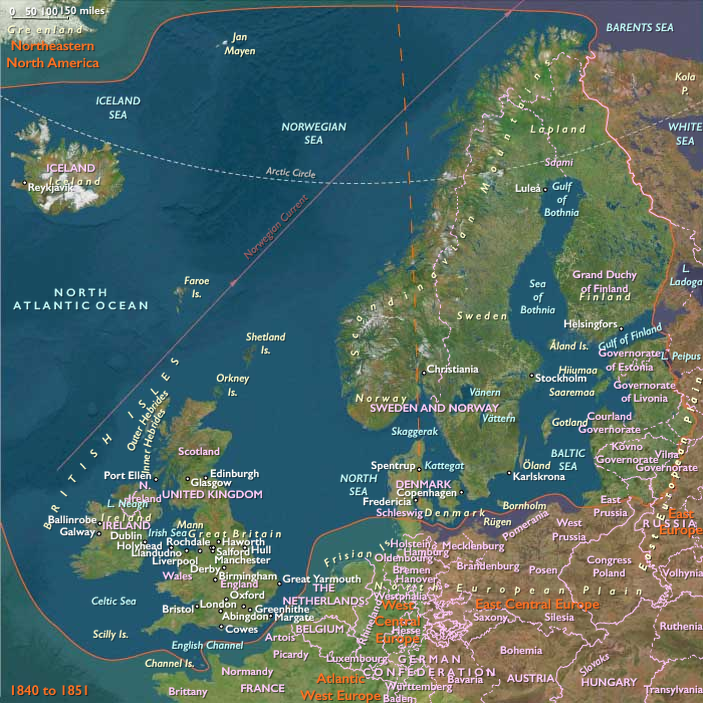
North Europe
View →Subregions