The Reformation in Europe, which had officially …
Years: 1525 - 1525
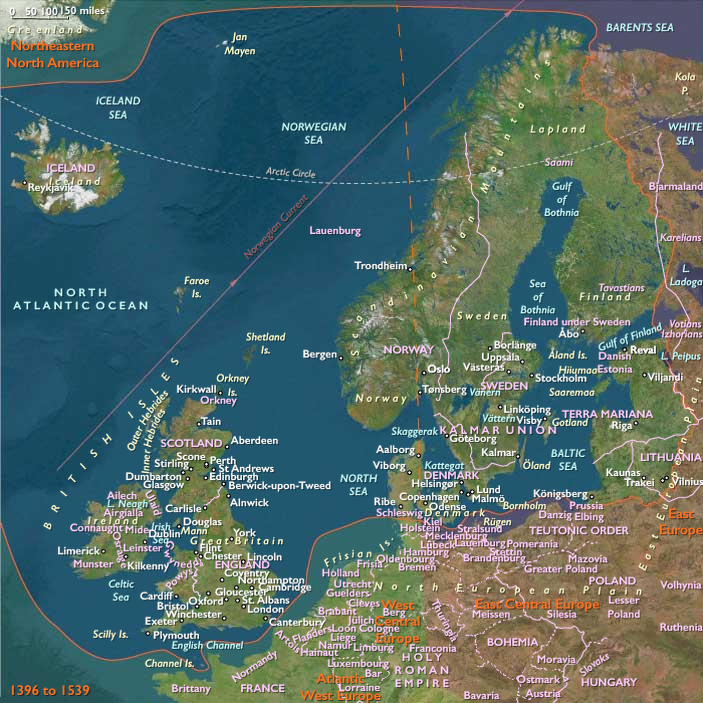
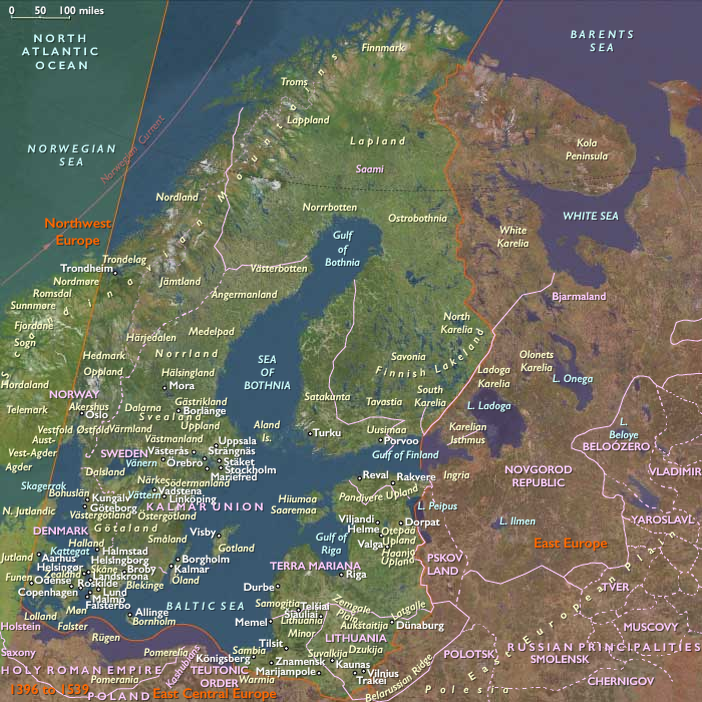
The Reformation in Europe, which had officially begun in 1517 with Martin Luther and his Ninety-five Theses, greatly changes the Baltic region.
Its ideas had come quickly to the Livonian Confederation and by the 1520s are widespread.
Language, education, religion and politics are transformed.
Church services are now conducted in the vernacular instead of the Latin previously used.
After the Teutonic Knights’ grand master, the thirty-five-year-old Albert of Brandenburg, converts in 1525 to Lutheranism and declares Prussia a secular hereditary duchy under Polish suzerainty, the Livonian Knights resume their independence.
Locations
People
Groups
- Christians, Roman Catholic
- Terra Mariana (Livonian Confederation)
- Livonian Order
- Lutheranism
- Protestantism
- Teutonic Knights of Württemberg, (House of the Hospitalers of Saint Mary of the Teutons in Jerusalem)
- Prussia, Duchy of
Topics
Subjects
Regions
Subregions
Related Events
Filter results
Showing 10 events out of 38436 total
The work of Song Chinese painter Muqi is the principal influence on Soami’s soft, mist-filled ink landscapes, as in Landscapes of the Four Seasons.
Soami, who, like his father, Geiami, and his grandfather Noami, had served the Ashikaga shoguns as art curator, painter, garden designer, and master of the tea ceremony, dies in 1525.
King Sigismund, after some delay, had assented to Albert’s offer to convert the Teutonic Knights realm into a hereditary duchy, with the provision that Prussia should be treated as a Polish fiefdom; and after this arrangement had been confirmed by a treaty concluded at Kraków, Albert had pledged a personal oath to Sigismund I and was invested with the duchy for himself and his heirs on February 10, 1525.
The Estates of the land now met at Königsberg and take the oath of allegiance to the new duke, who uses his full powers to promote the doctrines of Luther.
This transition does not, however, take place without protest.
Summoned before the imperial court of justice, Albert refuses to appear and is proscribed, while the Order elects a new Grand Master, Walter von Cronberg, who receives Prussia as a fief at the imperial Diet of Augsburg.
As the German princes are experiencing the tumult of the Reformation, the German Peasants' War, and the wars against the Ottoman Turks, they do not enforce the ban on the duke, and agitation against him soon dies away.
The Estonian language belongs to the Finnic branch of the Uralic family of languages, as does the Finnish language.
The first known book in Estonian is printed in 1525, while the oldest known examples of written Estonian originate in thirteenth-century chronicles.
Estonians are genetically closest to their neighboring Tver region Russians and Latvians.
However, Estonians are still the nearest genetic relatives of Finns.
Duke Albert IV of Bavaria, who died in 1508, had determined the everlasting succession of the firstborn prince in 1506, but his younger son Louis, had refused a spiritual career with the argument that he was born before the edict became valid.
With the support of his mother and the States-General, Louis had forced his elder brother William to accept him as co-regent in 1516.
Louis then ruled the districts of Landshut and Straubing, in general in concord with his brother.
William had initially sympathized with the Reformation but changed his mind as it grew more popular in Bavaria.
In 1522 William had issued the first Bavarian religion mandate, banning the promulgation of Martin Luther's works.
After an agreement with Pope Clement VII in 1524, William had become a political leader of the German Counter reformation, although he remains in opposition to the Habsburgs since his brother Louis X claims the Bohemian crown.
Both dukes also suppress the peasant uprising in South Germany in an alliance with the archbishop of Salzburg in 1525.
Joachim I Nestor, the eldest son of John Cicero, Elector of Brandenburg, had received an excellent education under the supervision of Dietrich von Bülow, Bishop of Lebus and Chancellor of Frankfurt University.
Becoming Elector of Brandenburg upon his father's death in January 1499, he soon afterwards married Elizabeth of Denmark, daughter of King John of Denmark.
They have five children: Joachim II Hektor, Anna, Elisabeth, Margaret, and John.
Joachim has taken some part in the political complications of the Scandinavian kingdoms, but the early years of his reign had mainly been spent in the administration of his electorate, where he had succeeded in restoring some degree of order through stern measures.
He has also improved the administration of justice, aided the development of commerce, and is sympathetic to the needs to the towns.
On the approach of the imperial election of 1519, Joachim's vote is eagerly solicited by the partisans of King Francis I of France, and Charles of Burgundy.
Having treated with both parties, and received lavish promises from them, he appears to have hoped to be Emperor himself; but when the election comes, he turned to the winning side and votes for Charles.
In spite of this, relations between the Emperor and the Elector are not friendly, and during the next few years Joachim will frequently be in communication with Charles' enemies.
In the course of Hohenzollern power politics Joachim Nestor and his brother had managed to get the latter, Albert of Mainz, first onto the sees of Magdeburg and then its suffragan of Halberstadt, both prince-bishoprics also comprising princely territories.
Since prince-episcopal sees are so influential, competing candidates usually run for them.
A candidature can turn into a bribery competition, without ever knowing exactly how much competitors pay to obtain office.
The expenditures involved, as far as they exceed one's own potential, are usually advanced by creditors and have then to be recovered by levying dues from the subjects and parishioners in the prince-bishoprics and dioceses that have just been acquired.
The acquisition in 1514 of the very influential Prince-Archbishopric-Electorate of Mainz for Albert was a coup that had provided the Hohenzollerns with control over two of the seven electoral votes in imperial elections and many suffragan dioceses to levy dues.
According to canon law, Albert was too young to hold such a position and since he would not give up the archiepiscopal see of Magdeburg (in order to terminate the accumulation of archdioceses, which was also prohibited by canon law), the Hohenzollerns had to dispense ever greater briberies at the Holy See.
This had exhausted their means and caused them to incur vast debts with the Fuggers.
To assist in the recovery of the enormous expenditures employed to assist Albert, mediators stipulate with the Holy See that the pope will allow Albert to sell indulgences to the believers in his archdioceses and their suffragans.
The sales proceeds have to cover the amortization and servicing of the debts; a share for the Holy See, for allowing this exploitation of the believers; the expenditure paid from the Hohenzollerns’ own pockets; and the charges involved with the sales.
The neighboring Electorate of Saxony also bid for the See of Mainz, but failed to secure it.
The Saxon elector Frederick the Wise had debts of his own as a result, but no see to show for it and no privilege to sell indulgences to recover his expenditures.
Frustrated, he has forbidden the sale of indulgences in his electorate and allowed Martin Luther to polemicize against them.
Joachim Nestor, in contrast, has become known as a pugnacious adherent of Roman Catholic orthodoxy who needs the sales of indulgences and the necessary intimidation of the believers in order to recover his expenditures.
Joachim Nestor's brother, Archbishop Albert, is the initial object of Luther's attack.
He urges on the Emperor the need to enforce the Edict of Worms, and at several diets is prominent among the enemies of the Reformers.
Karlstadt has become increasingly radical, favoring the destruction of religious images and reinterpretation of the sacrament of the Eucharist.
In 1525, Luther directly criticizes his former debating partner in his treatise “Against the Heavenly Prophets, on Images and Sacrament.”
The cultural flowering of Nuremberg in the fifteenth and sixteenth centuries has made it the center of the German Renaissance.
The brothers Hans Sebald Beham and Bartel Beham, along with Pencz, the so-called "godless painters", are expelled from Nuremberg in 1525 for spreading the radical views of Thomas Müntzer by asserting disbelief in baptism, Christ and transubstantiation, and not recognizing the authority of the City council.
The accusations against Pencz and the Behams are connected with their Lutheran beliefs, the city authorities at this time being Catholic, although they adopt Lutheranism as the city's official religion only two months later.
The three artists are soon allowed to return to Nuremberg and form the group known as the "Little Masters" because of their tiny, intricate and influential prints.
The Kleinmeisters will issue numerous editions of prints, often in small formats, on a vast range of subjects and widely popularize Renaissance forms outside Italy.
Pencz, who was probably born in Westheim near Bad Windsheim/Franconia, had traveled to Nuremberg in 1523 and joined Albrecht Dürer’s atelier.
Like Dürer, he visits Italy and is profoundly influenced by Venetian art; it is believed he worked with Marcantonio Raimondi.
Sebald, whose early works are characterized by exaggerated imitation of Dürer's sculpturesque style in the graphic arts, will produce about fifteen hundred engravings, etchings, and woodcuts.
Bartel, learning his art from his elder brother, and from Dürer, is particularly active as an engraver during the 1520s, creating tiny works of magnificent detail.
He is also fascinated with antiquity and he, too, may have worked with Raimondi in Bologna and Rome at some point in his career.
The teachings of Martin Luther are accepted most readily in the Polish lands in the regions with strong German connections: Silesia, Greater Poland, Pomerania and Prussia.
A lower-class Lutheran social uprising that takes place in 1525 in Danzig (Gdańsk) is bloodily subdued by Sigismund I; after the reckoning, he establishes a representation for the plebeian interests as a segment of the city government.
Ibrahim Pasha, a Greek born to Greek Orthodox Christian parents, in Parga, Epirus, northern Greece, at that time part of the Republic of Venice, is the son of a sailor in Parga, and as a child, had been carried off by pirates and sold as a slave to the Manisa Palace in western Anatolia, where Ottoman crown princes (şehzade) were being educated.
He had been befriended there by crown prince Suleiman, who was of the same age.
Ibrahim had received his education at the Ottoman court and become a polyglot and polymath.
Upon Suleiman's accession to the Ottoman throne in 1520, Ibrahim had been awarded various posts, the first being the Falconer of the Sultan.
Ibrahim had proved his skills in numerous diplomatic encounters and military campaigns, and had been so rapidly promoted that at one point he had begged Suleiman not to promote him too rapidly for fear of arousing the jealousy and enmity of the other viziers, who expected some of those titles for themselves.
Suleiman, pleased with Ibrahim's display of modesty, purportedly swore that he would never be put to death during his reign.
After being appointed grand vizier, Ibrahim Pasha continues to receive other additional appointments and titles from the sultan (such as the title of Serasker), and his power in the Ottoman Empire has become almost as absolute as his master's.
Following the execution of his rival Hain Ahmed Pasha, the former governor of Egypt who had declared himself independent of the Ottoman Empir, Ibrahim Pasha travels south to Egypt in the following year and reforms the Egyptian provincial civil and military administration system.
He promulgates an edict, the Kanunname, outlining his system.
Felix Manz, another radical leader, was born in Zürich, where his father was a canon of Grossmünster church.
Though records of his education are scant, there is evidence that he had a liberal education, with a thorough knowledge of Hebrew, Greek and Latin.
Manz had become a follower of Zwingli after he came to Zürich in 1519.
When Grebel joined the group in 1521, he and Manz had become friends.
They questioned the mass, the nature of church and state connections, and infant baptism.
After the Second Disputation of Zürich in 1523, they had become dissatisfied, believing that Zwingli's plans for reform had been compromised with the city council.
Grebel, Manz and others have made several attempts to plead their position.
Several parents refuse to have their children baptized.
A public debate is held on January 17, 1525, and the council decides in favor of Zwingli.
Anyone refusing to have their children baptized is required to leave Zurich.
The radicals ignore these measures and on January 21, they meet at the house of the mother of Manz.
Grebel and a third leader, George Blaurock, perform the first recorded Anabaptist adult baptisms: Grebel baptizes Blaurock, and Blaurock in turn baptizes the others.
This makes complete the break with Zwingli and the council, and forms the first church of the Radical Reformation.
On February 2, the council repeats the requirement on the baptism of all babies and some who fail to comply are arrested and fined, Manz and Blaurock among them.
Zwingli and Jud interview them and more debates are held before the Zurich council.
Meanwhile, the new teachings continue to spread to other parts of the Confederation as well as a number of Swabian towns.
Although the council had hesitated in abolishing the mass, the decrease in the exercise of traditional piety has allowed pastors to be unofficially released from the requirement of celebrating mass.
As individual pastors alter their practices as each sees fit, Zwingli is prompted to address this disorganized situation by designing a communion liturgy in the German language.
This is published in Aktion oder Brauch des Nachtmahls (Act or Custom of the Supper).
Shortly before Easter, Zwingli and his closest associates request the council to cancel the mass and to introduce the new public order of worship.
On Maundy Thursday, April 13, 1525, Zwingli celebrates communion under his new liturgy.
Wooden cups and plates are used to avoid any outward displays of formality.
The congregation sits at set tables to emphasize the meal aspect of the sacrament.
The sermon is the focal point of the service and there is no organ music or singing.
The importance of the sermon in the worship service is underlined by Zwingli's proposal to limit the celebration of communion to four times a year.
For some time, Zwingli has accused mendicant orders of hypocrisy and demanded their abolition in order to support the truly poor.
He suggests the monasteries be changed into hospitals and welfare institutions and incorporate their wealth into a welfare fund.
This is done by reorganizing the foundations of the Grossmünster and Fraumünster and pensioning off remaining nuns and monks.
The council secularizes the church properties and establishes new welfare programs for the poor.
Zwingli requess permission to establish a Latin school, the Prophezei (Prophecy) or Carolinum, at the Grossmünster.
The council agrees and it is officially opened on June 19, 1525 with Zwingli and Jud as teachers.
It serves to retrain and reeducate the clergy.
The Zurich Bible translation, traditionally attributed to Zwingli and printed by Christoph Froschauer, bears the mark of teamwork from the Prophecy school.
Scholars have not yet attempted to clarify Zwingli's share of the work based on external and stylistic evidence.
On November 6–8, the last debate on the subject of baptism took place in the Grossmünster.
Grebel, Manz, and Blaurock defend their cause before Zwingli, Jud, and other reformers.
There is no serious exchange of views as each side will not move from their positions and the debates degenerate into an uproar, each side shouting abuse at the other.

Years: 1525 - 1525
Locations
People
Groups
- Christians, Roman Catholic
- Terra Mariana (Livonian Confederation)
- Livonian Order
- Lutheranism
- Protestantism
- Teutonic Knights of Württemberg, (House of the Hospitalers of Saint Mary of the Teutons in Jerusalem)
- Prussia, Duchy of