
Filters:
Maria-Theresa's accession to the Habsburg lands is …
Years: 1684 - 1827
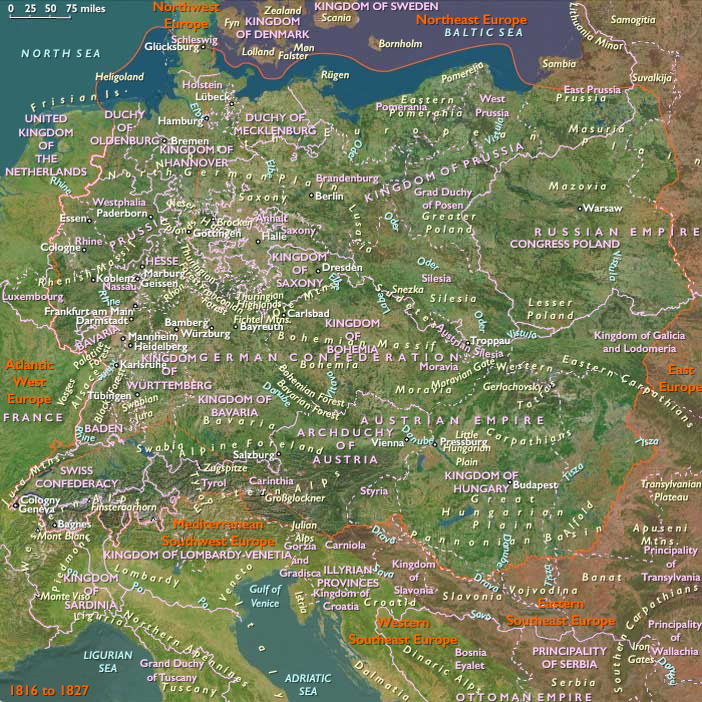
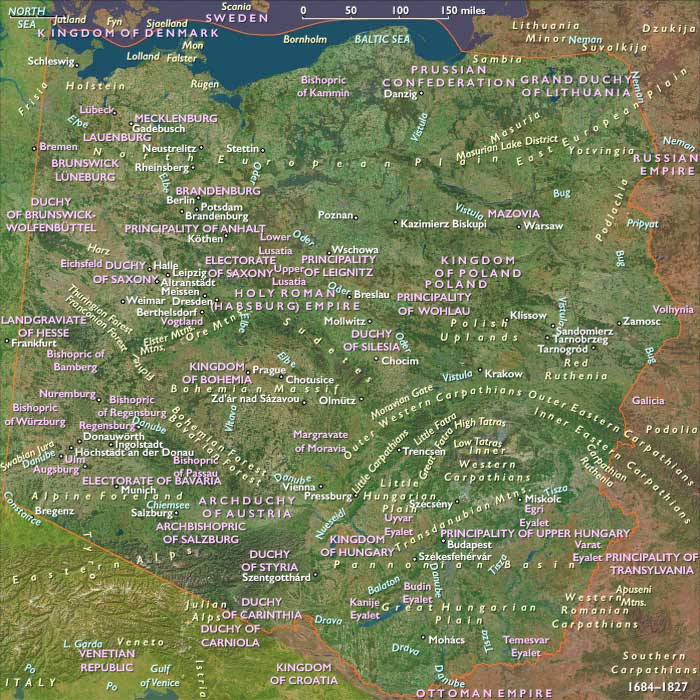
Maria-Theresa's accession to the Habsburg lands is challenged by the territorial aspirations of the increasingly powerful Hohenzollern dynasty.
The Prussian king, Frederick II, joined by the dukes of Bavaria and Saxony, invades the Bohemian Kingdom in 1741.
The duke of Bavaria, Charles Albert, is proclaimed king by the Czech nobility.
Although Maria-Theresa regains most of the Bohemian Kingdom and is crowned queen in Prague in 1743, all of the highly industrialized territory of Silesia except for Tesm, Opava, and Krnov is ceded to Prussia.
In attempting to make administration more rational, Maria-Theresa embarks on a policy of centralization and bureaucratization.
What remains of the Bohemian Kingdom is now merged into the Austrian provinces of the Habsburg realm.
The two separate chancelleries are abolished and replaced by a joint Austro-Bohemian chancellery.
The Czech estates are stripped of the last remnants of their political power, and their functions are assumed by imperial civil servants appointed by the queen.
The provinces of the Czech and Austrian territories are subdivided into administrative districts.
German becomes the official language.
Further reforms introduced by Maria-Theresa and Joseph II reflect such Enlightenment principles as the dissolution of feudal social structures and the curtailment of power of the Catholic Church.
Maria-Theresa nationalizes and Germanizes the education system, eliminates Jesuit control, and shifts educational emphasis from theology to the sciences.
Serfdom is modified: robota (forced labor on the lord's land) is reduced, and serfs can marry and change domiciles without the lord's consent.
Joseph II abolishes serfdom altogether.
Joseph's Edict of Toleration extends freedom of worship to Lutherans and Calvinists in 1781 .
The Prussian king, Frederick II, joined by the dukes of Bavaria and Saxony, invades the Bohemian Kingdom in 1741.
The duke of Bavaria, Charles Albert, is proclaimed king by the Czech nobility.
Although Maria-Theresa regains most of the Bohemian Kingdom and is crowned queen in Prague in 1743, all of the highly industrialized territory of Silesia except for Tesm, Opava, and Krnov is ceded to Prussia.
In attempting to make administration more rational, Maria-Theresa embarks on a policy of centralization and bureaucratization.
What remains of the Bohemian Kingdom is now merged into the Austrian provinces of the Habsburg realm.
The two separate chancelleries are abolished and replaced by a joint Austro-Bohemian chancellery.
The Czech estates are stripped of the last remnants of their political power, and their functions are assumed by imperial civil servants appointed by the queen.
The provinces of the Czech and Austrian territories are subdivided into administrative districts.
German becomes the official language.
Further reforms introduced by Maria-Theresa and Joseph II reflect such Enlightenment principles as the dissolution of feudal social structures and the curtailment of power of the Catholic Church.
Maria-Theresa nationalizes and Germanizes the education system, eliminates Jesuit control, and shifts educational emphasis from theology to the sciences.
Serfdom is modified: robota (forced labor on the lord's land) is reduced, and serfs can marry and change domiciles without the lord's consent.
Joseph II abolishes serfdom altogether.
Joseph's Edict of Toleration extends freedom of worship to Lutherans and Calvinists in 1781 .
Locations
People
Groups
- Germans
- Hungarian people
- Germany, Kingdom of (within the Holy Roman Empire)
- Czechs [formerly Bohemians] (West Slavs)
- Slovaks (West Slavs)
- Habsburg, House of
- Christians, Roman Catholic
- Austria, Archduchy of
- Moravian Margravate
- Bohemia, Kingdom of
- Holy Roman Empire
- Lutheranism
- Calvinists
- Jesuits, or Order of the Society of Jesus
- Habsburg Monarchy, or Empire
Topics
Subjects
Regions
Subregions
Years: 1684 - 1827
Locations
People
Groups
- Germans
- Hungarian people
- Germany, Kingdom of (within the Holy Roman Empire)
- Czechs [formerly Bohemians] (West Slavs)
- Slovaks (West Slavs)
- Habsburg, House of
- Christians, Roman Catholic
- Austria, Archduchy of
- Moravian Margravate
- Bohemia, Kingdom of
- Holy Roman Empire
- Lutheranism
- Calvinists
- Jesuits, or Order of the Society of Jesus
- Habsburg Monarchy, or Empire
Topics
Subjects
Regions
Subregions