The United States Congress enacts a general…
December 1807 CE
The United States Congress enacts a general embargo against Great Britain and France during the Napoleonic Wars.
The resumption of the European wars after the short truce in 1802–1803 have caused American relations with both Britain and France to deteriorate rapidly.
There is grave risk of war with one or the other.
With Britain supreme on the sea, and France on the land, the war has developed into a struggle of blockade and counter-blockade.
This commercial war peaks in 1806 and 1807.
Britain's Royal Navy shuts down most European harbors to American ships unless they first trade through British ports.
France has declared a paper blockade of Britain (which it lacks a navy to enforce) and seizes American ships that obey British regulations.
The Royal Navy needs large numbers of sailors, and sees the U.S. merchant fleet as a haven for British sailors.
The British system of impressment humiliates and dishonors the U.S. because it is unable to protect its ships and sailors.
This British practice of taking British deserters, and often Americans, from American ships and forcing them into the Royal Navy had increased greatly after 1803, and has caused bitter anger in the United States.
The anger reaches a peak after the Chesapeake-Leopard Affair.
This grave incident is perceived by Americans as a profound insult to American honor; combined with the increased commercial restrictions, it produces a demand for war in the United States in the summer of 1807.
President Jefferson does not want war, and is convinced that the United States has the power to coerce the European powers by economic methods rather than war.
Accordingly, in December 1807, Jefferson recommends to Congress an embargo that will prohibit all American ships from departing for a foreign port.
This measure, which becomes law on December 22, attempts to end American foreign trade.
Indeed, Congress had already, a few days before, put into effect a nonimportation act, originally passed in April 1806, which refuses entry to many British goods.
Enforcing measures put into effect to ensure that vessels engaged in the coastal trade would not sail for foreign ports are only partially successful.
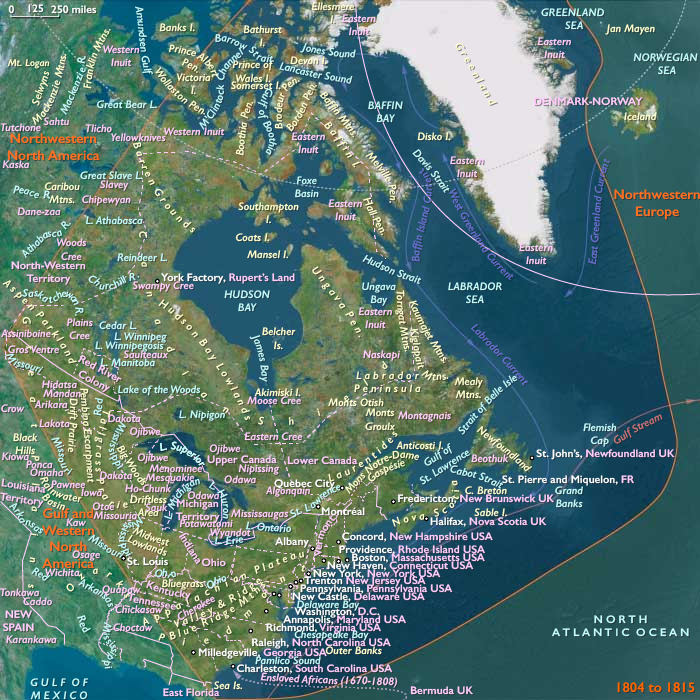
Some American vessels will trade abroad throughout the Embargo, and smuggling flourishes along the Canadian border.
People
Groups
Commodities
Subjects
Regions
Northern North America
View →Subregions