
The Royal Greenwich Observatory or RGO is…
August 1675 CE
The Royal Greenwich Observatory or RGO is commissioned in 1675 by King Charles II, with the foundation stone being laid on August 10.
At this time the king also creates the position of Astronomer Royal (initially filled by John Flamsteed), to serve as the director of the observatory and to "apply himself with the most exact care and diligence to the rectifying of the tables of the motions of the heavens, and the places of the fixed stars, so as to find out the so much desired longitude of places for the perfecting of the art of navigation."
It is situated on a hill in Greenwich Park in Greenwich, London, overlooking the River Thames.
There had been significant buildings on this land since the reign of Edward I. Greenwich Palace, next to the site of the present-day Observatory, was the birthplace of Henry VIII, and the Tudors used Greenwich Castle, which was built on the land that the Observatory now stands on.
Greenwich Castle was apparently a favorite place for Henry VIII to house his mistresses, so that he could easily travel from the Palace to see them.
The establishment of a Royal Observatory had been proposed in 1674 by Sir Jonas Moore who, in his role as Surveyor General at the Ordnance Office, had persuaded King Charles II that the Observatory might be built with Flamsteed employed in it.
The Ordnance Office had been given responsibility for building the Observatory, with Moore providing the key instruments and equipment for the observatory at his own personal cost.
Flamsteed House, the original part of the Observatory, is designed by Sir Christopher Wren, probably with the assistance of Robert Hooke, and is the first purpose-built scientific research facility in Britain.
It will be built for a cost of five hundred and twenty pounds (twenty pounds over budget) out of largely recycled materials on the foundations of Duke Humphrey's Tower, which results in the alignment being thirteen degrees away from true North, somewhat to Flamsteed's chagrin.
It not only houses the scientific instruments to be used by Flamsteed in his work on stellar tables, but over time will also incorporated a number of additional responsibilities such as the keeping of time and later Her Majesty's Nautical Almanac Office.
Images
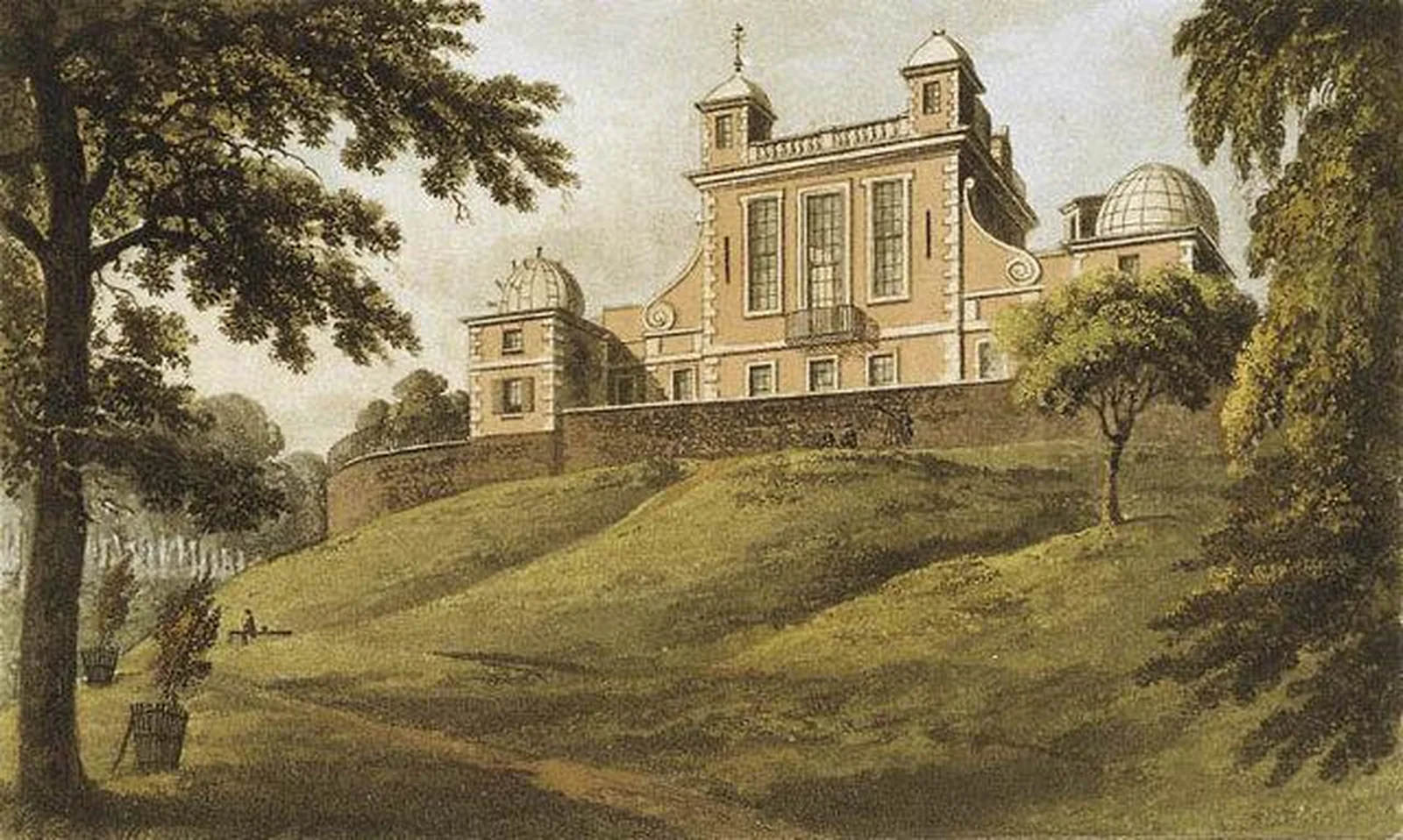
Flamsteed House in 1824
Locations
Regions

North Europe
View →Subregions
