The sacking and burning of Magdeburg by…
May 1631 CE
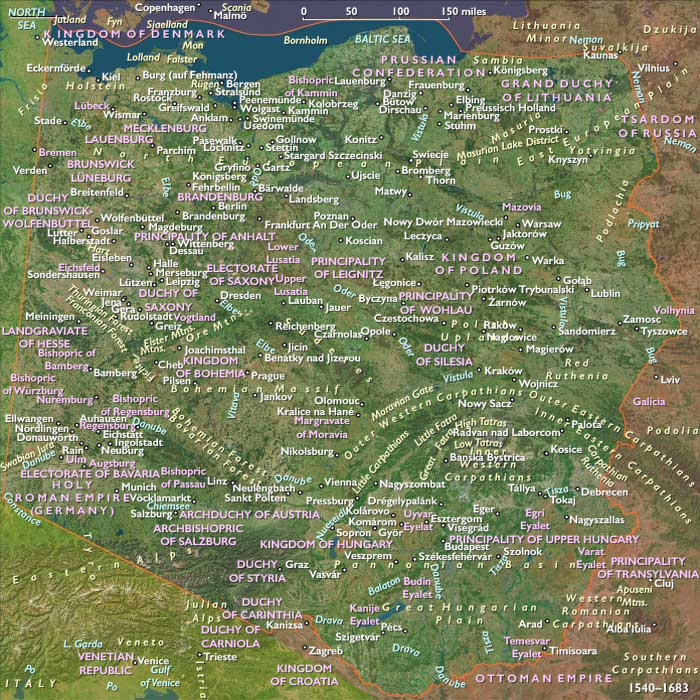
The sacking and burning of Magdeburg by Tilly’s troops in 1631 results in the loss of an estimated twenty thousand to twenty-five thousand lives.
The city of Magdeburg, which holds strategic value for its rich stores of goods, had withstood a first siege in 1629 by Wallenstein.
The second siege lasts from November 1630 until May 20, 1631, when Imperial troops under Tilly and Field Marshal Gottfried Heinrich Graf zu Pappenheim storm the city.
When the city is nearly lost, the garrison mines various places and sets others on fire.
After the city falls, the Imperial soldiers go out of control and start to massacre the inhabitants and set fire to the city.
Of the twenty-five thousand to thirty thousand citizens, only five thousand survive.
For fourteen days, charred bodies are carried to the Elbe River to be dumped to prevent disease.
The devastation is so great that for decades "magdeburgization" will become an oft-used term signifying total destruction, rape and pillaging.
The terms "Magdeburg justice", "Magdeburg mercy" and "Magdeburg quarter" will also arise as a result of the Sack of Magdeburg, used originally by Protestants when executing Catholics who beg for quarter.
The city, at this time among the major places in Germany and of the size of Cologne or Hamburg, will never recover from this disaster.
Locations
Groups
Topics
Commodities
Subjects
Regions
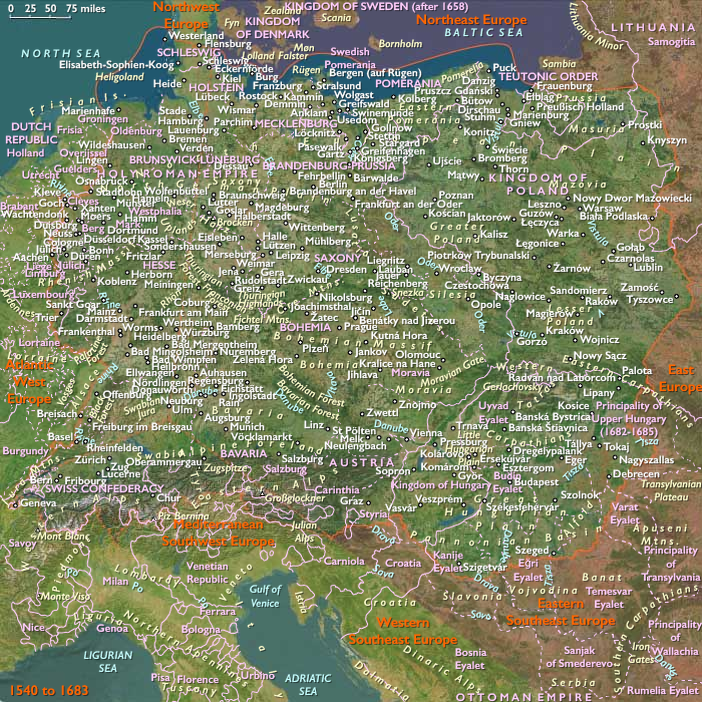
Central Europe
View →Subregions