
Filters:
Sucre's army, after a number of initial …
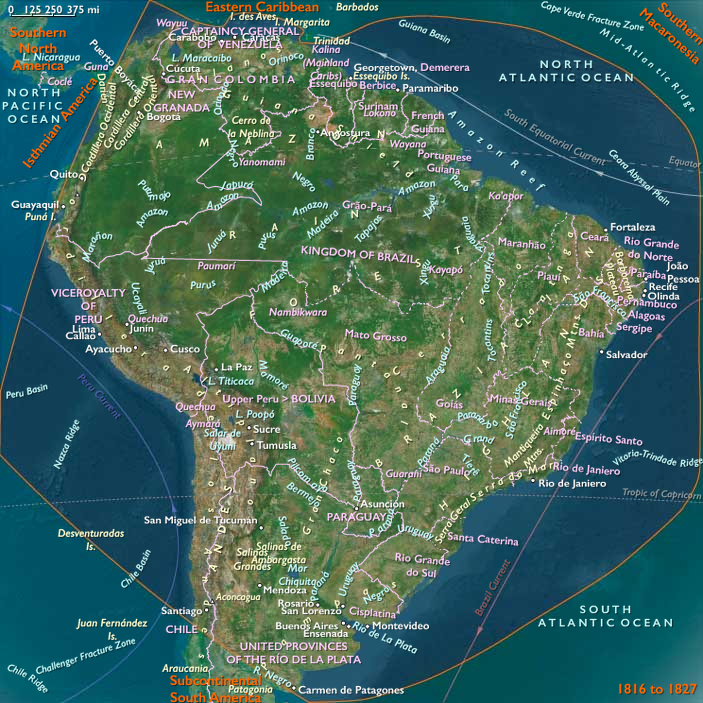
Years: 1816 - 1827
Sucre's army, after a number of initial successes, is defeated at Ambato in the central Sierra, and he appeals for assistance from San Martin, whose army is by now in Peru.
With the arrival from the south of fourteen hundred fresh soldiers under the command of Andres de Santa Cruz Calahumana, the fortunes of the patriotic army are again reversed.
A string of victories culminates in the decisive Battle of Pichincha, on the slopes of the volcano of that name on the western outskirts of Quito, on May 24, 1822.
A few hours after the victory by the patriots, the last president of the Audiencia of Quito signs a formal capitulation of his forces before Marshal Sucre.
Ecuador is at last free of Spanish rule.
Two months later, Bolivar, the liberator of northern South America, enters Quito to a hero's welcome.
Later that July, he meets San Martin in Guayaquil and convinces the Argentine general, who wants the port to return to Peruvian jurisdiction, and the local criollo elite in both major cities of the advantage of having the former Quito audiencia join with the liberated lands to the north.
As a result, Ecuador becomes the District of the South within the Confederation of Gran Colombia, which also includes present-day Venezuela and Colombia and has Bogota as its capital.
This status is maintained for eight tumultuous years.
They are years in which warfare dominates the affairs of Ecuador.
With the arrival from the south of fourteen hundred fresh soldiers under the command of Andres de Santa Cruz Calahumana, the fortunes of the patriotic army are again reversed.
A string of victories culminates in the decisive Battle of Pichincha, on the slopes of the volcano of that name on the western outskirts of Quito, on May 24, 1822.
A few hours after the victory by the patriots, the last president of the Audiencia of Quito signs a formal capitulation of his forces before Marshal Sucre.
Ecuador is at last free of Spanish rule.
Two months later, Bolivar, the liberator of northern South America, enters Quito to a hero's welcome.
Later that July, he meets San Martin in Guayaquil and convinces the Argentine general, who wants the port to return to Peruvian jurisdiction, and the local criollo elite in both major cities of the advantage of having the former Quito audiencia join with the liberated lands to the north.
As a result, Ecuador becomes the District of the South within the Confederation of Gran Colombia, which also includes present-day Venezuela and Colombia and has Bogota as its capital.
This status is maintained for eight tumultuous years.
They are years in which warfare dominates the affairs of Ecuador.
Locations
People
Groups
- Christians, Roman Catholic
- Spain, Habsburg Kingdom of
- Spaniards (Latins)
- Jesuits, or Order of the Society of Jesus
- Peru, Viceroyalty of
- Quito, Real Audiencia of
- Bogotá, Audiencia de Santa Fe de (Captaincy General of New Granada)
- Venezuela Province
- Spain, Bourbon Kingdom of
- Argentina (Argentine Republic)
Topics
Subjects
Regions
Subregions
Years: 1816 - 1827
Locations
People
Groups
- Christians, Roman Catholic
- Spain, Habsburg Kingdom of
- Spaniards (Latins)
- Jesuits, or Order of the Society of Jesus
- Peru, Viceroyalty of
- Quito, Real Audiencia of
- Bogotá, Audiencia de Santa Fe de (Captaincy General of New Granada)
- Venezuela Province
- Spain, Bourbon Kingdom of
- Argentina (Argentine Republic)
Topics
Subjects
Regions
Subregions