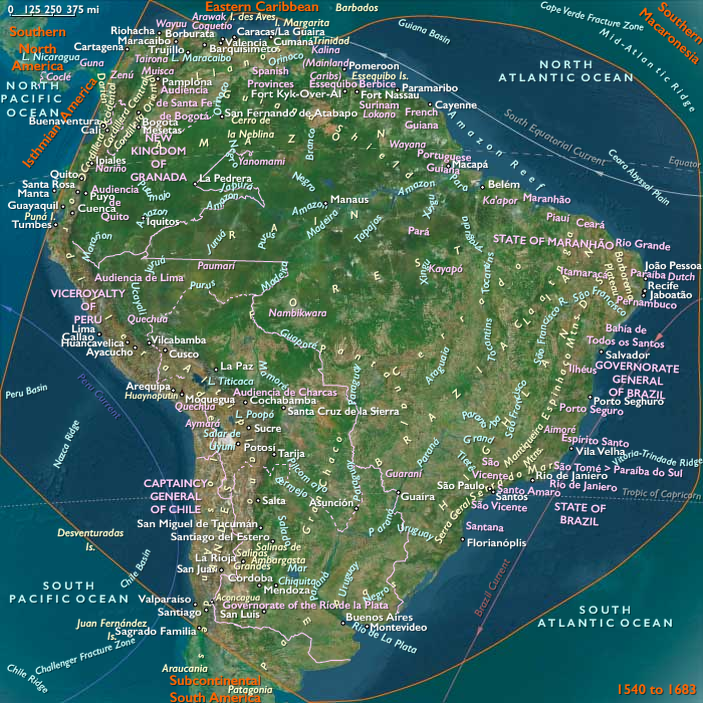
The Audiencia of Charcas (present-day Sucre, Bolivia)…
1540 CE to 1551 CE
In addition to the Spaniards, Asunción includes people—mostly men—from present-day France, Italy, Germany, England, and Portugal.
This community of about three hundred and fifty chooses wives and concubines from among the Guaraní women.
Irala has several Guarani concubines, and he encourages his men to marry native women and give up thoughts of returning to Spain.
Paraguay soon becomes a colony of mestizos, and the Europeans, prompted by Irala's example, raise their offspring as Spaniards.
Nevertheless, continued arrivals of Europeans allow for the development of a criollo elite.
The Guaraní, the Cario, Tape, Itatine, Guarajo, Tupí, and related subgroups are generous people who inhabit an immense area stretching from the Guyana Highlands in Brazil to the Rio Uruguay.
Because the Guaraní are surrounded by other hostile tribes, however, they are frequently at war.
They believe that permanent wives are inappropriate for warriors, so their marital relations are loose.
Some tribes practice polygamy with the aim of increasing the number of offspring.
Chiefs often have twenty or thirty concubines whom they share freely with visitors, yet they treat their wives well.
They often punish adulterers with death.
Like the area's other tribes, the Guaraní are cannibals, but they usually eat only their most valiant foes captured in battle in the hope that they will gain the bravery and power of their victims.
In contrast with the hospitable Guaraní, the Chaco tribes, such as the Payagua (whence the name Paraguay), Guaycuru, M'baya, Abipon, Mocobí, and Chiri guano, are implacable enemies of the whites.
Travelers in the Chaco report that the natives there are capable of running with incredible bursts of speed, lassoing and mounting wild horses in full gallop, and catching deer bare-handed.
Accordingly, the Guaraní accept the arrival of the Spaniards and look to them for protection against fiercer neighboring tribes.
The Guaraní also hope the Spaniards will lead them once more against the Incas.
Locations
People
Groups
Tupi people (Amerind tribe)
View →
Germans
View →
Portuguese people
View →
Guaraní (Amerind tribe)
View →
French people (Latins)
View →
English people
View →
Italians (Latins)
View →
Querandí
View →
Spain, Habsburg Kingdom of
View →
Spaniards (Latins)
View →
Neo-Inca State
View →
Río de la Plata, Governorate of the
View →
Charcas, Real Audiencia of (Upper Peru)
View →
Spain, Habsburg Kingdom of
View →
Topics
Regions
South America
View →Subregions