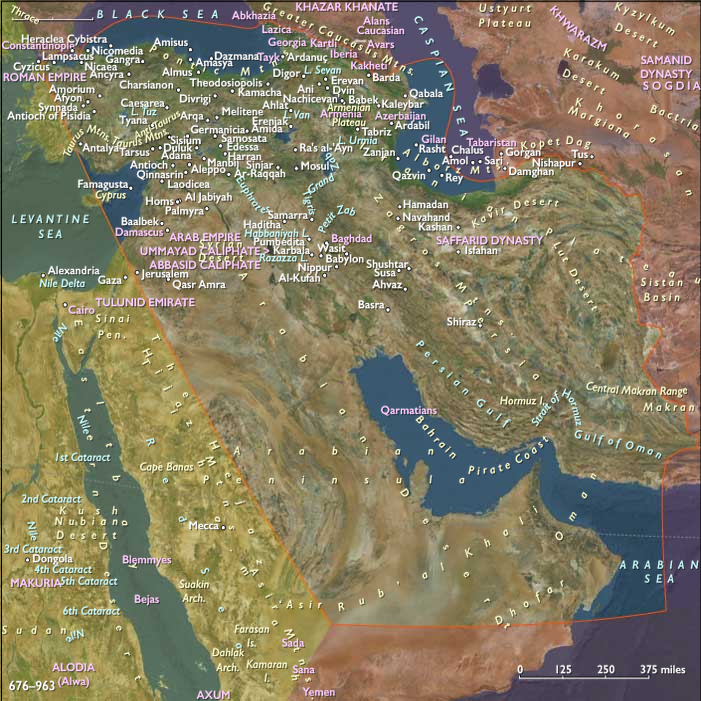
The Abbasids, who had overthrown the Umayyads…
820 CE to 963 CE
The Abbasids, who had overthrown the Umayyads in 750, are, while sympathetic to the Iranian Shias, clearly an Arab dynasty.
They had revolted in the name of descendants of Muhammad's uncle, Abbas, and the House of Hashim.
Hashim was an ancestor of both the Shia and the Abbas, or Sunni, lines, and the Abbasid movement had enjoyed the support of both Sunni and Shia Muslims.
The Abbasid army consisted primarily of people from Khorasan and was led by an Iranian general, Abu Muslim.
It contained both Iranian and Arab elements, and the Abbasids enjoyed both Iranian and Arab support.
The Abbasids, although interested in retaining Shia support, do not encourage the more extreme Shia aspirations.
The Abbasids had established their capital at Baghdad.
Al Mamun, who had seized power from his brother Amin and proclaimed himself caliph in 811, had an Iranian mother and thus a base of support in Khorasan.
The Abbasid dynasty continues the centralizing policies of its predecessors.
Under its rule, the Islamic world experiences a cultural efflorescence and the expansion of trade and economic prosperity.
These are developments in which Iran shares.
Subsequent ruling dynasties draw their rulers from the descendants of nomadic, Turkic-speaking warriors who had been moving out of Central Asia for more than a millennium.
The Abbasid caliphs had begun using these people as slave warriors as early as the ninth century.
Shortly thereafter the real power of the Abbasid caliphs began to wane; eventually they become religious figureheads under the control of the erstwhile slave warriors.
As the power of the Abbasid caliphs diminishes, a series of independent and indigenous dynasties rises in various parts of Iran, some with considerable influence and power.
Among the most important of these overlapping dynasties are the Tahirids in Khorasan (820-72), the Saffarids in Sistan (867-903), and the Samanids (875-1005), originally at Bukhora, a city in what is now Uzbekistan.
The Samanids eventually rule an area from central Iran to India.
A Turkish slave governor of the Samanids, Alptigin, conquers Ghazna (in present-day Afghanistan)
in 962 and establishes a dynasty, the Ghaznavids, that will last to 1186.
People
Groups
Commodities
Regions
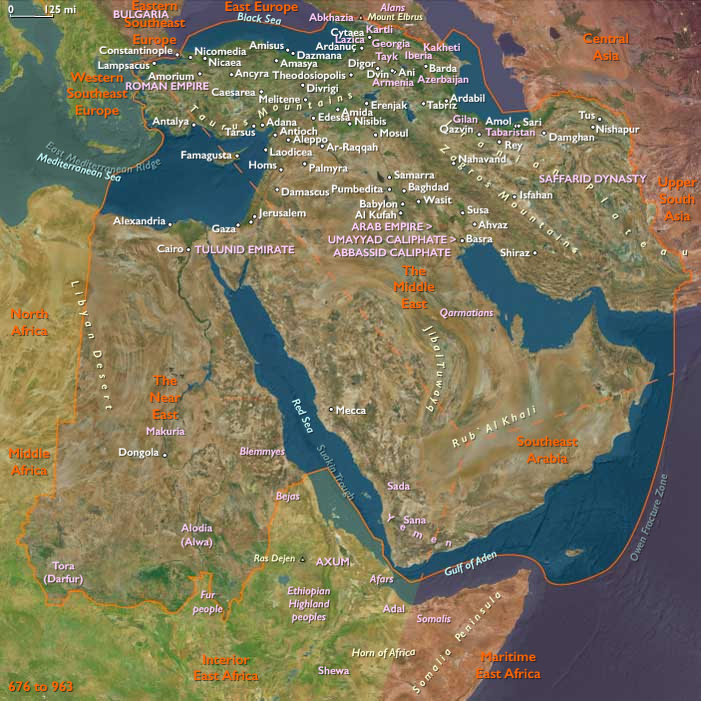
The Near and Middle East
View →Subregions