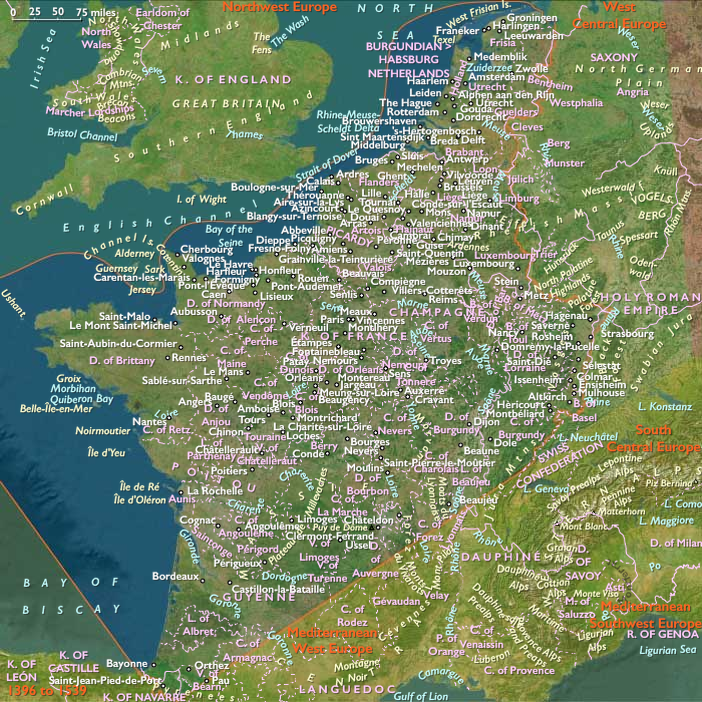
Rogier van der Weyden’s Portrait of a…
1435 CE
Rogier van der Weyden’s Portrait of a Young Woman (ca. 1435–1440)
In his small but striking work, Portrait of a Young Woman (also known as Lady Wearing a Gauze Headdress, ca. 1435–1440), the Netherlandish master Rogier van der Weyden skillfully blends realism with subtle abstraction, creating a portrait of exceptional intimacy and psychological depth. The sitter—possibly a member of the rising middle class—wears a simple brown dress with a black-lined, V-shaped neckline, complemented by a wide, white hennin veil. Her tightly clasped hands, typical of Van der Weyden’s portrayals of women, convey a sense of devout prayerfulness.
Yet this portrait diverges notably from convention. Unlike Van der Weyden’s other female portraits, where sitters usually bow their heads or gaze meditatively into space, here the subject looks directly and assertively at the viewer. This direct gaze creates a remarkable and even unsettling intimacy, dissolving boundaries between sitter, artist, and observer. The realistic individuality of her facial features—particularly her strikingly large, vivid blue eyes—is further evidence that Van der Weyden painted from a live model, possibly even his own wife, though this hypothesis remains unconfirmed.
The painting’s composition is carefully structured through a balanced interplay of horizontal and vertical lines. The verticality of the sitter’s headdress merges fluidly into the lines of her shoulders and chest, while the horizontal folds of the veil provide dynamic contrast to the lines formed by her lips. The illumination, coming from above and slightly to the viewer's right, accentuates contrasts between the luminous whiteness of her skin and veil and the darker hues of her dress, adding depth and three-dimensionality to her form.
Van der Weyden’s portrayal also displays notable stylistic similarities to portraits by his mentor, Robert Campin, so much so that the two artists' works have often been confused or misattributed. Yet, Van der Weyden here exhibits his distinct capacity for capturing emotional immediacy and psychological insight, making this portrait stand out as a uniquely personal and innovative work in Flemish portraiture of the mid-15th century.
Images

Rogier van der Weyden, Portrait of a Young Woman, c. 1435. 47 cm × 32 cm. Oil on wood. Staatlichen Museum, Berlin
People
Regions
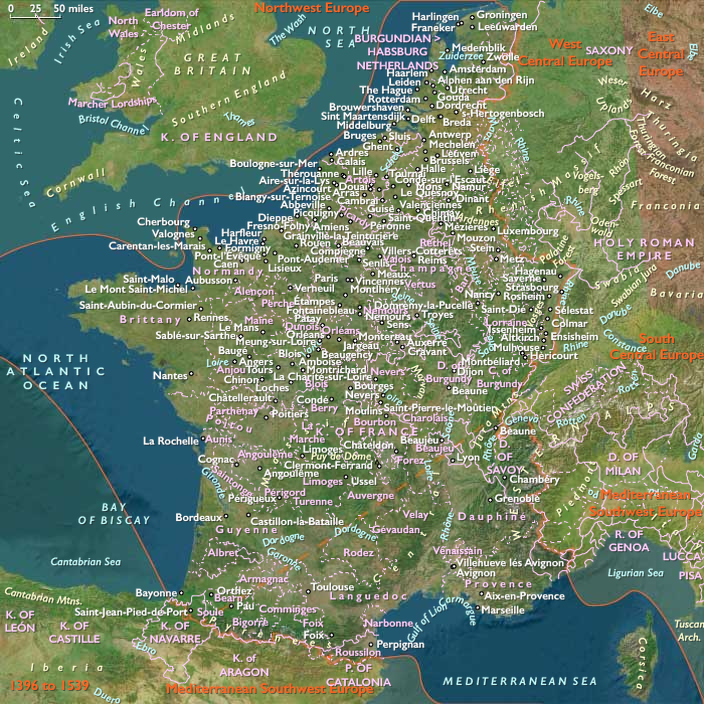
West Europe
View →Subregions