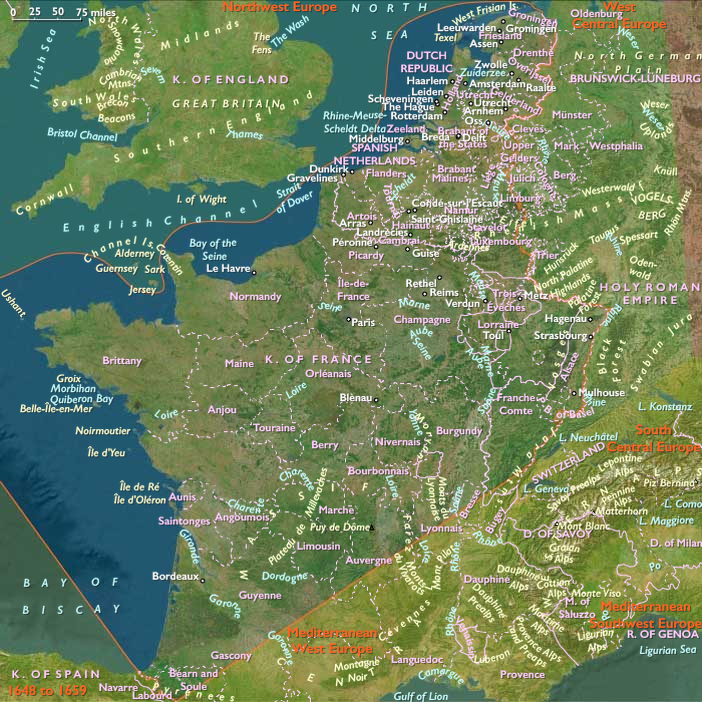
The States-General had recognized the Commonwealth on…
June 1651 CE
The States-General had recognized the Commonwealth on January 28, 1651, fully expecting this to be sufficient to solve all problems between the two countries.
To their enormous embarrassment, however, a large English delegation of two hundred and forty-six arrives on March 7 at The Hague, headed by Oliver St. John, to negotiate the conditions under which the Dutch Republic might unite itself with England, sent by Cromwell, who had taken the earlier suggestions quite too seriously.
St. John had in 1648 been appointed chief justice of the common pleas; and from that point forward he has devoted himself to his judicial duties.
He had refused to act as one of the commissioners for the trial of King Charles I, and had had no hand in Pride's Purge, nor in the constitution of the Commonwealth.
The delegation, trying to be polite, left it to the Dutch to provide the first proposals.
The Dutch, however, were too stunned and confused for a coherent reaction, so after a month the English delegation disclosed a plan by Cromwell to divide the world into two spheres of influence: the Dutch could control Africa and Asia; in return they would assist the English in conquering both Americas from the Spanish.
Cromwell hopes that this way the colonial rivalry will be eased by giving the English their own profitable empire, but the Dutch see it as an absurd grandiose scheme, which offers them little hope for profit but the certainty of much expense and a new war in the Southern Netherlands.
After much deliberation by the delegates of the seven provinces, on June 24 they make a counterproposal of thirty-six articles of which they hope it will be agreeable to the English without involving themselves in a war for world conquest.
This proposal is in essence a free trade agreement and nothing could have angered the English delegation more: precisely the fact that the English are unable to compete with the Dutch under conditions of free trade lies at the heart of the conflict between them.
They interpret the counter-proposal as a deliberate affront.
Other events have meanwhile persuaded the delegation of Dutch animosity.
The Hague is the residence of the young widow of William II, Charles I's daughter Mary Henrietta Stewart, the Princess Royal.
Those English noblemen in exile not fighting with her brother Charles in Scotland have mostly gathered in The Hague, which has become a Royalist bulwark, while it has been for many years an Orangist stronghold.
The delegation members can only leave their lodgings under armed escort, for fear of being assaulted by Royalists or large mobs paid by them.
The States of Holland are unwilling to restore order, fearing open revolt.
Deeply disappointed, the English delegates leave for England in the last week of June, reporting the Dutch are untrustworthy and that the United Provinces are under control of the Orangist party and thus a threat to the security of the Commonwealth.
Groups
Topics
Commodities
Subjects
Regions
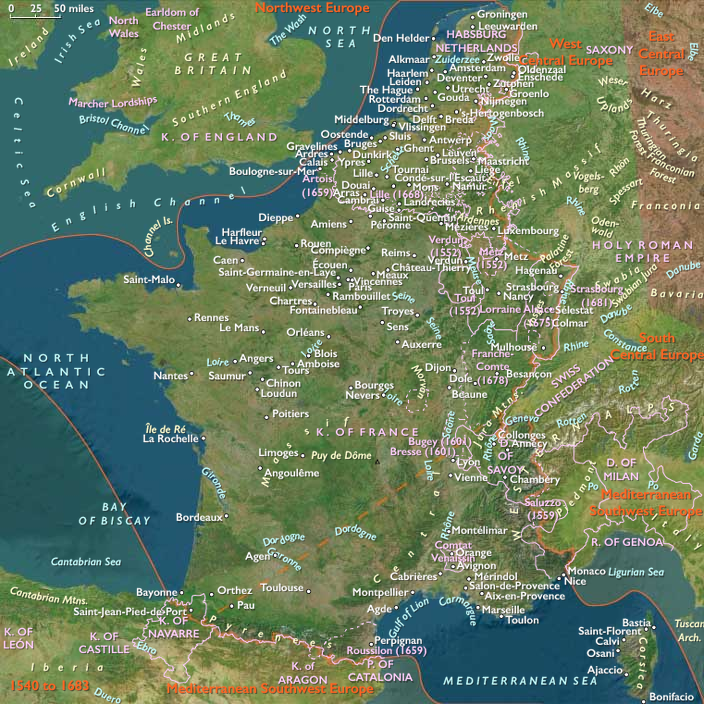
West Europe
View →Subregions